
Development of Political Parties – SS2 Government Lesson Note (Third Term)
Lesson note at a glance
- Class
- SS2
- Subject
- Government
- Term
- Third Term
- Reading time
- 5 min
A political party is an organised group of people who share ideas on how to govern and seek power through elections.
This lesson traces the development of political parties in Nigeria from 1923 to 1951. It covers the NNDP, the NYM, the NCNC and the NPC, with the leaders, aims and achievements of each.
Behavioural objectives
By the end of the lesson, students should be able to:
- State when and why the NNDP was formed and name its founder.
- Describe the origin and aims of the Nigerian Youth Movement.
- List the aims and achievements of the NCNC.
- Explain how the NPC emerged and who led it.
- Name the newspaper linked to each of the NNDP, NYM and NCNC.
Why did political parties start in Nigeria?
Political parties started in Nigeria in 1923 because the Clifford Constitution of 1922 introduced the elective principle.
- Elective principle: the idea that some members of the Legislative Council are chosen by voters, not appointed by the governor.
- Clifford Constitution of 1922: it provided four elective seats, three for Lagos and one for Calabar.
- Voting rights: only adult male residents of Lagos and Calabar who met an income condition could vote.
- Result: Nigerians needed organised groups to contest the seats, so parties were formed.
What was the Nigerian National Democratic Party (NNDP)?
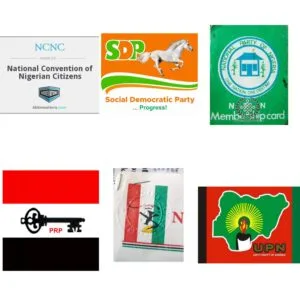
The Nigerian National Democratic Party (NNDP) was the first political party in Nigeria, formed in 1923 by Herbert Macaulay.
- Founder: Herbert Macaulay, regarded as the father of Nigerian nationalism.
- Reason for formation: to contest the elections made possible by the Clifford Constitution of 1922.
- Newspaper: the Lagos Daily News, which supported the campaigns of the party.
- Election record: it won all the three Lagos seats in the elections of 1923, 1928 and 1933.
- Period of control: it dominated Lagos politics from 1923 until 1938.
- Weakness: it was based only in Lagos and had no national outlook, despite its name.
What was the Nigerian Youth Movement (NYM)?
The Nigerian Youth Movement (NYM) was a nationalist group formed in 1935 that demanded complete autonomy for Nigeria.
- Earlier name: it began as the Lagos Youth Movement.
- Leaders: Ernest Ikoli and Samuel Akinsanya were two of its leaders.
- Newspaper: the Daily Service.
- 1938 election: it won all the elective seats in Lagos, ending the control of the NNDP.
- End: internal disputes led to its collapse in 1944.
What were the aims of the NYM?
- To fight for the improvement of Yaba Higher College by getting it affiliated with a British university.
- To gain independence for Nigeria.
- To work towards the unity of Nigeria.
What were the achievements of the NYM?
- Elections: it won all the Lagos elective seats in the Legislative Council in 1938.
- National outlook: it acted as the first nationalist movement with a national outlook.
- Nationalism: it gave birth to modern nationalism in Nigeria.
- Unity: it promoted Nigerian unity and national consciousness.
- Press: it established a powerful newspaper, the Daily Service.
- Emancipation: it set the machinery in motion for the political emancipation of Nigeria.
What was the National Council of Nigeria and Cameroon (NCNC)?
The National Council of Nigeria and Cameroon (NCNC) was a nationalist party formed in August 1944 to seek self-government for Nigeria.
- First president: Herbert Macaulay.
- First general secretary: Dr Nnamdi Azikiwe.
- Later leadership: Azikiwe became president after the death of Macaulay.
- Newspaper: the West African Pilot.
- Special mark: it was the first party organised to seek total independence for Nigeria.
What were the aims of the NCNC?
- To achieve self-government for Nigeria.
- To spread political education to the people.
- To arouse the political consciousness of the masses.
- To organise and collaborate with all its branches throughout the country.
- To provide members with a medium of expression.
What were the contributions of the NCNC?
- Unity and self-government: it encouraged the unity of Nigeria and helped in the struggle for self-government.
- Political awareness: it made Nigerians aware of their political rights.
- Press: it published the West African Pilot, a powerful platform against colonial rule.
- Opposition to the Richards Constitution: it led nationalist opposition to the 1946 constitution.
- Protest delegation: it raised funds to send a delegation to London against the 1946 constitution.
- Regional government: it formed the first regional government of the Eastern Region and contributed to its development.
- Coalition: it formed a coalition government with the NPC in 1960 and produced the first president.
What was the Northern People’s Congress (NPC)?
The Northern People’s Congress (NPC) was a political party formed in 1951 in Northern Nigeria under Sir Ahmadu Bello.
- Origin: it emerged from a socio-cultural group in Northern Nigeria.
- Leader: Sir Ahmadu Bello.
- Deputy: Sir Abubakar Tafawa Balewa.
- Membership: it was dominated by the Hausa/Fulani, and Islam was its main focus.
- Rule: it ruled Northern Nigeria and produced the first prime minister of Nigeria.
What were the aims of the NPC?
- To develop the North, both politically and economically.
- To work towards making the North autonomous.
- To create an atmosphere for common understanding among the people of the North.
- To help in educating Northerners on their political rights.
What were the contributions of the NPC?
- Governance: it controlled and ruled Northern Nigeria for several years.
- Leadership: it produced the first prime minister and led the government throughout the First Republic.
- Understanding: it created an atmosphere for common understanding among the people of the North.
- Conferences: it took part in most constitutional conferences, within and outside Nigeria.
- Education: it taught the people their political rights and raised political awareness in the North.
How do the early Nigerian parties compare?
The table below summarises the four parties side by side.
| Party | Year formed | Leader or founder | Newspaper | Main base |
|---|---|---|---|---|
| NNDP | 1923 | Herbert Macaulay | Lagos Daily News | Lagos |
| NYM | 1935 | Ernest Ikoli and Samuel Akinsanya (leaders) | Daily Service | Lagos, with a national outlook |
| NCNC | 1944 | Herbert Macaulay (president), Nnamdi Azikiwe (secretary) | West African Pilot | Nationwide, later strong in the East |
| NPC | 1951 | Sir Ahmadu Bello | None named in this note | Northern Nigeria |
Evaluation
- Why was the NNDP formed in 1923, and who founded it?
- State three aims of the Nigerian Youth Movement.
- Who were the first president and first general secretary of the NCNC?
- List three contributions of the NCNC to Nigeria’s political development.
- Name the leader and the deputy leader of the NPC when it was formed in 1951.
Assignment
- Explain three reasons why the NNDP could not be called a national party.
- Write short notes on the newspapers linked to the NNDP, the NYM and the NCNC.
- State four contributions of the NPC to Nigeria’s political development.
This term's Government topics
SS2 Third Term · 7 topics
SS2 Government Lesson Notes for Other Topics
Federalism
Read the full lesson note.
The Structure Of Nigerian Federalism
Read the full lesson note.

Development Of Political Parties II
Read the full lesson note.

Development Of Political Parties III
Read the full lesson note.
Minor Political Crisis In Nigeria
Read the full lesson note.

Electoral Crisis
Read the full lesson note.
Electoral Process
Read the full lesson note.
Franchise/Suffrage
Read the full lesson note.

Types Of Electoral Systems
Read the full lesson note.

Electoral Commission And Officials
Read the full lesson note.
Public Opinion
Read the full lesson note.

Public Administration
Read the full lesson note.

Local Government
Read the full lesson note.
Public Corporations
Read the full lesson note.
Pre colonial Administration
Read the full lesson note.
Lesson Notes for Other Classes

SS1 Lesson Note
The complete lesson note to guide your studies.

SS3 Lesson Note
The complete lesson note to guide your studies.
