
Dermatology Basics for Beautician SS2 Beauty & Cosmetology Lesson Note
Download Lesson NoteTopic: Dermatology Basics for Beautician
What is the Skin?
The skin is not just a covering; it is the largest organ of the human body. It protects everything inside us from the outside world. In dermatology (the study of skin), we look at how the skin stays healthy and how it reacts to the environment.
- The “Living” Organ: Your skin is constantly growing. It sheds old cells and makes new ones every day.
- The Beautician’s Goal: To keep the skin clean, balanced, and protected so it looks glowing and youthful.
The Three Layers of the Skin
Think of the skin like a three-story building. Each floor has a different job.
- The Epidermis (The Roof):
- This is the top layer that we see and touch.
- It acts as a waterproof shield.
- It contains Melanin, which gives our skin its color and protects us from the sun.
- The Dermis (The Middle Floor):
- This is the “engine room.” It is much thicker than the epidermis.
- It contains Collagen (which keeps skin firm) and Elastin (which makes skin bouncy).
- This is where you find sweat glands, oil glands (sebaceous glands), and hair follicles.
- The Hypodermis/Subcutaneous Layer (The Foundation):
- This is the deepest layer made mostly of fat.
- It acts as a cushion to protect our bones and keeps us warm by insulating the body.
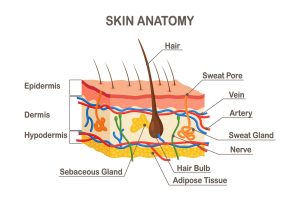 Shutterstock
The Functions of the Skin (The “SHAPES” Rule)
To remember why the skin is important, just remember the word SHAPES:
- S – Sensation: The skin lets us feel touch, heat, cold, and pain.
- H – Heat Regulation: When we are hot, we sweat to cool down. When we are cold, our pores close to keep heat in.
- A – Absorption: The skin can soak up certain oils and chemicals (which is why our creams work!).
- P – Protection: It keeps bacteria out and keeps our internal organs safe.
- E – Excretion: It gets rid of waste products through sweat.
- S – Secretion: It produces Sebum (oil) to keep the skin soft and waterproof.
Identifying Skin Types
As a beautician, you must identify a client’s skin type before you touch their face.
| Skin Type | What it looks like | How it feels |
| Normal | Clear, small pores, no breakouts. | Balanced (not too oily or dry). |
| Oily | Shiny, large pores, prone to blackheads. | Greasy to the touch, especially by midday. |
| Dry | Dull, may have flaky patches. | Tight, especially after washing. |
| Combination | Oily in the “T-Zone” (forehead, nose, chin). | Oily in the middle but dry on the cheeks. |
| Sensitive | Redness, easily irritated. | Itchy or stings when using new products. |
Skin Health and Aging
A lot of what we see on the outside is a result of what is happening on the inside.
- Hydration: If a client doesn’t drink enough water, the skin looks “crinkled” and tired.
- Sun Damage: Too much sun breaks down the collagen in the Dermis, leading to wrinkles and dark spots (hyperpigmentation).
- Diet: Sugary foods and lack of vitamins can lead to dull skin and acne.
- The “Golden Rule”: Never pick at the skin! This damages the Epidermis and causes permanent scars.
Classroom Practical & Discussion
- Skin Analysis: Look at your own face in a mirror or look closely at your partner’s skin. Can you see the “T-Zone”? Is the skin shiny or flaky?
- The Touch Test: Gently pinch the skin on the back of your hand. If it snaps back quickly, you have good Elastin. If it moves slowly, you might be dehydrated!
Discussion: Why do we say the skin is like a “sponge”? How does this help us when applying facial masks?
Third Term Beauty & Cosmetology Lesson Notes for Other Topics

Independent Project Work
Explore lesson notes covering all topics.

Report Writing
Explore lesson notes covering all topics.
Practical Sessions
Explore lesson notes covering all topics.
Field Work
Explore lesson notes covering all topics.
Regulation of Cosmetic Product
Explore lesson notes covering all topics.
Ethics in Beauty and Cosmetology
Explore lesson notes covering all topics.
Sustainable Beauty Practices
Explore lesson notes covering all topics.
International Beauty Trend
Explore lesson notes covering all topics.
Cosmetic Dermatology II
Explore lesson notes covering all topics.

Hair Removal Methods
Explore lesson notes covering all topics.
Cosmetic Dermatology I
Explore lesson notes covering all topics.
Traditional and Cultural Makeup
Explore lesson notes covering all topics.
Makeup Application II - Eyebrows & Eyeshadows
Explore lesson notes covering all topics.
Skin Disorders and Management
Explore lesson notes covering all topics.
Cosmetic Chemistry
Explore lesson notes covering all topics.


Lesson Notes for Other Classes

Basic 1 Lesson Note
The complete lesson note to guide your studies.

Basic 2 Lesson Note
The complete lesson note to guide your studies.

Basic 3 Lesson Note
The complete lesson note to guide your studies.

Basic 4 Lesson Note
The complete lesson note to guide your studies.

Basic 5 Lesson Note
The complete lesson note to guide your studies.

Basic 6 Lesson Note
The complete lesson note to guide your studies.