
Rule of Law I – SS1 Civic Education Lesson Note (Second Term)
Download Lesson NoteLesson note at a glance
- Subject
- Civic Education
- Class
- SS1
- Term
- Second Term
- Topic
- Rule of Law I
- Order
- Topic 2 of 9 this term
- Reading time
- 3 min
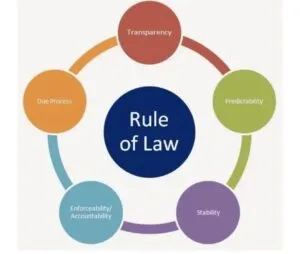
The rule of law is the principle that places law over and above all persons in society, no matter their positions, so that nobody is above the law. It emphasises the supremacy of the law, legal equality, impartiality and individual liberty. Those who rule must do so according to laid-down rules and regulations.
Behavioural objectives
By the end of the lesson, students should be able to:
- define law and the rule of law;
- state the three principles of the rule of law according to Prof. A. V. Dicey;
- list the limitations of the rule of law;
- state the benefits of the rule of law;
- explain what the rule of law requires of the state.
What is law?
Laws are official rules and regulations that guide human conduct, activities and behaviour in any group, society or nation. Laws are the means by which decisions or actions are formulated as rules and regulations and implemented as policies.
Laws can also be defined as a body of official rules and regulations, generally found in constitutions, legislation, judicial opinions and so on, that is used to govern a society and control the conduct of its members.
What is the rule of law?
The rule of law is a concept that emphasises the supremacy of the law, legal equality, impartiality and individual liberty.
It is also a principle of governance in which all persons, institutions and entities, public and private, including the State itself, are accountable to laws that are publicly promulgated, equally enforced and independently adjudicated, and which are consistent with international human rights norms and standards.
What are the principles of the rule of law?
According to Prof. A. V. Dicey, the rule of law has three principles, or three meanings:
- The supremacy of the law: Every citizen must act according to the law, and nobody should be punished except for breaking the established laws of the land. This principle emphasises the lack of arbitrariness. The power of the government is limited.
- Equality before the law: Every citizen, irrespective of his rank and position, is subject to the ordinary laws of the land. There is no special treatment for different people.
- Individual rights (fundamental human rights): Fundamental human rights are natural and inalienable rights of individual citizens. They are not derived from the constitution and must not be suspended. Citizens are entitled to fundamental human rights.
What are the limitations of the rule of law?
- Diplomatic immunity
- Immunity of heads of state
- Parliamentary immunity
- Delegated legislation
- Administrative tribunals
- Inadequate independence of the judiciary
- Immunity of judges
- Illiteracy and ignorance
- State of emergency
- Customs and traditions
- Type of government in power
What are the benefits of the rule of law?
- It makes everyone equal in a political system.
- It brings about obedience to the law of the land.
- It guarantees the supremacy of law over citizens.
- It guarantees peace and order in society.
- It enhances the protection of citizens’ rights.
- It ensures freedom of the press and association.
- It prevents tyrannical rule.
- It guards against illegal or unlawful detention.
- It guarantees the inalienable rights of the citizens.
- It promotes separation of powers.
- It guarantees good governance.
- It promotes the freedom of the judiciary.
- It enhances the freedom of the individual.
- It promotes a qualitative life.
- It preserves the constitution.
- It prevents arbitrariness and dictatorship.
- It guarantees fundamental human rights.
- It ensures the equality of all citizens.
- It upholds the supremacy of the law.
What does the rule of law require of the state?
By the rule of law, the state:
- has the responsibility of protecting the rights of an individual;
- must apply the rule of law in the adjudication of cases among people in the state;
- must ensure separation of powers among the organs of government;
- must ensure that government officials and citizens understand that the Constitution is the fundamental law of the land.
Evaluation
- Define the rule of law.
- State the three principles of the rule of law according to Prof. A. V. Dicey.
- List five limitations of the rule of law.
- State five benefits of the rule of law.
Assignment
- Explain the principle of equality before the law.
- State four responsibilities of the state under the rule of law.
This term's Civic Education topics
SS1 Second Term · 9 topics
Second Term Civic Education Lesson Notes for Other Topics

Food Safety
Read the full lesson note.

Rules and Regulations
Read the full lesson note.

Gains of Obeying
Read the full lesson note.

Results of Disobeying Rules and Regulations
Read the full lesson note.

Importance of School Rules and Regulations
Read the full lesson note.

Why Rules and Regulations are Necessary
Read the full lesson note.

Results of Not Obeying Government Rules and Regulations
Read the full lesson note.

Obedience
Read the full lesson note.

Types of Values that Promote Peace - Part II
Read the full lesson note.

Concept of Cooperation
Read the full lesson note.

Concept of Tolerance
Read the full lesson note.

Concept of Forgiveness
Read the full lesson note.

Concept of Self-control
Read the full lesson note.

Concept of Moderation
Read the full lesson note.

Concept of Compassion
Read the full lesson note.
Lesson Notes for Other Classes

Basic 1 Lesson Note
The complete lesson note to guide your studies.

Basic 2 Lesson Note
The complete lesson note to guide your studies.

Basic 3 Lesson Note
The complete lesson note to guide your studies.

Basic 4 Lesson Note
The complete lesson note to guide your studies.

Basic 5 Lesson Note
The complete lesson note to guide your studies.

Basic 6 Lesson Note
The complete lesson note to guide your studies.

