
Pillars of Democracy: The Constitution – SS1 Civic Education Lesson Note (Second Term)
Download Lesson NoteLesson note at a glance
- Subject
- Civic Education
- Class
- SS1
- Term
- Second Term
- Topic
- Pillars of Democracy: The Constitution
- Order
- Topic 4 of 9 this term
- Reading time
- 2 min
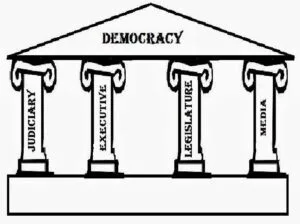
Pillars of democracy are the human and non-human factors that contribute to the smooth running of democratic processes in a given democratic system. The constitution is one of them. It is the document containing the fundamental laws and principles by which a state is governed, including how power is shared among the arms of government.
Behavioural objectives
By the end of the lesson, students should be able to:
- define a constitution;
- list the main sources of the Nigerian Constitution;
- explain why the constitution is a major pillar of democracy;
- state the functions the constitution performs in a country.
What is a constitution?
The constitution is the fundamental laws, rules, regulations and other related elements according to which democratic states are expected to be governed. It can also be defined as a book or document that contains the rules and principles by which a state is governed.
It is a body of fundamental principles or established precedents according to which a state or other organisation is acknowledged to be governed. The constitution of a country dictates how power is shared among the arms of government and sets out the rights and duties of citizens.
What are the sources of the Nigerian Constitution?
The main sources of the Nigerian Constitution include the following:
- History of the people
- Decrees
- Convention
- The customs of the people
- Acts of parliament
Why is the constitution a major pillar of democracy?
The constitution can be regarded as a pillar of democracy because of the following functions it performs in a country:
- It sets limits on the use of the powers of government.
- It protects the rights of the minority.
- It defines the rights and powers of the government.
- It helps to share power among the arms of government.
- It spells out political institutions, party systems, tenure of office of government, etc.
- It reflects the sovereign will of the people.
- It lays down the aims, objectives, values and goals which the people want to secure.
- It contains a description and guarantee of the fundamental rights of the people.
- It gives a detailed account of the organisation of the government, including the organisation, powers and functions of its three organs and their interrelationship.
- In a federation, it lays down the division of powers between the central government and the governments of the federating states or provinces. It is binding upon both the centre and the state governments.
- It specifies the power and method of amendment of the constitution.
- It governs all, and no one can violate its rules.
- It lays down the election system.
- It provides for the independence of the judiciary and the rule of law.
Evaluation
- What is a constitution?
- List the five main sources of the Nigerian Constitution.
- State five reasons why the constitution is regarded as a pillar of democracy.
- What does the constitution say about the division of powers in a federation?
Assignment
Explain, in your own words, any five functions of the constitution in a democratic country.
This term's Civic Education topics
SS1 Second Term · 9 topics
Second Term Civic Education Lesson Notes for Other Topics

Food Safety
Read the full lesson note.

Rules and Regulations
Read the full lesson note.

Gains of Obeying
Read the full lesson note.

Results of Disobeying Rules and Regulations
Read the full lesson note.
Importance of School Rules and Regulations
Read the full lesson note.

Why Rules and Regulations are Necessary
Read the full lesson note.

Results of Not Obeying Government Rules and Regulations
Read the full lesson note.

Obedience
Read the full lesson note.

Types of Values that Promote Peace - Part II
Read the full lesson note.

Concept of Cooperation
Read the full lesson note.
Concept of Tolerance
Read the full lesson note.

Concept of Forgiveness
Read the full lesson note.

Concept of Self-control
Read the full lesson note.

Concept of Moderation
Read the full lesson note.

Concept of Compassion
Read the full lesson note.
Lesson Notes for Other Classes

Basic 1 Lesson Note
The complete lesson note to guide your studies.

Basic 2 Lesson Note
The complete lesson note to guide your studies.

Basic 3 Lesson Note
The complete lesson note to guide your studies.

Basic 4 Lesson Note
The complete lesson note to guide your studies.

Basic 5 Lesson Note
The complete lesson note to guide your studies.

Basic 6 Lesson Note
The complete lesson note to guide your studies.

