
Proof of Some Basic Theorem and Deductive Proofs – SS1 Mathematics Lesson Note (Second Term)
Download Lesson NoteLesson note at a glance
- Subject
- Mathematics
- Class
- SS1
- Term
- Second Term
- Topic
- Proof of Some Basic Theorem and Deductive Proofs
- Order
- Topic 3 of 5 this term
- Reading time
- 3 min
A deductive proof shows that a statement is true by reasoning step by step from given facts and facts already proved. This note proves that the angles of a triangle add up to 180°, reviews angle relationships on parallel lines, lists the properties of a parallelogram and a rhombus, and proves the intercept theorem.
Behavioural objectives
By the end of the lesson, students should be able to:
- Prove that the sum of the angles of a triangle is 180°.
- Identify corresponding, alternate and vertically opposite angles.
- State the properties of a parallelogram and of a rhombus.
- State and prove the intercept theorem.
What is the sum of the angles of a triangle?
The sum of the angles of a triangle is 180°.
Given: Any triangle ABC.
To prove: A + B + C = 180°
Construction: Produce BC to a point X. Draw CP parallel to BA.

Proof: Draw a triangle ABC with the following lettering:
- a1 = a2 (alternate angles)
- b1 = b2 (corresponding angles)
- c + a1 + b1 = 180°
- c + a2 + b2 = 180°
- ABC + A + B = 180°
- A + B + C = 180°
What are the relationships between angles on lines?
Angles on a straight line
The sum of angles on a straight line is 180°.
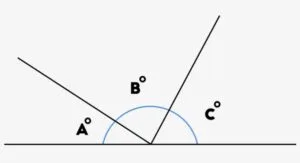
That is, A + B + C = 180°.
Angles on parallel lines cut by a transversal
The figure below shows parallel lines cut by a transversal, with the angles numbered 1 to 8.
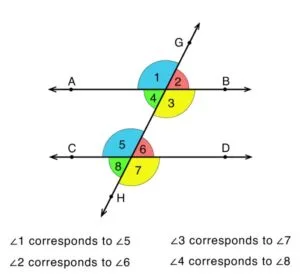
Corresponding angles
From the figure above, the following angles are corresponding:
<1 = <5; <3 = <7
<2 = <6; <4 = <8
Alternate angles
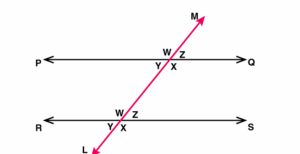
The alternate angles are shown in the diagram above.
Vertically opposite angles
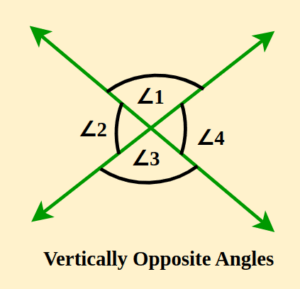
From the diagram above, the vertically opposite angles are:
<1 = <3; <2 = <4
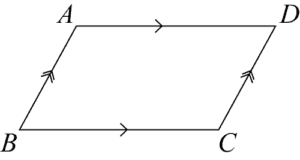
What is a parallelogram?
A parallelogram is a quadrilateral which has both pairs of opposite sides parallel.
Rhombuses, rectangles and squares are special examples of parallelograms. A rhombus is a parallelogram with sides of equal length.
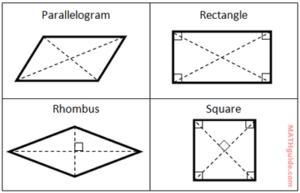
Properties of a parallelogram
- The opposite sides are parallel.
- The opposite sides are equal.
- The opposite angles are equal.
- The diagonals bisect one another.
Properties of a rhombus
- All four sides are equal.
- The opposite sides are parallel.
- The opposite angles are equal.
- The diagonals bisect one another at right angles.
- The diagonals bisect the angles.
NB: A rectangle has all the properties of a parallelogram, and all four angles are right angles. A square has all the properties of a rhombus, and all four angles are right angles.
What is the intercept theorem?
If three or more parallel lines cut off equal intercepts on a transversal, then they cut off equal intercepts on any other transversal.
Given: Three parallel lines cutting a fourth line at A, B and C so that /AB/ = /BC/, and cutting another line at X, Y and Z respectively.
To prove: /XY/ = /YZ/
Construction: Draw XP and YQ parallel to ABC to cut BY and CZ at P and Q respectively.
Proof:
- AXPB is a parallelogram (opposite sides parallel).
- /XP/ = /AB/ (opposite sides equal).
- Similarly, /YQ/ = /BC/ (in parallelogram YQCB).
- /XP/ = /YQ/ (given /AB/ = /BC/).
- In triangles XPY and YQZ:
- /XP/ = /YQ/ (proved)
- X1 = X2 (corresponding angles)
- Y1 = Y2 (corresponding angles)
- Therefore, triangle XPY ≅ triangle YQZ (AAS).
- /XY/ = /YZ/
Evaluation
- State the theorem about the sum of the angles of a triangle and name the construction used to prove it.
- Write down two pairs of corresponding angles and two pairs of vertically opposite angles from the figures above.
- List the properties of a rhombus.
- State the intercept theorem.
Assignment
- In triangle ABC, <BAC = 68° and <ABC = 30°. BC is produced to X. The bisectors of <ABC and <ACX meet at P. Calculate <BCP and <BPC.
This term's Mathematics topics
SS1 Second Term · 5 topics
- Construction I: Triangles & Angles
- Construction II: Construction of Quadilaterals
- Proof of Some Basic Theorem and Deductive Proofs
- Application of Trigonometric Ratios to Problem Solving
- Graphs of SINE & COSINE of Angles
Second Term Mathematics Lesson Notes for Other Topics

Whole Numbers 121-130 & Number Skills
Read the full lesson note.
Numbers 110-120 & Subtraction Facts
Read the full lesson note.

Numbers 101-110 & Addition Facts
Read the full lesson note.
Identification & Counting Numbers 1-100
Read the full lesson note.
Subtraction & Numbers 81-100
Read the full lesson note.
Math Facts & Numbers 71-80
Read the full lesson note.

Numbers 1-250
Read the full lesson note.

Data Collection
Read the full lesson note.
Numbers 241-250
Read the full lesson note.

Numbers 231-240
Read the full lesson note.
3D Shapes
Read the full lesson note.
Capacity
Read the full lesson note.
Revision of First Term’s Work
Read the full lesson note.
Length and Pythagoras Rule
Read the full lesson note.
Revision of First Term's Topic
Read the full lesson note.
Lesson Notes for Other Classes
Basic 1 Lesson Note
The complete lesson note to guide your studies.

Basic 2 Lesson Note
The complete lesson note to guide your studies.

Basic 3 Lesson Note
The complete lesson note to guide your studies.

Basic 4 Lesson Note
The complete lesson note to guide your studies.

Basic 5 Lesson Note
The complete lesson note to guide your studies.

Basic 6 Lesson Note
The complete lesson note to guide your studies.

