
Mensuration: Circle and It’s Properties – SS1 Mathematics Lesson Note (Third Term)
Download this term · ₦1,000Lesson note at a glance
- Subject
- Mathematics
- Class
- SS1
- Term
- Third Term
- Topic
- Mensuration: Circle and It’s Properties
- Order
- Topic 1 of 6 this term
- Reading time
- 5 min
A circle is the set of all points in a plane that are the same distance from a fixed point called the centre.
Behavioural objectives
By the end of the lesson, students should be able to:
- name and define the parts of a circle: centre, circumference, arc, radius, chord and diameter;
- name and define the regions of a circle: sector, semi-circle and segment;
- calculate the length of an arc and the perimeter of a sector;
- calculate the area of a sector;
- calculate the length of a chord and the perimeter of a segment.
What are the parts of a circle?
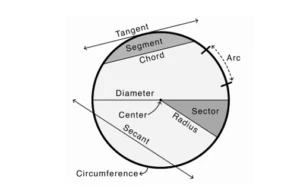
A circle has six main parts: centre, circumference, arc, radius, chord and diameter.
- Centre: the point in the middle of a circle.
- Circumference: the curved outer boundary of the circle.
- Arc: a curved part of the circumference.
- Radius: any straight line joining the centre to the circumference. The plural is radii.
- Chord: any straight line joining two points on the circumference.
- Diameter: a chord that passes through the centre. It divides the circle into two equal parts.
What is the difference between a chord and a diameter?
A chord joins any two points on the circle. A diameter is the longest chord because it passes through the centre.
| Feature | Chord | Diameter |
|---|---|---|
| Passes through the centre | Not always | Always |
| Number in a circle | Unlimited | Unlimited, but all have the same length |
| Length | Less than or equal to the diameter | 2r, the longest chord |
What are the key circle formulas?
- Circumference: C = 2πr, or C = πd, where d = 2r.
- Area of a circle: A = πr².
What are the regions of a circle?
A circle has three regions: the sector, the semi-circle and the segment.
- Sector: the region between two radii and the arc they cut off.
- Semi-circle: the region between a diameter and the circumference, that is, half of the circle.
- Segment: the region between a chord and the arc it cuts off.
What are minor and major arcs?
- Minor arc: the shorter arc cut off by a chord or two radii.
- Major arc: the longer arc, which makes up the rest of the circumference.
How do you calculate the length of an arc and the perimeter of a sector?
The length of an arc is a fraction of the circumference, and the fraction is the angle at the centre divided by 360°.
- Arc length: L = (θ ÷ 360°) × 2πr.
- θ: the angle subtended at the centre by arc XY.
- r: the radius of the circle.
- Perimeter of sector XOY: r + r + L, which gives 2r + (θ ÷ 360°) × 2πr.
Example 1: finding an angle from arc lengths
An arc of length 28 cm subtends an angle of 240° at the centre of a circle. In the same circle, what angle does an arc of length 35 cm subtend?
- Find the radius first. Write L = (θ ÷ 360°) × 2πr.
- Substitute: 28 = (240 ÷ 360) × 2 × (22 ÷ 7) × r.
- Simplify: 28 = (2 ÷ 3) × (44 ÷ 7) × r = 88r ÷ 21.
- Solve: r = (28 × 21) ÷ 88 = 147/22 cm.
- Now use L = 35 cm: 35 = (θ ÷ 360) × 2 × (22 ÷ 7) × (147 ÷ 22).
- Simplify: 35 = (θ ÷ 360) × 42.
- Solve: θ = (35 × 360) ÷ 42 = 300°.
The angle subtended by the 35 cm arc is 300°.
Example 2: perimeter of a sector
Calculate the perimeter of a sector of radius 7 cm and angle 108°. Take π = 22/7.
- Write the formula: perimeter = 2r + (θ ÷ 360°) × 2πr.
- Substitute: = 2 × 7 + (108 ÷ 360) × 2 × (22 ÷ 7) × 7.
- Simplify: = 14 + (108 ÷ 360) × 44.
- Reduce the fraction: = 14 + (3 ÷ 10) × 44.
- Multiply: = 14 + 13.2.
- Add: perimeter = 27.2 cm.
How do you calculate the area of a sector?
The area of a sector is a fraction of the area of the circle, and the fraction is θ ÷ 360°.
- Area of sector: A = (θ ÷ 360°) × πr².
Example 3: area of a sector
Find the area of a sector of radius 21 cm and angle 60°. Take π = 22/7.
- Write the formula: A = (θ ÷ 360°) × πr².
- Substitute: A = (60 ÷ 360) × (22 ÷ 7) × 21 × 21.
- Simplify: A = (1 ÷ 6) × 22 × 63 = 1386 ÷ 6.
- Divide: A = 231 cm².
How do you find the length of a chord and the perimeter of a segment?
The length of a chord AB is AB = 2r sin θ, where θ is half of the angle that the chord subtends at the centre.
Let O be the centre, r the radius, and OC the perpendicular from O to chord AB. Let angle AOB = 2θ.
- OC bisects the chord, so triangle OCA is right-angled at C.
- In triangle OCA: AC ÷ r = sin θ.
- Cross multiply: AC = r sin θ.
- Since AB = 2 × AC, the chord is AB = 2r sin θ.
- r: the radius of the circle.
- θ: the semi-vertical angle, which is half of the angle subtended at the centre by arc AB.
- Perimeter of segment ACBD: chord AB plus arc ADB.
- Formula: perimeter = 2r sin θ + (2θ ÷ 360°) × 2πr, since arc ADB subtends 2θ at the centre.
Example 4: chord and minor arc
In a circle of radius 6 cm, a chord is drawn 3 cm from the centre.
- Calculate the angle subtended by the chord at the centre of the circle.
- Find the length of the minor arc cut off by the chord.
Solution to (a)
- Let angle AOB = 2θ, where θ is the semi-vertical angle.
- cos θ = 3 cm ÷ 6 cm = 1/2 = 0.5000.
- θ = cos⁻¹ 0.5000 = 60°.
- Required angle = 2θ = 2 × 60° = 120°.
Solution to (b)
- Length of minor arc ADB = (120 ÷ 360) × 2πr.
- = (1 ÷ 3) × 2 × (22 ÷ 7) × 6 cm.
- = (4 × 22) ÷ 7 cm.
- = 88/7 cm = 124/7 cm.
Evaluation
- State the difference between a chord and a diameter.
- Write the formula for the length of an arc and the formula for the perimeter of a sector.
- Write the formula for the length of a chord AB in terms of the radius r and the semi-vertical angle θ.
- Calculate the perimeter of a sector of radius 14 cm and angle 90° (π = 22/7).
Assignment
Answer all the questions below. Use π = 22/7 where it is needed.
- Calculate the area of a sector of a circle of radius 6 cm which subtends an angle of 70° at the centre. A. 44 cm2 B. 22 cm2 C. 66 cm2 D. 11 cm2 E. 16.5 cm2
- What is the angle subtended at the centre of a sector of a circle of radius 2 cm if the area of the sector is 2.2 cm2? A. 120° B. 31½° C. 43° D. 58° E. 63°
- What is the radius of a sector of a circle which subtends 140° at its centre and has an area of 99 m2? A. 18 m B. 27 m C. 9 m D. 30 m E. 24 m
- A sector of 80° is removed from a circle of radius 12 cm. What area of the circle is left? A. 253 cm2 B. 704 cm2 C. 176 cm2 D. 125 cm2 E. 352 cm2
- An arc of a circle of radius 7 cm is 14 cm long. What angle does the arc subtend at the centre of the circle?
- An arc of a circle whose radius is 10 cm subtends an angle of 60° at the centre. Find the length of the arc.
This term's Mathematics topics
SS1 Third Term · 6 topics
Get Mathematics as PDF and Word
Every week of SS1 Mathematics, Third Term, formatted and ready to print. Ad-free, and the copy lock comes off.
Get this term Card, bank transfer, USSD or OPay
SS1 Mathematics Lesson Notes for Other Topics

Area Of Sector And Segment
Read the full lesson note.

Surface Area And Volume Of Solid Shapes
Read the full lesson note.

Area And Volume Of Frustum
Read the full lesson note.

Collection, Tabulation & Presentation of Grouped Data
Read the full lesson note.

Graphical Presentation of Data & Frequency Distribution
Read the full lesson note.

Number Base System
Read the full lesson note.
Modular Arithmetic
Read the full lesson note.

Indices
Read the full lesson note.

Logarithm
Read the full lesson note.
Quadratic Equations
Read the full lesson note.
Formation Of Quadratic Equations With Given Roots
Read the full lesson note.

Logical Reasoning
Read the full lesson note.

Logarithm
Read the full lesson note.
Logarithm II
Read the full lesson note.

Sequence And Series - Arithmetic Progression
Read the full lesson note.
Lesson Notes for Other Classes

SS2 Lesson Note
The complete lesson note to guide your studies.

SS3 Lesson Note
The complete lesson note to guide your studies.
