
Application of Trigonometric Ratios to Problem Solving – SS1 Mathematics Lesson Note (Second Term)
Download Lesson NoteLesson note at a glance
- Subject
- Mathematics
- Class
- SS1
- Term
- Second Term
- Topic
- Application of Trigonometric Ratios to Problem Solving
- Order
- Topic 4 of 5 this term
- Reading time
- 4 min
Trigonometric ratios compare the sides of a right-angled triangle. For an acute angle, sine is opposite over hypotenuse, cosine is adjacent over hypotenuse and tangent is opposite over adjacent. These ratios are used to find unknown lengths and angles, including distances and the lengths of chords in a circle. Where no angle is given, Pythagoras’ theorem is used.
Behavioural objectives
By the end of the lesson, students should be able to:
- write the sine, cosine and tangent of the acute angles of a right-angled triangle;
- use the relationship between sin θ and cos (90° – θ);
- use trigonometric ratios to solve problems on distances and angles;
- state Pythagoras’ theorem;
- find the length of a chord of a circle using trigonometric ratios or Pythagoras’ theorem.
What are the sine, cosine and tangent of an acute angle?
In a right-angled triangle, the trigonometric ratios of the acute angles can be found as follows. Triangle ABC is right-angled at A. Side a is opposite angle A (the hypotenuse), side b is opposite angle B and side c is opposite angle C.
| Angle | Sine | Cosine | Tangent |
|---|---|---|---|
| B | sin B = b/a | cos B = c/a | tan B = b/c |
| C | sin C = c/a | cos C = b/a | tan C = c/b |
In triangle ABC, B and C are complementary angles, that is, B + C = 90°. If B = θ, then C = 90° – θ. Therefore:
- sin θ = cos (90° – θ) = b/a
- cos θ = sin (90° – θ) = c/a
Always remember SOH CAH TOA:
- sin θ = Opp/Hyp
- cos θ = Adj/Hyp
- tan θ = Opp/Adj
Examples
- A triangle has sides 8 cm and 5 cm and an angle of 90° between them. Calculate the smallest angle of the triangle.
- Town Y is 200 km from town X in a direction of 40°. How far is Y east of X?
Solution to example 2
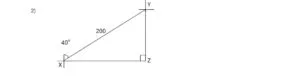
From the diagram, the distance of Y east of X = ZY.
Using the right-angled triangle XZY:
sin 40° = ZY/200 km
ZY = 200 km × sin 40°
= 200 km × 0.6428
= 128.56 km
= 128.6 km to 1 d.p.
How do we find the length of a chord using trigonometric ratios?
Trigonometric ratios can be used to find the length of a chord of a given circle. Where angles are not given, Pythagoras’ theorem is used instead.

Pythagoras’ theorem states that in a right-angled triangle, the square of the length of the hypotenuse is equal to the sum of the squares of the lengths of the other two sides: c2 = a2 + b2.
Examples
- A chord is drawn 3 cm away from the centre of a circle of radius 5 cm. Calculate the length of the chord.
- In a figure, O is the centre of the circle HKL. HK = 16 cm, HL = 10 cm and the perpendicular from O to HK is 4 cm. What is the length of the perpendicular from O to HL?

Solution to example 1
Sketch a right-angled triangle and label it correctly.
|AB|2 + 32 = 52 (Pythagoras’ theorem)
|AB|2 = 52 – 32
|AB|2 = 25 – 9
|AB|2 = 16
AB = √16 = 4 cm
Since B is the midpoint of chord AC, then:
Length of chord AC = 2 × AB = 2 × 4 cm = 8 cm
Solution to example 2
Let the distance from O to HL = x cm.
The perpendicular from O to HK meets HK at its midpoint M, so HM = 8 cm. In right-angled triangle OMH:
|OH|2 = |HM|2 + |MO|2
|OH|2 = 82 + 42
= 64 + 16 = 80
∴ |OH| = √80 cm
But OH is the radius of the circle, that is, r = OH = OL = √80 cm.
The perpendicular from O to HL meets HL at its midpoint N, so NL = 5 cm. In right-angled triangle ONL:
OL2 = ON2 + NL2
(√80)2 = x2 + 52
80 – 25 = x2
55 = x2
Take the square root of both sides:
√55 = x = 7.416 cm
∴ The length of the perpendicular from O to HL is 7.416 cm.
Evaluation
- In triangle ABC, right-angled at A, write down sin B, cos B and tan B in terms of the sides a, b and c.
- If B = θ, write down C in terms of θ and show that sin θ = cos (90° – θ).
- State Pythagoras’ theorem.
- A ladder 20 m long rests against a vertical wall so that the foot of the ladder is 9 m from the wall.
- Find, correct to the nearest degree, the angle that the ladder makes with the wall.
- Find, correct to 1 d.p., the height above the ground at which the upper end of the ladder touches the wall. Use tables of trigonometric ratios.
Assignment
Town Y is 200 km from town X in a direction of 40°. Using the method in the worked example, find how far Y is north of X. Give your answer correct to 1 d.p.
This term's Mathematics topics
SS1 Second Term · 5 topics
- Construction I: Triangles & Angles
- Construction II: Construction of Quadilaterals
- Proof of Some Basic Theorem and Deductive Proofs
- Application of Trigonometric Ratios to Problem Solving
- Graphs of SINE & COSINE of Angles
Second Term Mathematics Lesson Notes for Other Topics

Whole Numbers 121-130 & Number Skills
Read the full lesson note.

Numbers 110-120 & Subtraction Facts
Read the full lesson note.

Numbers 101-110 & Addition Facts
Read the full lesson note.

Identification & Counting Numbers 1-100
Read the full lesson note.

Subtraction & Numbers 81-100
Read the full lesson note.

Math Facts & Numbers 71-80
Read the full lesson note.

Numbers 1-250
Read the full lesson note.

Data Collection
Read the full lesson note.

Numbers 241-250
Read the full lesson note.

Numbers 231-240
Read the full lesson note.
3D Shapes
Read the full lesson note.

Capacity
Read the full lesson note.

Revision of First Term’s Work
Read the full lesson note.
Length and Pythagoras Rule
Read the full lesson note.

Revision of First Term's Topic
Read the full lesson note.
Lesson Notes for Other Classes
Basic 1 Lesson Note
The complete lesson note to guide your studies.

Basic 2 Lesson Note
The complete lesson note to guide your studies.

Basic 3 Lesson Note
The complete lesson note to guide your studies.

Basic 4 Lesson Note
The complete lesson note to guide your studies.

Basic 5 Lesson Note
The complete lesson note to guide your studies.

Basic 6 Lesson Note
The complete lesson note to guide your studies.

