
Bank Reconciliation Statement – SS1 Financial Accounting Lesson Note (Third Term)
Download this term · ₦1,000Lesson note at a glance
- Subject
- Financial Accounting
- Class
- SS1
- Term
- Third Term
- Topic
- Bank Reconciliation Statement
- Order
- Topic 4 of 4 this term
- Reading time
- 9 min
A bank reconciliation statement is a statement prepared by the account holder to explain why the Cash Book balance and the Bank Statement balance disagree, and to bring the two balances into agreement.
- Items it lists: unpresented cheques, uncredited cheques and bank errors (other items are first entered in the Cash Book).
- Record type: it is not part of the double-entry records.
Behavioural objectives
By the end of the lesson, students should be able to:
- define a Bank Statement and state its uses;
- define a bank reconciliation statement;
- list the items that cause a difference between the Cash Book balance and the Bank Statement balance;
- state the side on which each item appears and its effect on the two balances;
- describe the steps for preparing a bank reconciliation statement;
- state the advantages of bank reconciliation.
What is a Bank Statement?
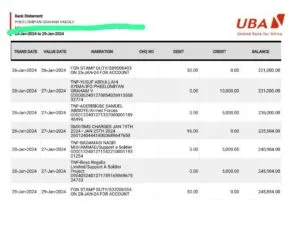
A Bank Statement is a statement prepared by a bank and sent to the customer at regular intervals.
- Content: it shows the transactions between the bank and the customer for a particular period.
- Prepared by: the bank, not the customer.
Format of a Bank Statement
What are the uses of a Bank Statement?
- To check the transactions that took place within that period.
- To serve as a source document.
- To prepare a bank reconciliation statement.
- To support auditing.
- To find the opening balance and the closing balance of a bank account.
What is a bank reconciliation statement?
A bank reconciliation statement is a statement prepared by an account holder (the trader or the business) to reconcile the Cash Book balance with the Bank Statement balance.
- Identifies: the causes of disagreement (discrepancy) between the two balances.
- Reconciles: it harmonises the two balances so that they agree.
Why compare the Bank Statement with the bank account in the Cash Book?
The two records are compared because their balances may not agree at a given date, and the reasons must be explained.
- Opposite sides: an entry in the Cash Book bank account appears on the opposite side of the Bank Statement.
- Different balances: when the balances disagree, they must be reconciled.
- Result: the reconciliation shows the correct balance to use as cash at the bank.
What causes a difference between the Cash Book balance and the Bank Statement balance?
The difference arises from items recorded in one record but not yet in the other, and from errors.
Which items are in the Cash Book but not in the Bank Statement?
- Unpresented cheques: cheques issued but not yet paid by the bank.
- Uncredited cheques: cheques lodged but not yet credited by the bank.
- Errors in the Cash Book: mistakes made by the business.
Which items are in the Bank Statement but not in the Cash Book?
- Bank charges: fees deducted by the bank.
- Dividends: shareholders’ profit share paid directly into the account.
- Standing orders: regular fixed payments made by the bank.
- Credit transfers (direct credits): payments made straight into the account.
- Direct debits: bills paid by the bank for the account holder.
- Dishonoured cheques: lodged cheques returned unpaid.
- Interest received: for example, on a fixed deposit.
- Interest charged: on an overdraft or loan.
- Errors in the Bank Statement: mistakes made by the bank.
What does each item mean?
Items arising from the Cash Book
- Unpresented cheques: cheques issued by the business but not yet presented for payment at the bank by the payee.
- Uncredited cheques: cheques received by the business and lodged (deposited) in the bank but not yet credited on the Bank Statement.
- Errors in the Cash Book: mistakes of omission, duplication, wrong figures and so on, made in the Cash Book entries.
Items arising from the Bank Statement
- Bank charges: amounts deducted by the bank for services rendered, such as Commission on Turnover (COT) and the cost of chequebooks.
- Dividends: the part of a limited liability company’s profits given to shareholders as a reward for their investment.
- Standing orders: instructions to the bank to pay a fixed amount regularly to a named beneficiary.
- Credit transfers (direct credits): payments by customers or debtors straight into the business bank account to settle what they owe.
- Direct debits: an arrangement in which the bank pays, for the account holder, bills presented by third parties.
- Dishonoured cheques: cheques received by the business and lodged, but returned unpaid by the drawer’s bank.
- Interest received: interest the bank pays into the current account on a fixed deposit held by the customer.
- Interest on overdraft: monthly interest the bank charges when a customer is allowed to overdraw the account.
- Errors in the Bank Statement: mistakes of omission, duplication, wrong figures and so on, made by the bank.
On which side does each item appear and what is its effect?
The table shows where each item is found and how it affects the two balances.
| Item | Where it is found | Effect on the balances |
|---|---|---|
| Unpresented cheques | Credit side of Cash Book, not on debit side of Bank Statement | Bank Statement balance is higher than Cash Book balance |
| Uncredited cheques | Debit side of Cash Book, not on credit side of Bank Statement | Cash Book balance is higher than Bank Statement balance |
| Bank charges | Debit side of Bank Statement, not on credit side of Cash Book | Cash Book balance is higher than Bank Statement balance |
| Dividends | Credit side of Bank Statement, not on debit side of Cash Book | Bank Statement balance is higher than Cash Book balance |
| Standing orders | Debit side of Bank Statement, not on credit side of Cash Book | Cash Book balance is higher than Bank Statement balance |
| Credit transfers | Credit side of Bank Statement, not on debit side of Cash Book | Bank Statement balance is higher than Cash Book balance |
| Direct debits | Debit side of Bank Statement, not on credit side of Cash Book | Cash Book balance is higher than Bank Statement balance |
| Dishonoured cheques | Debit side of Bank Statement, not on credit side of Cash Book | Cash Book balance is higher than Bank Statement balance |
| Interest on fixed deposit | Credit side of Bank Statement, not on debit side of Cash Book | Bank Statement balance is higher than Cash Book balance |
| Interest on overdraft | Debit side of Bank Statement, not on credit side of Cash Book | Bank Statement balance is smaller than Cash Book balance |
- Errors: the effect depends on the error and on which record it is in.
- Quick rule: an item debited on the Bank Statement lowers that balance, and an item credited raises it.
How do you prepare a bank reconciliation statement?
You prepare it in three steps: compare the records, update the Cash Book, then reconcile the two balances.
Step 1: Compare the two records
- Compare the entries in the Cash Book bank account with the Bank Statement.
- Compare the debit side of the bank account with the credit side of the Bank Statement.
- Compare the credit side of the bank account with the debit side of the Bank Statement.
- Tick (✔️) each item that appears in both records.
Step 2: Update the Cash Book (prepare an Adjusted Cash Book)
- Enter in the Cash Book any item on the Bank Statement not yet entered.
- Correct any error in the Cash Book.
- Balance the Cash Book and carry down the balance.
- NB: the new Cash Book balance is the correct bank balance.
- Balance Sheet: at the end of the financial year, this is the balance that appears in the Balance Sheet.
Step 3: Prepare the bank reconciliation statement
The statement shows why the updated Cash Book balance does not agree with the Bank Statement balance.
- Start with the balance as per the Adjusted Cash Book.
- Add the unpresented cheques.
- Deduct the uncredited cheques.
- Adjust for bank errors: add amounts debited in error by the bank and deduct amounts credited in error by the bank.
- The total should equal the balance as per the Bank Statement.
- NB: you may start with the balance as per the Bank Statement instead.
- Reverse the adjustments: if you start from the Bank Statement, reverse items 2, 3 and 4 above.
- Not double entry: the statement is not part of the double-entry records.
- Purpose: it shows that, on a certain date, the bank account and the Bank Statement were reconciled.
Worked example (illustrative figures)
Balance per Adjusted Cash Book is ₦50,000, unpresented cheques are ₦8,000 and uncredited cheques are ₦5,000.
| Item | ₦ |
|---|---|
| Balance as per Adjusted Cash Book | 50,000 |
| Add: unpresented cheques | 8,000 |
| Less: uncredited cheques | (5,000) |
| Balance as per Bank Statement | 53,000 |
What are the advantages and purposes of bank reconciliation?
Bank reconciliation explains differences between the two records, gives an accurate bank balance and acts as a control against fraud and error.
- Reveals causes: it shows the items that cause the discrepancy between the Cash Book balance and the Bank Statement balance.
- Harmonises balances: it makes the Cash Book and Bank Statement balances agree.
- Accurate balance: after the Cash Book is updated, an accurate bank balance is available.
- Updates the Cash Book: the customer can enter items debited or credited by the bank that are not yet in the Cash Book.
- Identifies cheques: unpresented and uncredited cheques are identified.
- Detects fraud: it helps to detect fraud and embezzlement, either from the bank or in the office.
- Finds errors: it helps to identify errors in the Cash Book and the Bank Statement.
- Stale cheques: a stale cheque (over six months old, which the bank will not pay) can be identified and written back into the bank account.
- Deters fraud: regular preparation, especially by someone other than the cashier, helps to reduce, prevent or deter fraud.
- Correct Balance Sheet figure: it shows the correct amount of cash at the bank for the Balance Sheet.
- Control system: bank reconciliation is an important system of control.
- Avoids overdrawing: unintended overdrawing of the bank account can be avoided.
- Uses surplus cash: a surplus of cash at the bank can be spotted and invested to earn interest.
Evaluation
- Define a bank reconciliation statement.
- State three items that appear in the Bank Statement but not in the Cash Book.
- What is the difference between an unpresented cheque and an uncredited cheque?
- State the effect of bank charges on the Cash Book balance and the Bank Statement balance.
- List the three steps in preparing a bank reconciliation statement.
Assignment
In your notebook, answer all three parts:
- State five uses of a Bank Statement.
- Explain any four advantages of bank reconciliation.
- What is a stale cheque, and how is it dealt with in the bank account?
This term's Financial Accounting topics
SS1 Third Term · 4 topics
- Introduction to Depreciation of Fixed Assets
- Methods of Depreciation
- Departmental Accounts
- Bank Reconciliation Statement
Get Financial Accounting as PDF and Word
Every week of SS1 Financial Accounting, Third Term, formatted and ready to print. Ad-free, and the copy lock comes off.
Get this term Card, bank transfer, USSD or OPay
SS1 Financial Accounting Lesson Notes for Other Topics

Introduction To Depreciation Of Fixed Assets
Read the full lesson note.
Methods Of Depreciation
Read the full lesson note.
Departmental Accounts
Read the full lesson note.
Introduction To Accounting And Its History
Read the full lesson note.

Advantages And Limitations Of Accounting
Read the full lesson note.

Career Opportunities In Bookkeeping And Accounting
Read the full lesson note.
Accounting Equation And Double Entry Principle
Read the full lesson note.
The Ledger
Read the full lesson note.

The Cash Book
Read the full lesson note.
Discounts
Read the full lesson note.

Three Column Cash Book
Read the full lesson note.
PETTY CASH BOOK
Read the full lesson note.

Trial Balance
Read the full lesson note.

Accounting Concepts And Convention
Read the full lesson note.

Final Account Of A Sole Trader
Read the full lesson note.
Lesson Notes for Other Classes

SS2 Lesson Note
The complete lesson note to guide your studies.

SS3 Lesson Note
The complete lesson note to guide your studies.
