
Accounting Equation and Double Entry Principle – SS1 Financial Accounting Lesson Note (First Term)
Download this term · ₦1,000Lesson note at a glance
- Subject
- Financial Accounting
- Class
- SS1
- Term
- First Term
- Topic
- Accounting Equation and Double Entry Principle
- Order
- Topic 4 of 7 this term
- Reading time
- 9 min
Double-entry bookkeeping is the system of recording every transaction in two accounts: one account is debited and another is credited.
Behavioural objectives
- State the accounting equation and show how transactions affect it.
- State the rules of double entry.
- Define source documents, name examples and state their uses.
- Define subsidiary books and state what each one is used for.
- Record simple transactions in the appropriate books of original entry.
What is the accounting equation?
The accounting equation states that the assets of a business equal what it owes to outsiders plus what it owes to the owner.
- Equation: Assets = Capital + Liabilities.
- Rearranged: Capital = Assets minus Liabilities.
- Assets: things of value that the business owns, such as cash, stock, buildings and machines.
- Liabilities: amounts the business owes to outsiders, such as a loan or a supplier (creditor) who has not been paid.
- Capital: the amount the owner has invested in the business.
- Balance: both sides of the equation are always equal after every transaction.
How do transactions affect the accounting equation?
Every transaction changes at least two items, and the two sides of the equation stay equal.
| Transaction | Effect on the equation |
|---|---|
| Owner starts business with ₦50,000 cash | Assets (cash) up by ₦50,000; capital up by ₦50,000 |
| Goods bought on credit for ₦10,000 | Assets (stock) up by ₦10,000; liabilities up by ₦10,000 |
| Creditor paid ₦10,000 in cash | Assets (cash) down by ₦10,000; liabilities down by ₦10,000 |
| Equipment bought for cash | One asset (equipment) up; another asset (cash) down by the same amount |
| Owner takes cash for personal use (drawings) | Assets (cash) down; capital down by the same amount |
What is double-entry bookkeeping?
Double-entry bookkeeping is the system of keeping accounts that records the two-fold aspect of every transaction.
- Debit: the account that receives value is debited.
- Credit: the account that gives value is credited.
- Ledger: both effects of the transaction are recorded in the ledger.
- Link to the equation: double entry keeps the accounting equation in balance.
What are the rules of double entry?
The rule of double entry is that every debit entry must have a matching credit entry of the same amount.
- Record every transaction in two accounts: debit one account and credit another.
- For every debit entry in an account, make a corresponding credit entry in another account.
- For every credit entry in an account, make a corresponding debit entry in another account.
- Debit the account that receives value, and credit the account that gives value.
How do debit and credit apply to each type of account?
| Type of account | To increase it | To decrease it |
|---|---|---|
| Asset (cash, stock, equipment) | Debit | Credit |
| Expense (rent, wages) | Debit | Credit |
| Drawings | Debit | Credit |
| Liability (creditors, loans) | Credit | Debit |
| Capital | Credit | Debit |
| Income (sales, commission received) | Credit | Debit |
What are examples of double entry?
| Transaction | Debit | Credit |
|---|---|---|
| Owner starts business with cash | Cash account | Capital account |
| Goods bought for cash | Purchases account | Cash account |
| Goods bought on credit from a supplier | Purchases account | Supplier’s account |
| Rent paid in cash | Rent account | Cash account |
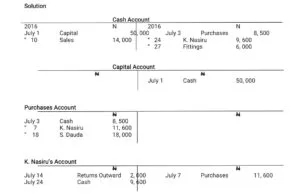
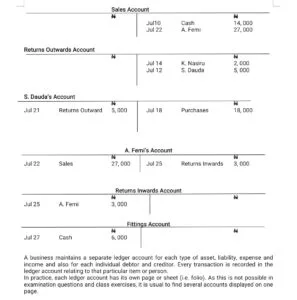
Illustration: recording transactions in the ledger
Record the following transactions in the ledger of F. Sanusi for July 2016.
| Date | Description |
|---|---|
| July 1 | |
| July 3 | |
| July 7 | |
| July 10 | |
| July 14 | |
| July 18 | |
| July 21 | |
| July 22 | |
| July 24 | |
| July 25 | |
| July 27 |
What are source documents?
Source documents are the written evidence of business transactions, generated when a business deals with others.
- Content: they describe the essential facts of each transaction.
- Purpose: they are the original documents used to prepare the books of account.
- Coverage: every cash or credit transaction must be supported by a source document.
- Verification: accounting records can only be verified when the appropriate source documents are available.
What are examples of source documents?
There are eight common source documents: receipt, invoice, cheque, bank paying-in slip, debit note, credit note, statement of account and voucher.
- Receipt: a written acknowledgement that money or valuable property has been received. A cash customer is usually given one.
- Invoice: a document prepared by the seller when goods are sold, usually on credit, and sent to the buyer.
- Cheque: a written order by a customer to the bank to pay a stated sum to the person or business named. The cheque or its stub (counterfoil) is the source document for the payment.
- Bank paying-in slip: a standard form filled in duplicate or triplicate when cash, cheques or bank drafts are paid into a bank account.
- Debit note: a document issued by the seller to correct an undercharge in the buyer’s account.
- Credit note: a document issued by the seller to correct an overcharge in the buyer’s account.
- Statement of account: a summary of transactions between the seller and a credit customer, sent at regular intervals, usually monthly.
- Voucher: a document used to obtain authorisation for payments, whether by cash, cheque or letters of authority.
What is a sales invoice and a purchase invoice?
- Sales invoice: the seller’s copy of the invoice.
- Purchase invoice: the same document in the hands of the buyer.
What does an invoice contain?
- The name and address of the supplier.
- The name, address and account number of the customer.
- The supplier’s invoice number.
- The customer’s order number (for goods supplied in response to an order).
- The date of the transaction.
- A detailed description of the goods: quantity, unit price, total price, terms of sale, terms of payment and trade discounts.
What is the difference between a debit note and a credit note?
- Debit note: raised when the buyer has been undercharged, so the amount due increases.
- Credit note: raised when the buyer has been overcharged or is owed an allowance, so the amount due falls.
- Debit note example: the amount due is ₦18,500 but the invoice shows ₦15,800, an undercharge of ₦2,700.
- Action: the seller issues a debit note for ₦2,700 to the purchaser.
Why does a seller issue a credit note?
- The customer was overcharged, for example by a mistake on the sales invoice.
- The customer returned some of the goods bought earlier.
- An allowance is made to the customer, for example for damaged goods the customer keeps.
What are the uses of source documents?
- Preparing books: they supply the information for the books of account.
- Evidence: they give written proof that transactions took place.
- Proof of ownership: they can show ownership of property, for example a receipt.
- Audit: auditors check the records against them.
- Reconciliation: they are used to reconcile accounts.
- Authorisation: vouchers show that payments were approved.
- Corrections: debit and credit notes correct undercharges and overcharges.
What are subsidiary books?
Subsidiary books are the books of prime (original) entry, in which transactions are first recorded in detail before totals are posted to the ledger.
- Use: they record credit sales, credit purchases, sales returns, purchases returns and similar items.
- Listing devices: they remove a lot of detail from the ledger.
- Division of work: bookkeeping can be shared among several people.
- Name: every transaction should be recorded in one of these books before it enters the ledger.
What are the types of subsidiary books?
There are seven subsidiary books: sales journal, purchases journal, returns inwards journal, returns outwards journal, general journal, cash book and petty cash book.
- Sales journal (sales day book): records goods sold on credit to customers.
- Purchases journal (purchases day book): records goods bought on credit from suppliers.
- Returns inwards journal (returns inwards day book): records goods returned by customers to the business.
- Returns outwards journal (returns outwards day book): records goods returned by the business to suppliers.
- General journal (also called the principal journal, journal proper or the journal): records transactions that fit no other book.
- Cash book: records receipts and payments of money (cash or cheque). It is part of double entry and works as both a ledger and a subsidiary book.
- Petty cash book: records minor (low-value) cash payments. It is also part of double entry and is a ledger account.
What is the general journal used for?
- Recording opening entries.
- Recording closing entries.
- Correcting errors.
- Recording the purchase of fixed assets on credit.
- Recording the sale of fixed assets on credit.
- Recording one-off transactions.
- Transferring balances between ledgers.
- Demonstrating the principle of double entry.
- Recording transactions that cannot conveniently pass through any other subsidiary book.
- Writing off bad debts.
- Recording the purchase of a business.
- Recording the issue, redemption and conversion of shares and debentures.
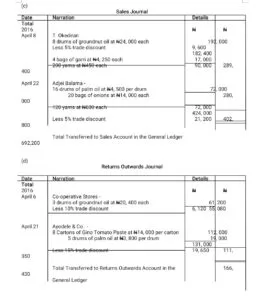
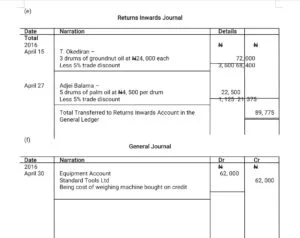
Illustration: recording transactions in the books of original entry
Laolu, a trader, undertook the following transactions in April 2016.
| Date | Description |
|---|---|
| Apr 1 | Started business with ₦25,000 cash |
| Apr 2 | Put ₦18,000 of the cash into a bank account |
| Apr 5 | Purchased from Co-operative Stores: 15 drums of groundnut oil at ₦20,400 each 12 bags of garri at ₦3,500 each Invoice subject to 10% trade discount |
| Apr 8 | Sold to T. Okediran: 8 drums of groundnut oil at ₦24,000 each, less 5% trade discount 4 bags of garri at ₦4,250 each 200 yams at ₦450 each |
| Apr 9 | Returned to Co-operative Stores: 3 drums of groundnut oil bought on 5th April 2016 |
| Apr 10 | Bought from Oyesile & Sons: 650 yams at ₦380 each 32 bags of onions at ₦12,500 per bag 60 bags of Dangote 50kg iodised salt at ₦3,200 per bag |
| Apr 12 | Paid Co-operative Stores ₦65,700 by cheque on account |
| Apr 15 | T. Okediran returned 3 drums of groundnut oil bought on the 8th of April 2016 |
| Apr 18 | Sold 320 yams at ₦550 each for cash |
| Apr 19 | Bought from Ayodele & Co: 45 bags of onions at ₦12,000 each 50 cartons of Gino Tomato Paste at ₦14,000 per carton 20 drums of palm oil at ₦3,800 per drum Invoice subject to 15% trade discount |
| Apr 21 | Returned to Ayodele & Co: 8 cartons of Gino Tomato Paste and 5 drums of palm oil bought on the 19th of April 2016 |
| Apr 22 | Sold to Adjei Balama: 16 drums of palm oil at ₦4,500 per drum 20 bags of onions at ₦14,000 each 120 yams at ₦600 each Invoice subject to 5% trade discount |
| Apr 25 | Paid sundry expenses ₦8,400 by cheque |
| Apr 26 | Paid rent of shop ₦15,000 cash |
| Apr 27 | Adjei Balama returned 5 drums of palm oil to us because they were damaged |
| Apr 29 | T. Okediran paid by cheque for all the sales made to him |
| Apr 30 | Bought weighing machine from Standard Tools Ltd on credit, ₦62,000 |
Required: record the above transactions in the appropriate books of original entry.
Evaluation
- What is double-entry bookkeeping?
- Write the accounting equation and define each of its three parts.
- State the rules of double entry.
- List four examples of source documents.
- Which subsidiary book is used to record goods returned by customers to the business?
Assignment
Explain the difference between a debit note and a credit note, and state three reasons why a seller may issue a credit note to a customer.
This term's Financial Accounting topics
SS1 First Term · 7 topics
- Introduction to Accounting and its History
- Advantages and Limitations of Accounting
- Career Opportunities in Bookkeeping and Accounting
- Accounting Equation and Double Entry Principle
- The Ledger
- The Cash Book
- Discounts
Get Financial Accounting as PDF and Word
Every week of SS1 Financial Accounting, First Term, formatted and ready to print. Ad-free, and the copy lock comes off.
Get this term Card, bank transfer, USSD or OPay
SS1 Financial Accounting Lesson Notes for Other Topics
Introduction To Accounting And Its History
Read the full lesson note.

Advantages And Limitations Of Accounting
Read the full lesson note.

Career Opportunities In Bookkeeping And Accounting
Read the full lesson note.
The Ledger
Read the full lesson note.

The Cash Book
Read the full lesson note.
Discounts
Read the full lesson note.

Three Column Cash Book
Read the full lesson note.
PETTY CASH BOOK
Read the full lesson note.

Trial Balance
Read the full lesson note.

Accounting Concepts And Convention
Read the full lesson note.

Final Account Of A Sole Trader
Read the full lesson note.
Balance Sheet
Read the full lesson note.

Introduction To Depreciation Of Fixed Assets
Read the full lesson note.
Methods Of Depreciation
Read the full lesson note.
Departmental Accounts
Read the full lesson note.
Lesson Notes for Other Classes

SS2 Lesson Note
The complete lesson note to guide your studies.

SS3 Lesson Note
The complete lesson note to guide your studies.
