
Past Questions Drills SS3 Digital Technologies Lesson Note
Download Lesson NoteTopic: Past Questions Drills
Mastering the Objectives (Section A)
The objective section is a game of speed and “elimination.” You have 50 questions, and many are designed to confuse you with similar-looking answers.
- The “Most Correct” Rule: Sometimes, two answers look right. For example: Question: What does a printer do?
- A) It uses paper.
- B) It is an output device.
- C) It produces hard copies of processed data. Answer C is the most professional and complete.
- Watch for “NOT” and “EXCEPT”: WAEC loves to hide these words. Example: “All the following are input devices EXCEPT…” If you are rushing, you might pick the first input device you see (A. Mouse) and get it wrong. Slow down!
- Units of Storage Drill: They almost always ask about bits and bytes.
- 1 Byte=8 Bits
- 1 Kilobyte (KB)=1024 Bytes (Not 1000!)
The “Big 3” Theory Diagrams
In the theory section, if a question asks you to “Describe” or “Identify” something, drawing a quick, neat diagram—even if not asked—often earns you the “bonus” marks that lead to an A1.
- The Von Neumann Architecture: This shows how the CPU, Memory, and I/O devices connect.
- Logic Gate Symbols: Don’t mix up the “D” shape of the AND gate with the “curved” shape of the OR gate.

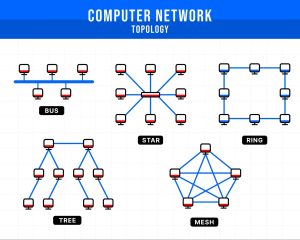
- Network Topologies: Be ready to draw a Star (hub in the middle) or a Bus (one main line).
High-Frequency Theory Questions (Part 1)
Based on the last 10 years of past questions, these topics appear almost every single time:
- Booting: * Cold Booting: Starting a computer that was completely off.
- Warm Booting: Restarting a computer that was already on (e.g., after a crash).
- System Files vs. Application Files:
- System Files: Needed for the OS to run (e.g., .sys, .dll, .exe).
- Application Files: Created by the user (e.g., .doc for Word, .xls for Excel).
- The Difference between Internet and Intranet:
- Internet: Public, global, anyone can join.
- Intranet: Private, belongs to one company/school, needs a password.
High-Frequency Theory Questions
- Spreadsheet Formulas: The examiners will give you a table and ask you to write a formula for a specific cell.
- Example: “Write the formula to find the average score in cells B2, B3, and B4.”
- Answer: =AVERAGE(B2:B4) (Note: Always start with the = sign!)
- Database Objects: Know these four terms cold:
- Tables: Where data is stored.
- Forms: Used for easy data entry.
- Queries: Used to search/ask questions.
- Reports: Used to print out a summary.
- Word Processing: Know your keyboard shortcuts!
- Ctrl + S (Save), Ctrl + C (Copy), Ctrl + V (Paste), Ctrl + P (Print).
Common Pitfalls & How to Avoid Them
- The Definition of “Algorithm”: Don’t just say “it’s a program.” Say: “An algorithm is a step-by-step set of instructions to solve a specific problem.”
- Flowchart Directions: Flowcharts must always have arrows! A line without an arrow doesn’t show the “flow,” and you will lose marks.
- Computer Ethics: If asked about the “Misuse of Computers,” mention:
- Hacking: Gaining unauthorized access.
- Phishing: Sending fake emails to steal passwords.
- Spamming: Sending unwanted bulk messages.
Final Exam Tip: When answering theory questions, use Bullet Points. Examiners have thousands of papers to mark. If your answer is easy to read, they are more likely to give you full marks!
Third Term Digital Technologies Lesson Notes for Other Topics

Practical Project II
Explore lesson notes covering all topics.

Practical Project I
Explore lesson notes covering all topics.

Comprehensive Revision of SS1, 2 and 3
Explore lesson notes covering all topics.

Mobile Application Development II
Explore lesson notes covering all topics.

Cloud Computing II
Explore lesson notes covering all topics.

Blockchain Technology
Explore lesson notes covering all topics.

Cybersecurity III
Explore lesson notes covering all topics.

Digital Entrepreneurship
Explore lesson notes covering all topics.

Cyber Laws and Digital Rights
Explore lesson notes covering all topics.

Project Work
Explore lesson notes covering all topics.

Mobile Application Development I
Explore lesson notes covering all topics.

Spreadsheets Application I
Explore lesson notes covering all topics.

Spreadsheets Application II
Explore lesson notes covering all topics.

Presentation Software
Explore lesson notes covering all topics.

Database Introduction
Explore lesson notes covering all topics.

Lesson Notes for Other Classes

Basic 1 Lesson Note
The complete lesson note to guide your studies.

Basic 2 Lesson Note
The complete lesson note to guide your studies.

Basic 3 Lesson Note
The complete lesson note to guide your studies.

Basic 4 Lesson Note
The complete lesson note to guide your studies.

Basic 5 Lesson Note
The complete lesson note to guide your studies.

Basic 6 Lesson Note
The complete lesson note to guide your studies.