
Symbols, Formula and Equations – SS1 Chemistry Lesson Note (First Term)
Download this term · ₦1,000Lesson note at a glance
- Subject
- Chemistry
- Class
- SS1
- Term
- First Term
- Topic
- Symbols, Formula and Equations
- Order
- Topic 3 of 5 this term
- Reading time
- 10 min
A chemical symbol is a short form of an element’s name, a formula shows the atoms in a compound, and an equation shows a chemical reaction.
Behavioural objectives
- Define an element and write the symbols of common elements.
- Classify elements into metals, non-metals and metalloids and state their differences.
- Define valency and radical, and use them to write chemical formulae.
- Calculate empirical and molecular formulae from given data.
- State and verify the three laws of chemical combination.
What is an element?
An element is a substance that cannot be split into simpler substances by ordinary chemical processes.
- Number: there are over one hundred known elements.
- Examples: hydrogen, oxygen, iron, copper and gold.
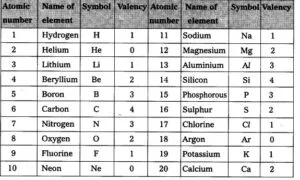
How are the symbols of elements derived?
A symbol is a one or two letter code for an element, and it is derived in three ways.
1. From the first letter of the name
- Hydrogen: H
- Oxygen: O
- Iodine: I
- Fluorine: F
- Nitrogen: N
- Sulphur: S
- Carbon: C
- Phosphorus: P
2. From the first letter plus one other letter
The first letter is a capital and the second letter is small, for example Cl, not CL.
- Chlorine: Cl
- Bromine: Br
- Calcium: Ca
- Aluminium: Al
- Magnesium: Mg
- Beryllium: Be
- Helium: He
- Neon: Ne
- Lithium: Li
3. From the Latin name
Some symbols come from the Latin names of the elements.
| Element | Latin name | Symbol |
|---|---|---|
| Mercury | Hydrargyrum | Hg |
| Sodium | Natrium | Na |
| Iron | Ferrum | Fe |
| Copper | Cuprum | Cu |
| Silver | Argentum | Ag |
| Tin | Stannum | Sn |
| Gold | Aurum | Au |
| Potassium | Kalium | K |
| Lead | Plumbum | Pb |
How are elements classified?
Elements are classified into three groups: metals, non-metals and metalloids.
- Metals: elements that are shiny, conduct well and are usually solid, such as iron, zinc, tin, aluminium and copper.
- Non-metals: elements that are mostly poor conductors and not shiny, such as chlorine, oxygen, sulphur, fluorine and hydrogen.
- Metalloids: elements with some properties of metals and some of non-metals, such as silicon and germanium.
What are the differences between metals and non-metals?
Metals and non-metals differ in physical state, conduction, strength and appearance.
| S/N | Property | Metals | Non-metals |
|---|---|---|---|
| 1 | Physical state | Solids, except mercury | Solids, liquids or gases |
| 2 | Conduction | Good conductors of heat and electricity | Poor conductors of heat and electricity (except graphite) |
| 3 | Hammering | Malleable | Brittle |
| 4 | Drawing into wire | Ductile | Non-ductile |
| 5 | Appearance | Shiny | Not shiny |
| 6 | Density | Often very dense | Usually less dense |
What is valency?
Valency is the combining power of an element.
- Hydrogen definition: it is the number of hydrogen atoms that can combine with or replace one atom of the element.
- Cause: it depends on the structure of the atom.
- Valence electrons: it often equals the number of electrons in the outermost shell.
- Positive sign: the element loses electrons.
- Negative sign: the element gains electrons.
- Metals: they generally show positive valencies.
- Non-metals: they generally show negative valencies.
- More than one valency: some elements, such as iron and copper, have two or more.
- Oxidation number: at this level, valency with its sign is also called the oxidation number or state.
Valencies of some elements
| Element | Symbol | Valency |
|---|---|---|
| Hydrogen | H | +1 |
| Sodium | Na | +1 |
| Potassium | K | +1 |
| Silver | Ag | +1 |
| Magnesium | Mg | +2 |
| Calcium | Ca | +2 |
| Barium | Ba | +2 |
| Zinc | Zn | +2 |
| Aluminium | Al | +3 |
| Copper | Cu | +1, +2 |
| Iron | Fe | +2, +3 |
| Oxygen | O | -2 |
| Chlorine | Cl | -1 |
| Sulphur | S | -2, +4, +6 |
| Carbon | C | +4, -4 |
| Argon | Ar | Nil |
What is a radical?
A radical is a group of atoms with an electric charge that keeps its identity and reacts as a single unit.
- Acid radical: a small group of atoms carrying a negative charge, such as SO42-, CO32- and NO3–.
- Basic radical: a group of atoms carrying a positive charge, such as NH4+.
- Valency of a radical: it equals the charge the radical carries.
| Radical | Formula | Valency |
|---|---|---|
| Ammonium | NH4+ | +1 |
| Hydroxide | OH– | -1 |
| Trioxonitrate (V) | NO3– | -1 |
| Dioxonitrate (III) | NO2– | -1 |
| Oxochlorate (I) | ClO– | -1 |
| Trioxocarbonate (IV) | CO32- | -2 |
| Tetraoxosulphate (VI) | SO42- | -2 |
| Hydrogen trioxocarbonate (IV) | HCO3– | -1 |
How do you write the formula of a compound?
A chemical formula shows the symbols and the number of atoms of each element in a compound.
- Write the symbol of the positive part first, then the negative part.
- Write the valency of each part, ignoring the signs.
- Swap the valencies and write them as subscripts.
- Put a radical in brackets if it needs a subscript.
- Leave out the number 1 and cancel any common factor.
Examples
- Sodium chloride: Na (+1), Cl (-1), so the formula is NaCl.
- Magnesium chloride: Mg (+2), Cl (-1), so the formula is MgCl2.
- Aluminium oxide: Al (+3), O (-2), so the formula is Al2O3.
- Calcium hydroxide: Ca (+2), OH (-1), so the formula is Ca(OH)2.
- Ammonium tetraoxosulphate (VI): NH4 (+1), SO4 (-2), so the formula is (NH4)2SO4.
What is a chemical equation?
A chemical equation is a short way of showing a chemical reaction using symbols and formulae.
- Reactants: the substances on the left of the arrow.
- Products: the substances on the right of the arrow.
- Arrow: it means “gives” or “produces”.
- Balanced equation: it has the same number of atoms of each element on both sides.
State symbols
| Symbol | Meaning |
|---|---|
| (s) | Solid |
| (l) | Liquid |
| (g) | Gas |
| (aq) | Aqueous, dissolved in water |
Steps in balancing an equation
- Write the word equation: magnesium + oxygen gives magnesium oxide.
- Replace the names with correct formulae: Mg + O2 → MgO.
- Count the atoms of each element on both sides: there are 2 oxygen atoms on the left and 1 on the right.
- Put numbers in front of formulae, never change the subscripts: 2Mg + O2 → 2MgO.
- Add state symbols: 2Mg(s) + O2(g) → 2MgO(s).
What are empirical and molecular formulae?
The empirical formula shows the simplest whole number ratio of atoms in a compound.
The molecular formula shows the actual number of atoms of each element in one molecule.
| Point | Empirical formula | Molecular formula |
|---|---|---|
| Shows | Simplest ratio of atoms | Actual number of atoms |
| Example (ethanoic acid) | CH2O | C2H4O2 |
| Link | Molecular formula = (empirical formula)n, where n is a whole number | |
Steps to find the empirical formula
- Write the mass or percentage of each element.
- Divide each by its atomic mass to get the mole ratio.
- Divide all values by the smallest value.
- If the ratio is not whole, multiply all values by the smallest number that makes them whole.
- Write the symbols with the whole numbers as subscripts.
Steps to find the molecular formula
- Find the mass of one empirical formula unit.
- Divide the relative molecular mass by it to get n.
- Multiply every subscript in the empirical formula by n.
Worked example 1
A compound contains 2.04 g carbon, 0.34 g hydrogen and 2.73 g oxygen. Its relative molecular mass is 60. Find its empirical and molecular formulae. (C = 12, H = 1, O = 16)
| Step | C | H | O |
|---|---|---|---|
| Reacting mass | 2.04 | 0.34 | 2.73 |
| Mole ratio (mass ÷ atomic mass) | 2.04 ÷ 12 = 0.17 | 0.34 ÷ 1 = 0.34 | 2.73 ÷ 16 = 0.17 |
| Divide by smallest (0.17) | 1 | 2 | 1 |
- Empirical formula: CH2O.
- Let the molecular formula be: (CH2O)n.
- Mass equation: (12 + 2 + 16)n = 60, so 30n = 60.
- Value of n: n = 60 ÷ 30 = 2.
- Molecular formula: (CH2O)2 = C2H4O2.
Worked example 2
Find the empirical formula of a compound containing 81.8% carbon and 18.2% hydrogen.
| Step | C | H |
|---|---|---|
| Percentage by mass | 81.8 | 18.2 |
| Mole ratio (% ÷ atomic mass) | 81.8 ÷ 12 = 6.82 | 18.2 ÷ 1 = 18.2 |
| Divide by smallest (6.82) | 1 | 2.67 |
| Multiply by 3 | 3 | 8.01, which is about 8 |
- Why multiply by 3: 2.67 is not whole, and multiplying by 3 gives a value very close to a whole number.
- Empirical formula: C3H8.
What are the laws of chemical combination?
There are three laws of chemical combination: conservation of mass, definite proportion and multiple proportions.
1. Law of conservation of mass
The law states that matter can neither be created nor destroyed in a chemical reaction.
- Meaning: the total mass of the reactants equals the total mass of the products.
- Aim: to verify the law of conservation of mass.
- Equation: HCl(aq) + AgNO3(aq) → AgCl(s) + HNO3(aq), where AgCl is a white precipitate.
- Apparatus: weighing balance, conical flask, small test tube, string and cork stopper.
- Reagents: solutions of HCl and AgNO3, kept in separate reagent bottles.
Method
- Pour dilute HCl into the conical flask.
- Fill the small test tube with AgNO3 solution.
- Tie string round the neck of the test tube and suspend it in the flask so the two solutions do not mix.
- Weigh the flask and its contents and record the mass.
- Swirl the flask to mix the two solutions.
- Weigh the flask and its contents again.
- Result: a white precipitate of AgCl forms, which shows a chemical reaction has taken place.
- Discussion: the mass before and after mixing is the same.
- Conclusion: matter was neither created nor destroyed in the reaction.
2. Law of definite proportion (constant composition)
The law states that all pure samples of a compound contain the same elements combined in the same proportion by mass.
- Aim: to verify the law of definite proportion.
- Apparatus: crucible, test tube, combustion boats, combustion tube, weighing balance, Bunsen burner, U-tube, two retort stands with clamps.
- Reagents: CuCO3 crystals, Na2CO3 solution, Cu(NO3)2 solution, dry hydrogen gas and CaCl2 crystals.
Method
- Prepare sample A of black CuO by heating CuCO3 strongly in a crucible: CuCO3(s) → CuO(s) + CO2(g).
- Prepare sample B by mixing Na2CO3(aq) with Cu(NO3)2(aq): Na2CO3(aq) + Cu(NO3)2(aq) → CuCO3(s) + 2NaNO3(aq).
- Filter off the green CuCO3 precipitate and heat it strongly to get black CuO.
- Place each CuO sample in a dried, weighed combustion boat (A and B) and weigh again.
- Heat the boats in a combustion tube while dry hydrogen passes over them, to reduce CuO to copper.
- Continue until a reddish-brown residue shows all the CuO has become copper.
- Remove the flame but keep the hydrogen flowing, so hot copper is not re-oxidised by air.
- Let fused CaCl2 in the U-tube absorb the water formed.
- Cool the boats, weigh them and calculate the percentage of copper.
Sample results
| Measurement | Sample A | Sample B |
|---|---|---|
| (i) Mass of boat | 3.16 g | 3.31 g |
| (ii) Mass of boat + CuO | 5.15 g | 5.29 g |
| (iii) Mass of boat + Cu | 4.76 g | 4.90 g |
| Mass of CuO = (ii) – (i) | 1.99 g | 1.98 g |
| Mass of Cu = (iii) – (i) | 1.60 g | 1.59 g |
| % of Cu in CuO | (1.60 ÷ 1.99) × 100 = 80.40% | (1.59 ÷ 1.98) × 100 = 80.30% |
| Approximate % of Cu | 80% | 80% |
| Approximate % of O | 20% | 20% |
- Discussion: both samples contain about 80% copper, whatever method made the CuO.
- Conclusion: in pure CuO, copper and oxygen are always present in the mass ratio of about 4:1.
3. Law of multiple proportions
The law states that when two elements form more than one compound, the masses of one element that combine with a fixed mass of the other are in a simple whole number ratio.
- Aim: to verify the law of multiple proportions.
- Apparatus: combustion boats, combustion tube, weighing balance, Bunsen burner, U-tube, retort stand with clamp.
- Reagents: Cu2O crystals, CuO crystals, dry hydrogen gas and calcium chloride crystals.
Method
- Dry and weigh two boats.
- Put Cu2O in boat A and CuO in boat B, then weigh both boats again.
- Place the boats in a combustion tube and pass hydrogen gas over them while heating, to reduce the oxides to copper.
- Cool the boats and weigh the copper residues.
Sample results
| Measurement | Cu2O | CuO |
|---|---|---|
| Mass of oxide | 3.04 g | 1.91 g |
| Mass of Cu residue | 2.55 g | 1.38 g |
| Mass of oxygen removed | 0.49 g | 0.53 g |
| Mass of Cu combining with 1.0 g of O | 5.20 g | 2.60 g |
Calculation (fixed mass of oxygen = 1.0 g)
- For Cu2O: 0.49 g of O combines with 2.55 g of Cu, so 1.0 g of O combines with (2.55 × 1.0) ÷ 0.49 = 5.20 g of Cu.
- For CuO: 0.53 g of O combines with 1.38 g of Cu, so 1.0 g of O combines with (1.38 × 1.0) ÷ 0.53 = 2.60 g of Cu.
- Ratio of copper masses: 5.20 : 2.60 = 2 : 1.
- Conclusion: the masses of copper that combine with a fixed mass of oxygen in Cu2O and CuO are in the simple ratio 2:1.
Evaluation
- Define (a) valency and (b) radical.
- Write the valency of (a) oxygen, (b) potassium, (c) SO42- and (d) NH4+.
- State the three laws of chemical combination.
- An organic compound has the empirical formula CH2 and a molecular mass of 42 g/mol. Find its molecular formula. (C = 12, H = 1)
- Calculate the relative molecular mass of calcium trioxocarbonate (IV). (Ca = 40, C = 12, O = 16)
Assignment
- Write the formula of (a) sodium hydrogen trioxocarbonate (IV), (b) oxochlorate (I) acid and (c) ammonium tetraoxosulphate (VI).
This term's Chemistry topics
SS1 First Term · 5 topics
- Introduction to Chemistry I
- Particulate Nature of Matter
- Symbols, Formula and Equations
- Symbols, Formula and Equations II
- Chemical Combinations
Get Chemistry as PDF and Word
Every week of SS1 Chemistry, First Term, formatted and ready to print. Ad-free, and the copy lock comes off.
Get this term Card, bank transfer, USSD or OPay
SS1 Chemistry Lesson Notes for Other Topics

Introduction To Chemistry I
Read the full lesson note.

Particulate Nature Of Matter
Read the full lesson note.
Symbols, Formula And Equations II
Read the full lesson note.
Chemical Combinations
Read the full lesson note.

Gas Law
Read the full lesson note.

Standard Separation Techniques for Mixtures
Read the full lesson note.
Acids
Read the full lesson note.

Bases And Salts
Read the full lesson note.
Carbon And Its Compounds I
Read the full lesson note.
Carbon And Its Compounds II
Read the full lesson note.
Carbon And It'S Compounds III
Read the full lesson note.
Carbon And It'S Compounds IV - Coal & Fuel Gases
Read the full lesson note.
Carbon And It'S Compounds V - Trioxocarbonate (IV) Acid
Read the full lesson note.
Carbon And It'S Compounds VI - Hydrocarbon
Read the full lesson note.
Carbon And It'S Compounds VII - Octane & Petrol
Read the full lesson note.
Lesson Notes for Other Classes

SS2 Lesson Note
The complete lesson note to guide your studies.

SS3 Lesson Note
The complete lesson note to guide your studies.
