
Gas Law – SS1 Chemistry Lesson Note (Second Term)
Download this term · ₦1,000Lesson note at a glance
- Subject
- Chemistry
- Class
- SS1
- Term
- Second Term
- Topic
- Gas Law
- Order
- Topic 1 of 4 this term
- Reading time
- 9 min
Gas laws are rules that describe how the volume, pressure and temperature of a fixed mass of gas are related.
- Boyle’s law: links volume and pressure at constant temperature.
- Charles’ law: links volume and temperature at constant pressure.
- Other laws in this note: the general and ideal gas equations, and the laws of Dalton, Avogadro, Gay Lussac and Graham.
Behavioural objectives
By the end of the lesson, students should be able to:
- state Boyle’s law, Charles’ law, Dalton’s law of partial pressure, Avogadro’s law, Gay Lussac’s law of combining volumes and Graham’s law of diffusion;
- explain Boyle’s law and Charles’ law using the kinetic theory;
- use the general gas equation and the ideal gas equation to solve calculations;
- calculate partial pressures of gases in a mixture;
- use Gay Lussac’s law and Graham’s law to solve calculations.
What quantities and units are used in gas law calculations?
Gas law calculations use the volume, pressure and temperature of a fixed mass of gas.
| Quantity | Common units | Note |
|---|---|---|
| Volume (V) | cm3, dm3 | 1 dm3 = 1000 cm3 |
| Pressure (P) | mmHg, atm, N m-2 | Use the same unit on both sides of an equation. |
| Temperature (T) | Kelvin (K) | T (K) = temperature in °C + 273 |
- Always convert to Kelvin: gas law equations only work with temperature in kelvin.
- s.t.p.: standard temperature and pressure, which is 273 K (0°C) and 1 atm (760 mmHg or 1.01 × 10⁵ N m-2).
What is Boyle’s law?
Boyle’s law states that the volume of a fixed mass of gas is inversely proportional to the pressure, provided the temperature remains constant.
Mathematical form of Boyle’s law
- V ∝ 1/P
- V = k/P
- PV = k (a constant)
- Hence, P1V1 = P2V2
Graph of Boyle’s law

- Pressure doubled: the volume falls to half its former value.
- Pressure halved: the volume doubles.
How does the kinetic theory explain Boyle’s law?
The kinetic theory explains Boyle’s law by the number of collisions the gas molecules make with the container walls.
- Volume decreased: the molecules are closer together and hit the walls more often, so pressure increases.
- Volume increased: the molecules are farther apart and hit the walls less often, so pressure decreases.
What is Charles’ law?
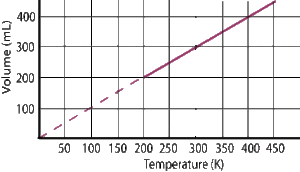
Charles’ law states that the volume of a fixed mass of gas at constant pressure is directly proportional to its temperature on the Kelvin scale.
Mathematical form of Charles’ law
- V ∝ T
- V = kT
- V/T = k (a constant)
- Hence, V1/T1 = V2/T2
Graph of Charles’ law
How does the kinetic theory explain Charles’ law?
The kinetic theory explains Charles’ law by the effect of heat on the speed of the gas molecules.
- When the gas is heated at constant pressure, the molecules gain kinetic energy and move faster.
- They collide with one another and with the container walls more often.
- To keep the pressure constant, the number of wall collisions must stay the same.
- The volume of the gas therefore increases.
How do we solve calculations based on Boyle’s and Charles’ laws?
Write down the known values, choose the correct law, make the subject of the formula, then substitute.
Example 1 (Boyle’s law)
200 cm3 of a gas has a pressure of 510 mmHg. What will be its volume if the pressure is increased to 780 mmHg, assuming no change in temperature?
- Data: V1 = 200 cm3, P1 = 510 mmHg, P2 = 780 mmHg, V2 = ?
- Use Boyle’s law: P1V1 = P2V2
- V2 = P1V1/P2 = (510 mmHg × 200 cm3)/780 mmHg
- V2 = 130.769 = 131 cm3
Example 2 (Charles’ law)
A certain mass of gas occupies 300 cm3 at 35°C. At what temperature will its volume be reduced by half, assuming its pressure remains constant?
- Data: V1 = 300 cm3, T1 = 35°C = (35 + 273) K = 308 K
- V2 = 300/2 = 150 cm3, T2 = ?
- Use Charles’ law: V1/T1 = V2/T2
- T2 = V2T1/V1 = (150 cm3 × 308 K)/300 cm3
- T2 = 154 K
What is the general gas equation?
The general gas equation is a single expression that combines Boyle’s law and Charles’ law for a fixed mass of gas.
- Equation: P1V1/T1 = P2V2/T2
- Use: finding the new volume, pressure or temperature when two or more conditions change.
What is the ideal gas equation?
The ideal gas equation is PV = nRT, which relates pressure, volume, temperature and the amount of an ideal gas.
- Ideal gas: a gas that obeys the gas laws exactly at all temperatures and pressures.
- One mole of gas: PV/T = R, so PV = RT.
- n moles of gas: PV = nRT.
- R: the molar gas constant, 0.082 atm dm3 K-1 mol-1 when pressure is in atm and volume in dm3.
- n: number of moles of the gas.
Example 1 (general gas equation)
What is the volume at s.t.p. of a fixed mass of gas that occupies 700 cm3 at 25°C and 0.84 × 10⁵ N m-2 pressure?
- At s.t.p.: T1 = 273 K, P1 = 1.01 × 10⁵ N m-2, V1 = ?
- Given conditions: T2 = (25 + 273) K = 298 K, P2 = 0.84 × 10⁵ N m-2, V2 = 700 cm3
- Use P1V1/T1 = P2V2/T2
- V1 = P2V2T1/(P1T2)
- V1 = (0.84 × 105 × 700 cm3 × 273 K)/(1.01 × 105 × 298 K)
- V1 = 533.337 = 533 cm3
Example 2 (ideal gas equation)
Calculate the number of moles in a certain mass of gas occupying 6.5 dm3 at 3 atm and 15°C (R = 0.082 atm dm3 K-1 mol-1).
- Data: V = 6.5 dm3, P = 3 atm, T = (15 + 273) K = 288 K, n = ?
- Use PV = nRT, so n = PV/RT
- n = (3 atm × 6.5 dm3)/(0.082 atm dm3 K-1 mol-1 × 288 K)
- n = 0.8257
- Number of moles = 0.83 mole
What is Dalton’s law of partial pressure?
Dalton’s law states that in a mixture of gases that do not react chemically, the total pressure is the sum of the partial pressures of the individual gases.
- Partial pressure: the pressure each constituent gas would exert if it alone filled the container.
- Total pressure: Ptotal = PA + PB + PC + … + Pn
- Partial pressure of gas A: PA = (moles of A / total moles in the mixture) × Ptotal
- Short form: PA = nA/(nA + nB + nC) × Ptotal
What happens when a gas is collected over water?
A gas collected over water is saturated with water vapour, so the total pressure includes the vapour pressure of water.
- Ptotal = Pgas + Pwater vapour
- Pgas = Ptotal – Pwater vapour
Calculation on Dalton’s law
A gaseous mixture contains 64 g of O2 and 70 g of N2 and exerts a total pressure of 1.80 atm. What is the partial pressure of oxygen?
- Molar mass of O2 = 16 × 2 = 32 g mol-1. Molar mass of N2 = 14 × 2 = 28 g mol-1.
- Moles of O2 = 64 g / 32 g mol-1 = 2.0 mole.
- Moles of N2 = 70 g / 28 g mol-1 = 2.5 mole.
- Total moles = 2.0 + 2.5 = 4.5 mole.
- Partial pressure of O2 = (2.0/4.5) × 1.80 atm = 0.80 atm.
What is Avogadro’s law?
Avogadro’s law states that equal volumes of all gases at the same temperature and pressure contain the same number of molecules.
- Molar volume: 1 mole of any gas occupies 22.4 dm3 at s.t.p.
- Example: 1 mole of oxygen and 1 mole of carbon dioxide each occupy 22.4 dm3 at s.t.p.
What is Gay Lussac’s law of combining volumes?
Gay Lussac’s law states that gases react in volumes that are in simple ratios to one another and to the volumes of any gaseous products, at constant temperature and pressure.
Calculation on Gay Lussac’s law
Calculate the volume of oxygen required to burn 500 cm3 of methane completely.
- Equation: CH4(g) + 2O2(g) → CO2(g) + 2H2O(g)
- By the law, 1 volume of CH4 needs 2 volumes of O2.
- So 1 cm3 of CH4 needs 2 cm3 of O2.
- 500 cm3 of CH4 needs X cm3 of O2.
- X = (500 cm3 × 2 cm3)/1 cm3 = 1000 cm3
- Thus, 1000 cm3 of O2 is required.
What is Graham’s law of diffusion?
Graham’s law states that the rate of diffusion of a gas is inversely proportional to the square root of its density at constant temperature and pressure.
- Diffusion: the spreading of a gas from a region of higher concentration to one of lower concentration, as when the smell of cooking spreads through a house.
- In terms of density (d): R ∝ 1/√d, so R = k/√d, where k is a constant.
- Two gases, density: R1/R2 = √d2/√d1
- In terms of relative molecular mass (M): R ∝ 1/√M.
- Two gases, mass: R1/R2 = √M2/√M1
- In terms of time: rate is the reciprocal of time, R = 1/t, so R1/R2 = t2/t1.
- Meaning: the less dense a gas, the faster it diffuses, and the denser a gas, the slower it diffuses.
Calculation on Graham’s law
A given volume of SO2 diffuses in 60 seconds. How long will the same volume of CH4 take to diffuse under the same conditions? (SO2 = 64, CH4 = 16)
- Let SO2 be gas 1 (t1 = 60 s, M1 = 64) and CH4 be gas 2 (M2 = 16).
- Use t2/t1 = √M2/√M1
- t2 = (√16/√64) × 60 s = (4/8) × 60 s
- t2 = 30 seconds
What are the gas laws at a glance?
This table summarises each law, what is kept constant and its formula.
| Law | Relationship | Formula |
|---|---|---|
| Boyle’s law | V is inversely proportional to P (T constant) | P1V1 = P2V2 |
| Charles’ law | V is directly proportional to T in kelvin (P constant) | V1/T1 = V2/T2 |
| General gas equation | Combines Boyle’s and Charles’ laws | P1V1/T1 = P2V2/T2 |
| Ideal gas equation | Relates P, V, T and moles | PV = nRT |
| Dalton’s law | Total pressure is the sum of partial pressures | Ptotal = PA + PB + … |
| Avogadro’s law | Equal volumes hold equal numbers of molecules | 1 mole = 22.4 dm3 at s.t.p. |
| Gay Lussac’s law | Gases combine in simple volume ratios | Ratio of volumes = ratio of moles in the equation |
| Graham’s law | Rate of diffusion is inversely proportional to √M | R1/R2 = √M2/√M1 |
Evaluation
- State Boyle’s law and Charles’ law.
- Using the kinetic theory, explain why the volume of a gas increases when it is heated at constant pressure.
- State Dalton’s law of partial pressure and write the expression for the partial pressure of gas A in a mixture.
- What volume does 1 mole of any gas occupy at s.t.p.?
- Write the relationship between the rates of diffusion of two gases and their relative molecular masses.
Assignment
Answer all four parts.
- A given mass of nitrogen occupies 0.12 dm3 at 60°C and 1.01 × 10⁵ N m-2. Find its pressure at the same temperature if its volume is changed to 0.24 dm3.
- 272 cm3 of CO2 was collected over water at 15°C and 782 mmHg pressure. Calculate the volume of the dry gas at s.t.p. (saturated vapour pressure of water at 15°C is 12 mmHg).
- State Graham’s law of diffusion.
- Under the same conditions of temperature and pressure, hydrogen diffuses 8 times as fast as gas Y. Calculate the relative molecular mass of Y.
This term's Chemistry topics
SS1 Second Term · 4 topics
Get Chemistry as PDF and Word
Every week of SS1 Chemistry, Second Term, formatted and ready to print. Ad-free, and the copy lock comes off.
Get this term Card, bank transfer, USSD or OPay
SS1 Chemistry Lesson Notes for Other Topics

Standard Separation Techniques for Mixtures
Read the full lesson note.

Acids
Read the full lesson note.

Bases And Salts
Read the full lesson note.

Introduction To Chemistry I
Read the full lesson note.

Particulate Nature Of Matter
Read the full lesson note.
Symbols, Formula And Equations
Read the full lesson note.
Symbols, Formula And Equations II
Read the full lesson note.

Chemical Combinations
Read the full lesson note.
Carbon And Its Compounds I
Read the full lesson note.
Carbon And Its Compounds II
Read the full lesson note.
Carbon And It'S Compounds III
Read the full lesson note.
Carbon And It'S Compounds IV - Coal & Fuel Gases
Read the full lesson note.
Carbon And It'S Compounds V - Trioxocarbonate (IV) Acid
Read the full lesson note.
Carbon And It'S Compounds VI - Hydrocarbon
Read the full lesson note.
Carbon And It'S Compounds VII - Octane & Petrol
Read the full lesson note.
Lesson Notes for Other Classes

SS2 Lesson Note
The complete lesson note to guide your studies.

SS3 Lesson Note
The complete lesson note to guide your studies.
