
Carbon and It’S Compounds VI: Hydrocarbon – SS1 Chemistry Lesson Note (Third Term)
Download this term · ₦1,000Lesson note at a glance
- Subject
- Chemistry
- Class
- SS1
- Term
- Third Term
- Topic
- Carbon and It’S Compounds VI: Hydrocarbon
- Order
- Topic 6 of 9 this term
- Reading time
- 7 min
Hydrocarbons are organic compounds made of carbon and hydrogen only. They come from coal, natural gas and petroleum.
Behavioural objectives
- Define hydrocarbons and state their sources.
- Classify hydrocarbons into aliphatic and aromatic hydrocarbons.
- Describe how crude oil and natural gas were formed.
- Explain how crude oil is refined by fractional distillation.
- State the uses of the petroleum fractions.
- Distinguish between cracking and reforming.
What are hydrocarbons?
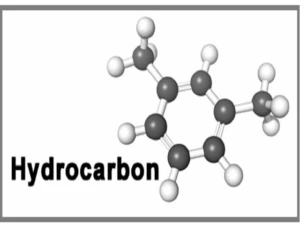
A hydrocarbon is a simple organic compound composed of hydrogen and carbon only.
- Coal: a solid fossil fuel that is a source of hydrocarbons.
- Natural gas: a gas found with petroleum, made mainly of methane.
- Petroleum: crude oil, the chief source of hydrocarbons.
What are the classes of hydrocarbons?
There are two classes of hydrocarbons: aliphatic hydrocarbons and aromatic hydrocarbons.
Aliphatic hydrocarbons
Aliphatic hydrocarbons are hydrocarbons that do not contain a benzene ring. They are grouped into alkanes, alkenes and alkynes.
- Alkanes: contain only single bonds between carbon atoms, e.g. methane, CH4.
- Alkenes: contain a carbon-carbon double bond, e.g. ethene, C2H4.
- Alkynes: contain a carbon-carbon triple bond, e.g. ethyne, C2H2.
- Acyclic hydrocarbons: straight or branched chain hydrocarbons.
- Cyclic hydrocarbons: closed-ring hydrocarbons, such as cycloalkanes, e.g. cyclopropane.
Aromatic hydrocarbons
Aromatic hydrocarbons are cyclic hydrocarbons that contain a ring structure with delocalised (non-localised) electrons.
- Basic structure: the benzene ring.
- Example: benzene, C6H6.
- Shape: all aromatic hydrocarbons are cyclic.
What is petroleum (crude oil)?
Petroleum is a dark, viscous liquid mixture of hydrocarbons found under the ground or sea beds. It is the chief source of aliphatic hydrocarbons.
- Where found: Nigeria, Saudi Arabia, Iran, USA, Iraq and Russia.
- Composition: a mixture of alkanes, alkenes, cycloalkanes and aromatic hydrocarbons.
- Impurities: about 1 to 6%, mainly sulphur compounds with small amounts of other compounds.
- Natural gas: consists mainly of methane.
How were crude oil and natural gas formed?
Crude oil and natural gas formed from the decomposition of huge quantities of dead organic material, mainly of marine origin, buried in sediment.
- Tiny aquatic plants and animals died and their remains settled on the sea beds.
- Mud, silt and other sediments covered the remains over many years.
- The weight of the sediment pressed on the lower layers and changed them to hard sedimentary rocks.
- Bacterial action, heat and pressure changed the remains into crude oil and natural gas.
- The oil and gas moved through the pores of the porous rocks around them.
- Oil and gas are not dense, so they seep upwards until a non-porous rock layer stops them.
- They are trapped under that layer. This forms an oil trap.
How is petroleum refined?
Petroleum refining is the process of converting crude oil into the range of products needed by the market.
- Crude oil: a complex mixture of hydrocarbons that are gases, liquids or solids at normal temperature and pressure.
- Method used: fractional distillation, which separates the mixture into groups of similar compounds.
- Fraction: a group of compounds that boil within a certain range of temperature.
- How fractions differ: in volatility, odour, texture and rate of ignition and burning.
How does fractional distillation of crude oil work?
Fractional distillation separates crude oil into fractions by their boiling points in a fractionating column.
- Crude oil is heated to about 400°C so that the components vaporise.
- The vapour enters the bottom of the steel fractionating column.
- The column is hotter at the bottom (about 400°C) and cooler at the top (about 40°C).
- The vapour rises through perforated plates called trays, each kept within a set temperature range.
- Components with high boiling points condense early and collect on the lower trays.
- Components with low boiling points travel higher before they condense, so they collect on the upper trays.
- The fractions are redistilled to improve purity and treated to make fuels and petrochemicals.
The fractions are gases, petrol, kerosene, diesel oil, lubricating oil and bitumen.
What are the uses of the petroleum fractions?
Each petroleum fraction has its own range of carbon atoms and boiling points, and its own uses.
| Fraction | Carbon atoms per molecule | Boiling range | Main uses |
|---|---|---|---|
| Gases | C1 to C4 | Around 40°C | Fuel, cooking gas, raw materials |
| Petrol | C6 to C10 | 50°C to 200°C | Fuel for vehicles, solvent |
| Kerosene | C10 to C16 | 170°C to 250°C | Lighting, heating, jet fuel |
| Diesel oil | C14 to C18 | 300°C to 360°C | Diesel engine fuel, cracking |
| Lubricating oil and wax | More than C20 | 350°C to 500°C | Lubricants, candles, petroleum jelly |
| Bitumen | Polycyclic hydrocarbons | Residue | Roofing, road surfacing |
1. Gases (natural gas)
- Composition: methane, ethane, propane and butane.
- Methane and ethane: usually burnt as fuel.
- Propane and butane: liquefied and sold in high-pressure cylinders for lighting and heating in homes.
- Raw materials: used to make methanol and butadiene.
- Other products: hydrogen, carbon(IV) sulphide, tetrachloromethane and ethyne.
2. Petrol (motor gasoline)
- Composition: a mixture of volatile hydrocarbons such as hexane, heptane and octane.
- Importance: the most important petroleum product because of the many motor vehicles.
- Fuel: used in aeroplanes and vehicles.
- Solvent: removes paint and grease stains.
- Knocking: straight-chain hydrocarbons cause engine knock and wear, so they are reformed to branched-chain ones.
3. Kerosene (paraffin oil)
- Nature: a fairly volatile liquid.
- Fuel: used for lighting and heating.
- Engines: a major fuel in jet engines and gas turbines.
- Solvent: dissolves grease and paints.
4. Gas oil (diesel oil)
- Engines: fuel for diesel engines of trains, lorries and tractors.
- Raw material: feed for the cracking process.
5. Lubricating oil, grease and wax
- Nature: viscous liquids made of long-chain hydrocarbons.
- Lubricants: reduce friction in moving parts of engines and machines.
- Petroleum jelly: used to make Vaseline.
- Paraffin wax: used for candles, waterproof materials, polish, grease, ointment and cream.
6. Bitumen (asphalt)
- Nature: a complex mixture of insoluble solids made of polycyclic hydrocarbons.
- Roofing: a binding agent for roofing materials.
- Roads: a protective coating for road surfaces.
What is cracking?
Cracking is the process of breaking down large hydrocarbon molecules into two or more smaller hydrocarbon molecules. It is used to increase the quantity of petrol.
Why is cracking needed?
- Small petrol fraction: crude oil gives less petrol than the market demands.
- Surplus: refineries are left with large amounts of less volatile fractions such as kerosene and diesel oil.
- Solution: cracking converts these heavy fractions into petrol.
What are the types of cracking?
There are two types of cracking: thermal cracking and catalytic cracking.
Thermal cracking
- Feed: oil fractions with long carbon chains (C12 to C18), vaporised.
- Conditions: heated for a short time at about 600°C under very high pressure (about 300 atm).
Catalytic cracking
- Feed: long-chain hydrocarbons heated with a silica-alumina or zeolite catalyst.
- Conditions: about 500°C and a lower pressure.
- Effect of catalyst: speeds up the process, so less energy is needed.
- Product: high-grade petrol with a higher octane number.
Why is catalytic cracking more widely used?
- It is more controllable. Conditions can be adjusted to give products of chosen chain lengths, including alkenes for making organic chemicals.
- It gives more petrol, and the petrol is of higher grade than petrol taken directly from distillation.
Examples of cracking reactions
- C16H34 → C8H18 + C8H16
- CH3(CH2)8CH3 → C8H18 + C2H4
What are the benefits of cracking?
- It increases the yield of petrol.
- It gives petrol rich in branched-chain hydrocarbons, with a higher octane number.
- It gives ethene, propene and butene as by-products, used for plastics, synthetic rubber, detergents, ethanol and phenol.
What is reforming?
Reforming is the process of converting long-chain hydrocarbons into shorter, branched-chain molecules to improve their anti-knock properties.
- Catalyst: oxides of silicon and aluminium.
- Conditions: about 600°C and a pressure of 8 to 15 atm.
- Result: a higher octane number and high-grade petrol.
What is the difference between cracking and reforming?
Cracking breaks large molecules into smaller ones. Reforming rearranges molecules into branched isomers.
| Feature | Cracking | Reforming |
|---|---|---|
| Type of change | Breaking down of large molecules | Isomerisation (changing a compound into its isomers) |
| Main aim | Increase the quantity of petrol | Improve the quality of petrol |
| Product | Smaller molecules, including alkenes | Branched-chain molecules |
| Effect on octane number | Raises it, mainly in catalytic cracking | Raises it |
Evaluation
- What is a hydrocarbon? Name the two main classes of hydrocarbons.
- State the sources of hydrocarbons.
- Describe how fractional distillation separates crude oil into fractions.
- List the fractions of petroleum.
- Distinguish between cracking and reforming.
Assignment
- Explain how crude oil and natural gas were formed.
- State two uses each of petrol and kerosene.
- Name the two types of cracking and give two reasons why catalytic cracking is more widely used.
This term's Chemistry topics
SS1 Third Term · 9 topics
- Carbon and its Compounds I
- Carbon and its Compounds II
- Carbon and It’S Compounds III
- Carbon and It’S Compounds IV: Coal & Fuel Gases
- Carbon and It’S Compounds V: Trioxocarbonate (IV) Acid
- Carbon and It’S Compounds VI: Hydrocarbon
- Carbon and It’S Compounds VII: Octane & Petrol
- Chemical Industries
- Chemical Industries II
Get Chemistry as PDF and Word
Every week of SS1 Chemistry, Third Term, formatted and ready to print. Ad-free, and the copy lock comes off.
Get this term Card, bank transfer, USSD or OPay
SS1 Chemistry Lesson Notes for Other Topics
Carbon And Its Compounds I
Read the full lesson note.
Carbon And Its Compounds II
Read the full lesson note.
Carbon And It'S Compounds III
Read the full lesson note.
Carbon And It'S Compounds IV - Coal & Fuel Gases
Read the full lesson note.
Carbon And It'S Compounds V - Trioxocarbonate (IV) Acid
Read the full lesson note.
Carbon And It'S Compounds VII - Octane & Petrol
Read the full lesson note.
Chemical Industries
Read the full lesson note.
Chemical Industries II
Read the full lesson note.

Introduction To Chemistry I
Read the full lesson note.

Particulate Nature Of Matter
Read the full lesson note.
Symbols, Formula And Equations
Read the full lesson note.

Symbols, Formula And Equations II
Read the full lesson note.
Chemical Combinations
Read the full lesson note.

Gas Law
Read the full lesson note.

Standard Separation Techniques for Mixtures
Read the full lesson note.
Lesson Notes for Other Classes

SS2 Lesson Note
The complete lesson note to guide your studies.

SS3 Lesson Note
The complete lesson note to guide your studies.
