
Reproduction – SS1 Biology Lesson Note (First Term)
Download this term · ₦1,000Lesson note at a glance
- Subject
- Biology
- Class
- SS1
- Term
- First Term
- Topic
- Reproduction
- Order
- Topic 11 of 11 this term
- Reading time
- 6 min
Reproduction is the ability of an organism to give rise to new individuals of the same species to ensure continuity of life.
Behavioural objectives
By the end of the lesson, students should be able to:
- define reproduction and name its two types;
- state the differences between asexual and sexual reproduction;
- describe binary fission, budding, spore formation and fragmentation, giving an example of each;
- explain vegetative propagation and name the organs of natural vegetative propagation with examples;
- list the types of artificial vegetative propagation.
What are the types of reproduction?
There are two types of reproduction: asexual reproduction and sexual reproduction.
- Asexual reproduction: one parent produces offspring without gametes.
- Sexual reproduction: two parents produce offspring through the fusion of gametes.
Asexual reproduction
Asexual reproduction is the process whereby an organism produces offspring by itself, so only one parent is present.
- Gametes: none are involved, so there is no fusion of nuclei.
- Cell division: the cells that give rise to the offspring usually divide by mitosis.
- Offspring: they are identical to the parent in all respects and are called clones.
Sexual reproduction
Sexual reproduction is the production of offspring by two parents through the fusion of a male gamete and a female gamete to form a zygote.
- Each parent produces sex cells (gametes) by meiotic cell division.
- The male and female gametes fuse in fertilisation to form a zygote.
- The zygote grows into a new individual.
- The new individual produces more cells by mitosis as it grows.
- Offspring: they show new variation, so they differ from both parents.
What is the difference between asexual and sexual reproduction?
The two types differ in the number of parents, the use of gametes and the variation in the offspring.
| Feature | Asexual reproduction | Sexual reproduction |
|---|---|---|
| Number of parents | One | Two |
| Gametes | Not involved | Involved |
| Fusion of nuclei | Absent | Present, forming a zygote |
| Type of cell division | Mitosis | Meiosis forms the gametes |
| Offspring | Identical to the parent (clones) | Show variation |
| Examples | Bacteria, yeast, Rhizopus, yam | Humans, fish, flowering plants |
What are the forms of asexual reproduction?
There are five forms of asexual reproduction: binary fission, budding, spore formation, fragmentation and vegetative propagation.
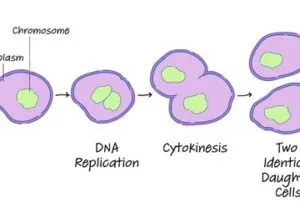
1. Binary fission
Binary fission is the division of a single organism into two complete organisms, each identical to the parent.
- The nucleus of the parent divides into two.
- The cytoplasm divides.
- Two new daughter organisms are formed.
- Where it occurs: it is common among unicellular organisms such as bacteria, many protists (Amoeba, Paramecium) and some algae.
- Importance: it is the simplest form of asexual reproduction.
2. Budding
Budding is the growth of an outgrowth on the parent organism that forms a new individual.
- The parent develops a small outgrowth, called a bud.
- The bud grows and develops into a small organism.
- The bud breaks off from the parent without injuring it.
- The bud lives an independent life.
- Examples: yeast and Hydra.
3. Spore formation
Spore formation is the production of tiny reproductive units called spores, which grow into new organisms.
- Spores: they are produced without the fusion of gametes.
- Dispersal: each spore can develop into a new organism when it lands in suitable conditions.
- Examples: fungi such as Rhizopus and Penicillium.
4. Fragmentation
Fragmentation is the breaking of a part of the parent organism, which then develops into a new independent organism.
- Regeneration: the broken part regrows the missing parts of the body.
- Examples: Spirogyra and some coelenterates.
5. Vegetative propagation
Vegetative propagation is the growth of a new plant from any part of an old plant other than the seed.
- Where it occurs: it occurs in higher plants.
- Methods: there are two, natural and artificial.
Natural vegetative propagation
Natural vegetative propagation is the growth of new plants from vegetative parts such as stems, leaves, roots or buds without human help.
- Food store: the part involved must have a store of food.
- Perennating organ: some of these parts also act as perennating organs, which enable the plant to survive from one growing season to the next.
There are seven organs of natural vegetative propagation:
- Bulbil: axillary buds growing from the veins of leaves, e.g. Bryophyllum and Begonia.
- Runners or stolons: stems that creep horizontally on the soil surface. Buds and adventitious roots develop from the nodes of the parent plant, e.g. sweet potato and grass.
- Rhizomes: underground horizontal stems. They have scaly leaves which cover lateral buds at the nodes. The lateral buds grow into new aerial shoots, e.g. ginger and canna lily.
- Corms: underground stems which grow vertically in the soil. Buds develop from the axils of scale leaves, grow upward and form leaves and flowers, e.g. cocoyam.
- Stem tubers: underground stems which have swollen tips. Axillary buds on the tubers give rise to new aerial shoots, e.g. yam and Irish potato.
- Suckers: short underground horizontal branches, e.g. banana and pineapple.
- Bulb: an underground condensed shoot with a compressed stem and scaly leaves, e.g. onion and garlic.
Artificial vegetative propagation
Artificial vegetative propagation is the use of parts of the parent plant by people to multiply the plant.
There are five types of artificial vegetative propagation:
- Cutting: a piece of stem, leaf or root is cut from the parent and planted to grow roots, e.g. cassava stem and sugar cane.
- Grafting: a shoot (scion) of one plant is joined to the rooted stem (stock) of another so that they grow as one plant, e.g. orange and mango.
- Budding: a bud from one plant is inserted under the bark of another plant, where it grows, e.g. rubber and citrus.
- Layering: a branch is bent down and part of it is buried in the soil while still attached to the parent, until it forms roots.
- Marcotting: a branch is wounded and wrapped in moist soil while still on the tree, until roots form. It is also called air layering.
Practice questions
- Bacteria multiply rapidly by
A. fragmentation
B. binary fission
C. spore formation
D. budding - The type of reproduction that is common to both Hydra and Yeast is
A. conjugation
B. binary fission
C. grafting
D. budding - During asexual reproduction in Paramecium, how many times does the nucleus divide to produce eight nuclei?
A. 1
B. 2
C. 3
D. 4 - Vegetative propagation is described as asexual reproduction because
A. reproductive organs are not involved
B. many new plants are produced
C. there is no exchange of genetic materials
D. new individuals are not formed - Which of these organs of vegetative propagation is not a perennating organ?
A. Rhizome
B. Sucker
C. Bulbil
D. Bulb - List four forms of asexual reproduction, giving one example of an organism that exhibits each.
- List four common natural vegetative parts in plants, giving one example of a plant in each case.
Evaluation
- Define reproduction.
- State two differences between asexual and sexual reproduction.
- Name the form of asexual reproduction that is common in yeast and hydra.
- What is a perennating organ?
- Name the organ of vegetative propagation found in ginger and give one other example.
Assignment
Describe five types of artificial vegetative propagation, giving one example of a plant for each type where the note gives one.
This term's Biology topics
SS1 First Term · 11 topics
Get Biology as PDF and Word
Every week of SS1 Biology, First Term, formatted and ready to print. Ad-free, and the copy lock comes off.
Get this term Card, bank transfer, USSD or OPay
SS1 Biology Lesson Notes for Other Topics
Grassland
Read the full lesson note.
Science Of Living Things
Read the full lesson note.
Recognizing Living Things
Read the full lesson note.
Classification Of Living Things I
Read the full lesson note.
The Cell
Read the full lesson note.
The Cell And It's Environment
Read the full lesson note.
Some Properties And Functions Of The Cell
Read the full lesson note.
Some Properties And Functions Of The Cell II
Read the full lesson note.
Some Properties And Functions Of The Cell III
Read the full lesson note.
Movement
Read the full lesson note.

Tissues And Supporting Systems
Read the full lesson note.

Nutrition In Mammals
Read the full lesson note.

Basic Ecological Concepts
Read the full lesson note.

Basic Ecological System II
Read the full lesson note.
Basic Ecological Systems III
Read the full lesson note.
Lesson Notes for Other Classes

SS2 Lesson Note
The complete lesson note to guide your studies.

SS3 Lesson Note
The complete lesson note to guide your studies.
