
Soil and Soil Formation – SS1 Agricultural Science Lesson Note (Second Term)
Download this term · ₦1,000Lesson note at a glance
- Subject
- Agricultural Science
- Class
- SS1
- Term
- Second Term
- Topic
- Soil and Soil Formation
- Order
- Topic 2 of 7 this term
- Reading time
- 6 min

Soil is the unconsolidated weathered material in the uppermost layer of the earth’s surface on which plants grow.
Behavioural objectives
By the end of the lesson, students should be able to:
- define soil and soil formation;
- describe the types of weathering and the factors that form soil;
- name the three types of soil and state the properties of each;
- list ways of improving sandy soil and clay soil;
- state the components of soil and their percentage composition.
What is soil?
Soil is the unconsolidated weathered material in the uppermost layer of the earth’s surface on which plants grow.
- Support: soil holds plant roots firmly in place.
- Nutrients: soil supplies the mineral elements plants need.
- Water and air: soil stores water and air for roots and soil organisms.
What is soil formation?
Soil formation is the slow process by which rocks are broken down by weathering and mixed with organic matter to make soil.
- Weathering: the breaking down of rocks into smaller particles by weather, water, wind and living things.
- Parent material: the rock or deposit from which a soil forms.
- Humus: dark, decayed plant and animal matter in the soil.
What are the types of weathering?
There are three types of weathering: physical, chemical and biological.
1. Physical weathering
Physical weathering breaks rocks into smaller pieces without changing their chemical make-up.
- Temperature changes: rocks expand in the day heat and contract at night, so they crack.
- Running water: rain and rivers wear rocks down and carry the pieces away.
- Wind: blown sand grains rub against rock surfaces and wear them away.
2. Chemical weathering
Chemical weathering changes the minerals in rocks through reactions with water, air and weak acids.
- Solution: some minerals dissolve in rainwater.
- Oxidation: oxygen reacts with minerals such as iron compounds, giving rocks a reddish colour.
- Hydration: minerals take in water, swell and become soft.
- Carbonation: rainwater with dissolved carbon dioxide forms a weak acid that attacks rocks such as limestone.
3. Biological weathering
Biological weathering is the breaking down of rocks by plants and animals.
- Plant roots: roots grow into cracks and widen them.
- Burrowing animals: termites, earthworms and rodents loosen and mix rock particles.
- Lichens and mosses: they grow on bare rock and release acids that wear it down.
What are the steps in soil formation?
Soil forms in stages, starting from bare rock.
- Rock is exposed on the earth’s surface.
- Physical, chemical and biological weathering break it into small fragments.
- Lichens and mosses grow on the fragments and help to break them down further.
- Dead plants and animals decay to form humus.
- Humus mixes with the rock particles, and bigger plants can now grow.
- Over a long time, the soil builds up in layers called horizons.
What are the factors of soil formation?
The five main factors of soil formation are parent material, climate, topography, living organisms and time.
- Parent material: it decides the mineral content and texture. Sandstone gives sandy soil, while shale gives clay soil.
- Climate: rainfall and temperature control the speed of weathering and decay. Weathering is faster in hot, wet areas.
- Topography: slope affects erosion and drainage. Steep slopes have thin soils, while valleys collect deeper soils.
- Living organisms: plants, animals and microbes add humus and mix the soil.
- Time: mature soils need a very long time to develop.
What is a soil profile?
A soil profile is a vertical section through the soil showing its layers, called horizons.
- A horizon (topsoil): dark layer rich in humus, roots and organisms.
- B horizon (subsoil): lighter layer holding materials washed down from the topsoil.
- C horizon: partly weathered parent material.
- Bedrock: unweathered solid rock at the base.
What are the types of soil?
There are three types of soil: sandy soil, clay soil and loamy soil.
1. Sandy soil
Sandy soil is a soil with a high proportion of sand particles, mainly quartz (SiO2).
Properties of sandy soil
- Texture: coarse-grained and gritty.
- Pore spaces: loose, with large pore spaces.
- Water: absorbs and loses water easily, so water holding capacity is low.
- Stickiness: not sticky when wet and cannot form a cast or ribbon.
- Aeration: well aerated.
- Percolation and capillarity: percolation is high but capillarity is low.
- Temperature: heats up easily by day and cools quickly at night.
- Nutrients: supports leaching, so it is low in plant nutrients.
- Waterlogging and erosion: does not support waterlogging and erosion.
- Colour: grey or brownish.
Methods of improving sandy soil
- Cover crops: they protect the soil and add humus when they decay.
- Compost manure: it adds nutrients and helps the soil hold water.
- Farmyard manure: it adds organic matter and nutrients.
- Mulching: a cover of dry grass or leaves reduces water loss.
- Avoiding bush burning: it protects humus and soil organisms.
Economic importance of sandy soil
- Crop farming: good for cassava, cotton and groundnut.
- Building: used for construction when mixed with cement.
2. Clay soil
Clay soil is a soil with a very high proportion of clay particles.
Properties of clay soil
- Texture: fine, powdery and smooth when dry.
- When wet: sticky and muddy.
- Pore spaces: particles are tightly bound with little air space.
- Water: high water holding capacity.
- Aeration: poorly aerated.
- Percolation and capillarity: percolation is low but capillarity is high.
- Nutrients: does not support leaching, so it keeps plant nutrients.
- Hardness: hard when dry and sticky when wet.
- Moulding: easily forms a ribbon or cast.
- Waterlogging and erosion: supports waterlogging and erosion.
Methods of improving clay soil
- Liming: lime makes the fine particles clump together, which improves drainage and aeration.
- Organic manure: it loosens the soil and adds humus.
- Drainage: channels and ridges remove excess water.
Economic importance of clay soil
- Pottery: used to make pots and other earthenware.
- Building: used to make bricks.
- Crop farming: suits crops such as rice, which need much water.
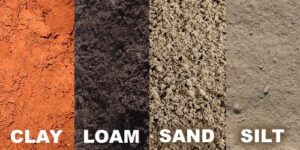
3. Loamy soil
Loamy soil is a mixture of sand, silt and clay particles with a high proportion of organic matter.
Properties of loamy soil
- Moisture and pores: moist and loose, with moderate-sized pore spaces.
- Structure: breaks easily when wet and is friable when dry.
- Texture: non-powdery and non-sticky.
- Cultivation: easy to work.
- Humus: contains plenty of organic matter.
- Waterlogging and erosion: does not support them.
- Air and water: well aerated and able to hold water.
- Colour: dark brown.
- Use: the best soil for growing crops.
What is the difference between sandy, clay and loamy soil?
The three soils differ in particle size, water holding capacity, aeration and nutrient content.
| Property | Sandy soil | Clay soil | Loamy soil |
|---|---|---|---|
| Particle size | Coarse | Very fine | Mixed |
| Pore spaces | Large | Small | Moderate |
| Water holding capacity | Low | High | Good |
| Aeration | Good | Poor | Good |
| Percolation | High | Low | Moderate |
| Capillarity | Low | High | Moderate |
| Leaching | Supports leaching | Does not support leaching | Little leaching |
| Nutrients | Low | Rich | Rich in humus |
| Suitability for crops | Fair | Fair | Best |
What are the components of soil?
Soil is made up of four components: mineral matter, water, air and organic matter with living organisms.
- Mineral matter (45%): particles of sand, silt and clay from weathered rock.
- Soil water (25%): dissolves nutrients so roots can absorb them.
- Soil air (25%): supplies oxygen for roots and soil organisms.
- Organic matter and living organisms (5%): humus, earthworms, termites and microbes that release nutrients.
Evaluation
- Define soil.
- Name the three types of weathering and give one example of each.
- State the five factors of soil formation.
- State two differences between sandy soil and clay soil in percolation and capillarity.
- Which type of soil is best for the cultivation of crops, and why?
Assignment
Write short notes on sandy soil and clay soil. For each, list five properties and the methods of improving it. Then list the four components of soil with their percentages.
This term's Agricultural Science topics
SS1 Second Term · 7 topics
Get Agricultural Science as PDF and Word
Every week of SS1 Agricultural Science, Second Term, formatted and ready to print. Ad-free, and the copy lock comes off.
Get this term Card, bank transfer, USSD or OPay
SS1 Agricultural Science Lesson Notes for Other Topics
Environmental Factors Affecting Agricultural Production
Read the full lesson note.
Soil Formation And Profile Development
Read the full lesson note.
Types, Properties And Composition of Soil
Read the full lesson note.

Simple Farm Tools
Read the full lesson note.

Farm Machinery And Implements
Read the full lesson note.

Apiculture/beekeeping
Read the full lesson note.

Meaning And Importance Of Agriculture
Read the full lesson note.
Problems Of Agricultural Development And Possible Solutions
Read the full lesson note.
Meaning And Differences Between Subsistence And Commercial Agriculture
Read the full lesson note.

Role Of Government In Agricultural Development
Read the full lesson note.
Role Of Non-Governmental Organizations In Agricultural Development
Read the full lesson note.

Agricultural Laws And Reforms
Read the full lesson note.
Meaning And Importance Of Agricultural Ecology
Read the full lesson note.

Land And It's Uses
Read the full lesson note.

Factors Affecting Availability For Agricultural Purposes
Read the full lesson note.
Lesson Notes for Other Classes

SS2 Lesson Note
The complete lesson note to guide your studies.

SS3 Lesson Note
The complete lesson note to guide your studies.
