
Meaning and Differences Between Subsistence and Commercial Agriculture – SS1 Agricultural Science Lesson Note (First Term)
Download this term · ₦1,000Lesson note at a glance
- Subject
- Agricultural Science
- Class
- SS1
- Term
- First Term
- Topic
- Meaning and Differences Between Subsistence and Commercial Agriculture
- Order
- Topic 3 of 10 this term
- Reading time
- 5 min
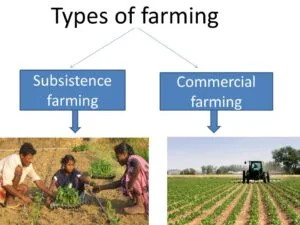
Subsistence agriculture is farming in which a farmer produces crops and animals to feed the farmer’s family only, on a small scale with simple tools. Commercial agriculture is farming in which food and cash crops are produced in large quantities for sale, on a large scale with farm machines.
Behavioural objectives
- Define subsistence agriculture and commercial agriculture.
- State the tools and machines used in each type of agriculture.
- State the main features of each type of agriculture.
- List the differences between subsistence and commercial agriculture.
- Give one advantage and one disadvantage of each type.
What is subsistence agriculture?
Subsistence agriculture is farming in which crops are grown and animals reared to feed the farmer and the family only.
- Other name: peasant farming, because it is done by small-scale farmers with little money (capital).
- Scale: small, on small plots of land.
- Tools: simple or crude tools such as the cutlass, hoe, axe, shovel and rake.
- Example: a family that grows yam, cassava, maize and vegetables on a small farm near the house and keeps a few goats and fowls.
What are the features of subsistence agriculture?
- Small farm size: farms are small, often scattered plots.
- Family labour: the farmer, his wife and children do most of the work.
- Low capital: the farmer has little money to buy inputs.
- Local inputs: farmers often plant seeds saved from the last harvest.
- Mixed cropping: several crops are often grown together on one plot.
- Low yield: output is usually small.
- Little or no surplus: any small excess may be sold or shared.
What are the advantages of subsistence agriculture?
- Food supply: the family is sure of food from its own farm.
- Low cost: little money is needed to start.
- No hired labour: family members do the work, so wages are not paid.
What are the disadvantages of subsistence agriculture?
- Low output: small farms and simple tools give small harvests.
- Low income: very little is sold, so the farmer earns little.
- Hard work: hand tools are slow and tiring.
- Slow growth: the farmer cannot easily expand the farm.
What is commercial agriculture?
Commercial agriculture is farming in which food and cash crops are produced in large quantities for sale.
- Scale: large, on large areas of land.
- Capital: a lot of money is needed, so it is usually done by wealthy farmers, companies or groups.
- Machines: complex farm machines such as tractors, bulldozers, planters and harvesters.
- Food crops: crops grown mainly for eating, such as maize, rice and yam.
- Cash crops: crops grown mainly for sale or export, such as cocoa, rubber and oil palm.
- Example: a large poultry farm selling eggs and birds, or a plantation of oil palm, cocoa or rubber.
What are the features of commercial agriculture?
- Large farm size: farms cover large, often connected, areas.
- Hired labour: skilled workers and machine operators are paid.
- High capital: money is spent on land, machines, buildings and inputs.
- Improved inputs: improved seeds, fertilisers and chemicals to control pests and diseases are used.
- Specialisation: a farm may grow or rear one main product.
- High yield: output is large.
- Record keeping: accounts are kept to know profit or loss.
What are the advantages of commercial agriculture?
- High output: large farms and machines give large harvests.
- High income: products are sold for profit.
- Jobs: workers are employed.
- Raw materials: industries get crops such as cotton and oil palm fruit.
- Food supply: towns and cities get food in large amounts.
What are the disadvantages of commercial agriculture?
- High cost: a lot of money is needed to start and run the farm.
- Risk of loss: a poor harvest or a fall in market price can cause heavy loss.
- Skilled workers needed: machines and modern methods need trained people.
- Need for market and transport: goods must reach buyers in good condition.
What are the differences between subsistence and commercial agriculture?
- Subsistence agriculture: small-scale farming mainly to feed the farmer’s family.
- Commercial agriculture: large-scale farming mainly to sell products for profit.
| Point | Subsistence agriculture | Commercial agriculture |
|---|---|---|
| Purpose | Produced mainly for the family with little or no excess. | Products are principally for sale. |
| Land size | Practised on small areas of land. | Practised on large areas of land. |
| Labour | Family labour is used. | Skilled and mechanised labour is employed. |
| Management | Traditional management is employed. | Modern or scientific management is employed. |
| Scale | Production is on a small scale. | Production is on a large scale. |
| Cost | The cost of production is low. | The cost of production is high. |
| Market | Does not need an organised market for the sale of its products. | Needs a well organised market for the sale of its products. |
| Tools | Simple tools such as cutlass, hoe and axe. | Machines such as tractors, planters and harvesters. |
| Capital | Small amount of capital. | Large amount of capital. |
| Yield | Usually low. | Usually high. |
What are the tools and machines used in each type?
Subsistence farmers use simple hand tools, while commercial farmers use farm machines.
What tools are used in subsistence agriculture?
- Cutlass: used to clear bush and cut weeds.
- Hoe: used to loosen soil, make ridges and weed.
- Axe: used to fell trees and cut wood.
- Shovel: used to dig and move soil.
- Rake: used to gather loose weeds and level the soil.
What machines are used in commercial agriculture?
- Bulldozer: clears land and removes tree stumps.
- Tractor: pulls implements such as the plough and harrow.
- Planter: sows seeds in rows at the right spacing.
- Harvester: cuts and gathers crops such as rice and maize.
Evaluation
- Define subsistence agriculture.
- Define commercial agriculture.
- Why is subsistence agriculture also called peasant farming?
- State four differences between subsistence and commercial agriculture.
- Give two disadvantages of commercial agriculture.
Assignment
Name three tools used in subsistence agriculture and three machines used in commercial agriculture, then compare the two types in terms of land size, labour and cost of production.
This term's Agricultural Science topics
SS1 First Term · 10 topics
- Meaning and Importance of Agriculture
- Problems of Agricultural Development and Possible Solutions
- Meaning and Differences Between Subsistence and Commercial Agriculture
- Role of Government in Agricultural Development
- Role of Non-Governmental Organizations in Agricultural Development
- Agricultural Laws and Reforms
- Meaning and Importance of Agricultural Ecology
- Land and It’s Uses
- Factors Affecting Availability for Agricultural Purposes
- Agro-Allied Industry
Get Agricultural Science as PDF and Word
Every week of SS1 Agricultural Science, First Term, formatted and ready to print. Ad-free, and the copy lock comes off.
Get this term Card, bank transfer, USSD or OPay
SS1 Agricultural Science Lesson Notes for Other Topics

Meaning And Importance Of Agriculture
Read the full lesson note.
Problems Of Agricultural Development And Possible Solutions
Read the full lesson note.
Role Of Government In Agricultural Development
Read the full lesson note.
Role Of Non-Governmental Organizations In Agricultural Development
Read the full lesson note.
Agricultural Laws And Reforms
Read the full lesson note.
Meaning And Importance Of Agricultural Ecology
Read the full lesson note.
Land And It's Uses
Read the full lesson note.
Factors Affecting Availability For Agricultural Purposes
Read the full lesson note.
Agro-Allied Industry
Read the full lesson note.
Environmental Factors Affecting Agricultural Production
Read the full lesson note.
Soil And Soil Formation
Read the full lesson note.
Soil Formation And Profile Development
Read the full lesson note.
Types, Properties And Composition of Soil
Read the full lesson note.
Simple Farm Tools
Read the full lesson note.
Farm Machinery And Implements
Read the full lesson note.
Lesson Notes for Other Classes

SS2 Lesson Note
The complete lesson note to guide your studies.

SS3 Lesson Note
The complete lesson note to guide your studies.
