
Simple Farm Tools – SS1 Agricultural Science Lesson Note (Second Term)
Download this term · ₦1,000Lesson note at a glance
- Subject
- Agricultural Science
- Class
- SS1
- Term
- Second Term
- Topic
- Simple Farm Tools
- Order
- Topic 5 of 7 this term
- Reading time
- 5 min
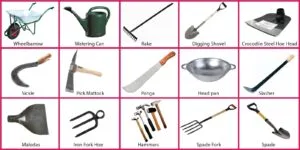
Farm tools are simple handy tools, made by the farmer or craftsmen, that are used to carry out basic farming operations.
- Users: farmers who grow crops and keep animals.
- Purpose: they make farm work easier, faster and less tiring.
- Power source: they are worked by hand, not by an engine.
Behavioural objectives
- Define farm tools.
- List at least ten examples of simple farm tools.
- Group simple farm tools according to their uses.
- Describe the cutlass, spade, shovel, garden fork, secateurs and emasculator and state their uses.
- State ways of maintaining farm tools.
- State safety rules for using farm tools.
What are examples of simple farm tools?
Simple farm tools fall into six groups: cutting, digging, gathering and carrying, watering, workshop and repair, and animal tools.
- Cutting tools: cutlass, axe, sickle, shear, harvesting knife, budding knife, secateurs, pruning saw.
- Digging tools: hoe, spade, shovel, garden fork, hand fork, hand trowel, mattock, digger, crowbar.
- Gathering and carrying tools: rake, manure drag, head pan, wheelbarrow.
- Watering tool: watering can.
- Workshop and repair tools: hammer, mallet, chisel, spanner, plier, screwdriver, bolt and nut.
- Animal tool: emasculator.
What are the uses of simple farm tools?
Each simple farm tool is made for a particular job, as the table shows.
| Tool | Main use |
|---|---|
| Cutlass | Clearing land, weeding, cutting small trunks and pegs. |
| Hoe | Weeding, loosening soil, making ridges and heaps. |
| Axe | Felling trees and splitting wood. |
| Sickle | Cutting grass and harvesting crops such as grains. |
| Shear | Trimming hedges and cutting grass. |
| Harvesting knife | Cutting fruits, vegetables and other crops at harvest. |
| Budding knife | Budding and grafting plants. |
| Pruning saw | Cutting thick branches. |
| Hand trowel | Digging small holes and transplanting seedlings. |
| Hand fork | Loosening soil around plants and removing weeds. |
| Mattock | Breaking hard ground and digging. |
| Crowbar | Digging deep holes and levering out stones. |
| Rake | Levelling seedbeds and gathering weeds, stones and leaves. |
| Manure drag | Pulling and loading manure. |
| Head pan | Carrying soil, manure and farm produce. |
| Wheelbarrow | Moving soil, manure and produce over short distances. |
| Watering can | Watering seedlings and nursery beds. |
| Hammer and mallet | Driving in nails and pegs. The mallet has a wooden head. |
| Spanner, plier and screwdriver | Tightening, holding and loosening nuts, wires and screws when repairing tools. |
| Chisel | Cutting and shaping wood. |
What are the descriptions and functions of some selected tools?
The cutlass, spade, shovel, garden fork, secateurs and emasculator are the tools you must be able to describe.
What is a cutlass?
A cutlass is a cutting tool with a metal blade and a wooden handle.
- Description: a metal blade with a slightly curved end and a wooden handle.
- Uses: land clearing, planting, weeding, and cutting small trunks and pegs.
What are a spade and a shovel?
A spade and a shovel are digging tools with a long handle and a metal blade.
- Description: a long wooden handle ending with a flat metal blade. The handle has a D-shaped grip for proper handling.
- Shovel: its blade is curved to give a scoop shape.
- Uses: digging soil, spreading manure, and turning and mixing soil.
| Feature | Spade | Shovel |
|---|---|---|
| Blade shape | Flat | Curved, like a scoop |
| Handle | Long, with a D-shaped grip | Long, with a D-shaped grip |
| Uses | Digging and turning soil | Digging, scooping and spreading manure |
What is a garden fork?
A garden fork is a digging tool with strong metal prongs and a wooden handle.
- Description: four strong metal prongs that taper to a point.
- Size: the prongs are about 20 cm long. The wooden handle is about 70 to 80 cm long.
- Uses: digging, loosening and breaking the soil.
What are secateurs?
Secateurs are a scissors-like cutting tool used for pruning.
- Description: a scissors-like tool with two short metal blades, one concave and one convex.
- Parts: the blades are joined at a pivot by a bolt and nut. Two short handles have a spring between them.
- Uses: preparing stem cuttings and pruning small branches of hard-wooded plants.
What is an emasculator?
An emasculator is a tool used to castrate male farm animals.
- Description: a pair of powerful pincers with plastic or metal handles.
- Use: castrating male animals by crushing the spermatic cord.
How do we maintain farm tools?
Farm tools are maintained by cleaning, sharpening, oiling, painting and storing them properly.
- Store safely: keep tools with wooden parts in a store free of termites.
- Oil or grease: apply to metal parts to prevent rust.
- Paint: paint the metal parts of tools that will be stored for a long time.
- Sharpen: sharpen blunt edges regularly for better results.
- Clean: wash and dry tools after each use.
- Clear nozzles: keep nozzles of watering cans and sprayers free from blockage.
What are the safety rules for using farm tools?
Safety rules protect the user from cuts, blows and other injuries.
- Use the right tool: choose the tool made for the job.
- Check handles: do not use a tool with a loose or cracked handle.
- Carry with care: point sharp blades downwards and away from other people.
- Keep sharp: a sharp tool cuts cleanly and is less likely to slip.
- Do not leave tools lying about: a person may step on a rake or fork left on the ground.
- Wear protection: use boots and gloves where possible.
Evaluation
- What are farm tools?
- List ten examples of simple farm tools.
- Describe the garden fork and state its uses.
- What is an emasculator used for?
- State four ways of maintaining farm tools.
Assignment
- Describe the secateurs and state its use. Then explain why the metal parts of farm tools are oiled, greased or painted.
This term's Agricultural Science topics
SS1 Second Term · 7 topics
Get Agricultural Science as PDF and Word
Every week of SS1 Agricultural Science, Second Term, formatted and ready to print. Ad-free, and the copy lock comes off.
Get this term Card, bank transfer, USSD or OPay
SS1 Agricultural Science Lesson Notes for Other Topics

Environmental Factors Affecting Agricultural Production
Read the full lesson note.

Soil And Soil Formation
Read the full lesson note.

Soil Formation And Profile Development
Read the full lesson note.
Types, Properties And Composition of Soil
Read the full lesson note.

Farm Machinery And Implements
Read the full lesson note.

Apiculture/beekeeping
Read the full lesson note.

Meaning And Importance Of Agriculture
Read the full lesson note.

Problems Of Agricultural Development And Possible Solutions
Read the full lesson note.
Meaning And Differences Between Subsistence And Commercial Agriculture
Read the full lesson note.

Role Of Government In Agricultural Development
Read the full lesson note.
Role Of Non-Governmental Organizations In Agricultural Development
Read the full lesson note.

Agricultural Laws And Reforms
Read the full lesson note.

Meaning And Importance Of Agricultural Ecology
Read the full lesson note.

Land And It's Uses
Read the full lesson note.

Factors Affecting Availability For Agricultural Purposes
Read the full lesson note.
Lesson Notes for Other Classes

SS2 Lesson Note
The complete lesson note to guide your studies.

SS3 Lesson Note
The complete lesson note to guide your studies.
