
The Basic Swimming Strokes & Facilities for Swimming – JSS3 Physical Education Lesson Note (Second Term)
Download this term · ₦1,000Lesson note at a glance
- Subject
- Physical Education
- Class
- JSS3
- Term
- Second Term
- Topic
- The Basic Swimming Strokes & Facilities for Swimming
- Order
- Topic 2 of 4 this term
- Reading time
- 5 min
Swimming is the skill of moving through water using the arms and legs, and it has four basic strokes: front crawl (freestyle), breaststroke, backstroke and butterfly.
Behavioural objectives
By the end of the lesson, students should be able to:
- Name the four basic swimming strokes.
- Describe the arm and leg movements of each stroke.
- State the main rules of each stroke.
- List the equipment and facilities used in swimming.
- Mention some of the competitions and events in swimming.
What are the basic swimming strokes?
There are four basic swimming strokes: front crawl (freestyle), breaststroke, backstroke and butterfly.
- Front crawl or freestyle: the fastest and most efficient stroke.
- Breaststroke: arms and legs move together in matching patterns.
- Backstroke: the only one of the four swum on the back.
- Butterfly stroke: the second-fastest stroke, which needs strength and stamina.
| Stroke | Body position | Arm movement | Leg movement |
|---|---|---|---|
| Front crawl | Face down | Arms pull one after the other | Flutter kick |
| Breaststroke | Face down | Both arms move together | Frog (whip) kick |
| Backstroke | On the back | Arms pull one after the other | Flutter kick |
| Butterfly | Face down | Both arms move together over the water | Dolphin kick |
What is front crawl (freestyle)?
Front crawl is a stroke swum face down, with the arms pulling in turn and the legs kicking up and down.
- Arms: one arm pulls under the water while the other swings forward over the water.
- Legs: the legs kick up and down in a steady flutter kick.
- Breathing: the swimmer turns the head to the side to breathe.
- Freestyle rule: the swimmer may use any stroke, and the rules for breaststroke, butterfly and backstroke do not apply.
- Turning and finishing: the swimmer must touch the end of the pool with any part of the body.
- Speed: the crawling style is the fastest and most efficient swimming stroke.
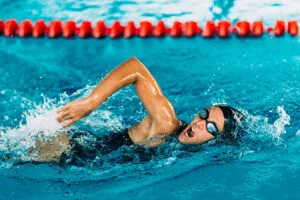
Female freestyle swimming competitor in action
What is breaststroke?
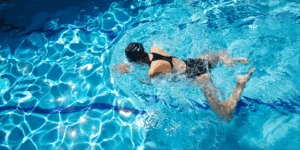
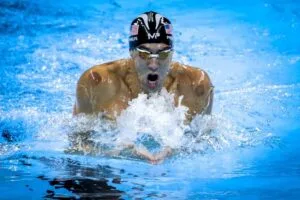
Breaststroke is a stroke swum face down, with both arms and both legs moving together in matching patterns.
- Arms: both hands move forward and backward together, in the same way on both sides.
- Shoulders: they stay level with the water surface.
- Legs: the legs are drawn up with a distinct bend at the knees (flexion).
- Kick: the legs then kick outward and backward, then come together.
- Turning and finishing: the swimmer touches the wall with both hands at the same time.
What is backstroke?
Backstroke is a stroke swum on the back, with the arms pulling in turn and the legs using flutter kicks.
- Arms: the arms stroke alternately, with recovery out of the water.
- Legs: the legs use flutter kicks.
- Body position: the face stays up, so the swimmer breathes freely.
- Start: the race begins with the swimmer in the water, not on a block.
- Disqualification: a swimmer is disqualified for changing from the back before the hands touch the finishing line.

Young woman swimmer in blue pool water
What is the butterfly stroke?
The butterfly stroke is a stroke swum face down, with both arms lifted together over the water and both feet kicking together.
- Arms: the swimmer lifts both arms at the same time above and over the head.
- Legs: both feet kick together in an upward and downward motion (dolphin kick).
- Other name: the butterfly stroke is also called the dolphin stroke.
- Effort: it needs more stamina and strength than the other strokes.
- Speed: it is the second-fastest stroke in swimming.
- Turning and finishing: the swimmer touches the wall with both hands at the same time.
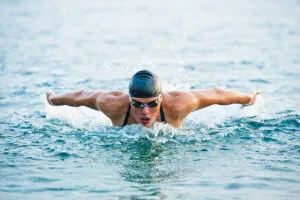
Young female swimmer practising the butterfly stroke in the sea

What equipment and facilities are used for swimming?
Swimming equipment and facilities are the clothing, training aids and places that make swimming possible and safe.
What do swimmers wear?
- Swimming trunks: close-fitting wear that allows free movement in the water.
- Swimming cap: keeps hair out of the face and the water.
- Swimming goggles: protect the eyes and help the swimmer see under water.
- Earplugs: keep water out of the ears.
- Slippers: worn on the wet poolside to prevent slipping.
What training aids are used?
- Kickboard: held in the hands to practise leg kicks.
- Swimming float: helps a learner stay on top of the water.
- Swimming flippers: worn on the feet to build leg strength and speed in training.
What facilities and safety items are needed?
- Swimming pool: the water area where swimming takes place.
- Starting blocks: raised platforms at the pool end from which racers dive.
- Towers: raised seats from which the lifeguard watches swimmers.
- Whistles: used by coaches and lifeguards to give signals and warnings.
What are the competitions and events in swimming?
Swimming events are races swum over set distances in one stroke or in a mix of strokes.
What are the individual events?
| Event | Distances |
|---|---|
| Freestyle | 100 m, 200 m, 400 m |
| Breaststroke | 100 m, 200 m |
| Butterfly | 100 m, 200 m |
| Backstroke | 100 m, 200 m |
| Individual medley | 100 m, 200 m, 400 m |
What are the relay events?
- Freestyle relay: a team of four swimmers, such as 4 × 100 m or 4 × 200 m.
- Medley relay: a team of four swimmers, each swimming a different stroke over 4 × 100 m.
- Who takes part: relay events are swum by both men and women.
What is a medley?
- Individual medley: one swimmer swims butterfly, backstroke, breaststroke, then freestyle.
- Medley relay: the four swimmers swim backstroke, breaststroke, butterfly, then freestyle.
Evaluation
- Name the four basic swimming strokes.
- Which stroke is the fastest, and which is the second-fastest?
- Describe the leg movement in breaststroke.
- When is a backstroke swimmer disqualified?
- List five items of equipment used in swimming.
Assignment
- Draw a table with the four strokes. For each stroke, write the arm movement, the leg movement and one rule.
This term's Physical Education topics
JSS3 Second Term · 4 topics
- Career Guidance in Physical
- The Basic Swimming Strokes & Facilities for Swimming
- Gymnastics
- Officials of Gymnastics and Their Duties
Get Physical Education as PDF and Word
Every week of JSS3 Physical Education, Second Term, formatted and ready to print. Ad-free, and the copy lock comes off.
Get this term Card, bank transfer, USSD or OPay
JSS3 Physical Education Lesson Notes for Other Topics

Career Guidance in Physical
Read the full lesson note.

Gymnastics
Read the full lesson note.

Officials Of Gymnastics And Their Duties
Read the full lesson note.
Lesson Notes for Other Classes

JSS1 Lesson Note
The complete lesson note to guide your studies.

JSS2 Lesson Note
The complete lesson note to guide your studies.
