
Balancing the Ledger Account – JSS3 Business Studies Lesson Note (Second Term)
Download this term · ₦1,000Lesson note at a glance
- Subject
- Business Studies
- Class
- JSS3
- Term
- Second Term
- Topic
- Balancing the Ledger Account
- Order
- Topic 5 of 8 this term
- Reading time
- 6 min
Balancing a ledger account is the process of finding the difference between the debit total and the credit total of an account at the end of a period.
A ledger is the principal book in which transactions are recorded in summarised form. It is the final destination of all transactions in the subsidiary books.
Behavioural objectives
By the end of the lesson, students should be able to:
- define a ledger and state its format;
- classify ledger accounts into personal, real and nominal accounts;
- name the types of ledger and say what each records;
- list the items found on each side of a ledger;
- state the rule for recording cash received and cash paid, and define a contra entry;
- balance a ledger account and bring down the balance.
What is the format of a ledger?
A ledger account has two sides: the left side is the debit (Dr) side and the right side is the credit (Cr) side.
- Debit side: the left side of the account.
- Credit side: the right side of the account.
- Columns: each side has the same columns, shown below.
| Date | Particular | Folio | Amount | Date | Particular | Folio | Amount |
|---|---|---|---|---|---|---|---|
| ₦ | ₦ |
How are ledger accounts classified?
Ledger accounts are classified as personal accounts and impersonal accounts, and impersonal accounts are further split into real and nominal accounts.
Personal account
- Personal account: records the accounts of persons, such as debtors, creditors, capital and bank account.
Impersonal account
- Impersonal account: records non-person accounts. It includes real and nominal accounts.
- Real account: records the assets of the business, such as building, motor vehicle, furniture and stock.
- Nominal account: records the income and expenses of the business, such as insurance, transport and salary.
What are the types of ledger?
There are four types of ledger: the sales ledger, the purchases ledger, the general ledger and the private ledger.
- Sales ledger (debtors ledger): records the accounts of debtors. Debtors are people who owe money to the business.
- Purchases ledger (creditors ledger): records the accounts of creditors. Creditors are people to whom money is owed, or from whom goods have been bought.
- General ledger: records the real and nominal accounts.
- Private ledger: records confidential accounts.
What items are found in a ledger?
The same items are found on both the debit side and the credit side of a ledger.
- Date: the date and month the transaction took place.
- Particulars: the details of the transaction that took place.
- Folio: the page number of the subsidiary book the entry was transferred from.
- Amount: the amount of money received or spent.
- Discount: the column where discount allowed or discount received is recorded.
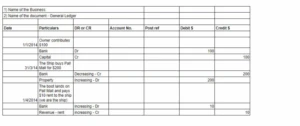
How are cash received and cash paid recorded?
The rule: debit cash received in the cash book and credit cash paid in the cash book.
Every transaction is entered twice, once on the debit side of one account and once on the credit side of another. This is double entry.
| Type of account | Debit side | Credit side |
|---|---|---|
| Asset (cash, equipment, stock) | Increase | Decrease |
| Expense (wages, transport) | Increase | Decrease |
| Capital and liability | Decrease | Increase |
| Income (commission received) | Decrease | Increase |
Examples of double entry
- Owner starts business with ₦10,000 cash: debit Cash account, credit Capital account.
- Office equipment bought for cash: debit Office equipment account, credit Cash account.
- Wages paid in cash: debit Wages account, credit Cash account.
- Commission received in cash: debit Cash account, credit Commission received account.
What is a contra entry?
A contra entry is a transaction whose debit and credit entries are both made in the same book, usually the cash book.
- Example: cash paid into the bank is debited in the bank column and credited in the cash column.
- Example: cash withdrawn from the bank is debited in the cash column and credited in the bank column.
How do you balance a ledger account?
To balance a ledger account, add both sides, find the difference, and carry that difference down to the opposite side.
- Add up the debit side and the credit side separately.
- Subtract the smaller total from the larger total to get the balance.
- Write the balance on the smaller side as Balance c/d (carried down).
- Add both sides again. The two totals must now be equal.
- Write the equal totals on the same line, one on each side.
- Bring the balance down below the totals on the opposite side as Balance b/d (brought down).
What is a debit balance and a credit balance?
- Debit balance: the debit total is larger. Assets, expenses and debtors usually have debit balances.
- Credit balance: the credit total is larger. Capital, liabilities, income and creditors usually have credit balances.
Worked example: Cash account
- Cash received: capital ₦20,000 and sales ₦5,000.
- Cash paid: purchases ₦8,000 and rent ₦2,000.
- Debit total is ₦25,000. Credit total is ₦10,000. Difference is ₦15,000.
| Debit side | Credit side | ||
|---|---|---|---|
| Particulars | ₦ | Particulars | ₦ |
| Capital | 20,000 | Purchases | 8,000 |
| Sales | 5,000 | Rent | 2,000 |
| Balance c/d | 15,000 | ||
| Total | 25,000 | Total | 25,000 |
| Balance b/d | 15,000 | ||
- Reading the result: the business has ₦15,000 cash in hand at the start of the next period.
What happens after the ledger is balanced?
After balancing, the accountant checks the accounts with a trial balance and then prepares the financial statements.
- Record in the journal: each transaction is first entered as a debit and a credit.
- Post to the ledger: entries are moved to the ledger accounts. A subsidiary ledger gives detail, for example one account for each customer.
- Balance the accounts: find the balance on every account.
- Prepare a trial balance: list all balances and check that total debits equal total credits.
- Make adjustments: record items that are not yet entered in the books.
- Prepare financial statements: the balances are used to prepare the final accounts.
- Close income and expense accounts: their balances are transferred so the accounts start the next period at zero.
Common adjustments
- Accrued expense: a cost incurred but not yet paid, such as wages owed.
- Prepaid expense: a cost paid in advance, such as an insurance premium.
- Accrued revenue: income earned but not yet received, such as interest.
- Depreciation: the cost of a machine spread as an expense over its useful life.
- Bad debts: money owed by debtors that is not expected to be collected.
Evaluation
- What is a ledger?
- Define contra entry.
- Name the three classes of ledger accounts.
- What do the abbreviations c/d and b/d mean?
- A cash account has a debit total of ₦30,000 and a credit total of ₦18,000. State the balance and the side on which Balance c/d is written.
Assignment
Post the following transactions into ledger accounts and balance each account.
- 5/1/09 (a) Mr. Ojo started a business with ₦10,000
- 10/1/09 (b) Bought office equipment by cash ₦3,000
- 15/1/09 (c) Bought goods in cash ₦3,000
- 20/1/09 (d) Paid wages in cash ₦12,000
- 28/1/09 (e) Received commission by cash ₦4,000
This term's Business Studies topics
JSS3 Second Term · 8 topics
Get Business Studies as PDF and Word
Every week of JSS3 Business Studies, Second Term, formatted and ready to print. Ad-free, and the copy lock comes off.
Get this term Card, bank transfer, USSD or OPay
JSS3 Business Studies Lesson Notes for Other Topics

Consumer Protection And Awareness
Read the full lesson note.

How To Make Complaints
Read the full lesson note.

Personal Finance
Read the full lesson note.

Trial Balance
Read the full lesson note.

Trading Profit And Loss Account
Read the full lesson note.

Balance Sheet
Read the full lesson note.

Bookkeeping Ethics
Read the full lesson note.
Office Procedures
Read the full lesson note.
Office Equipment
Read the full lesson note.
Transportation
Read the full lesson note.
Communication
Read the full lesson note.

Setting Clear Business Goals - SWOT Analysis
Read the full lesson note.
Simple Single Business Plan
Read the full lesson note.

Advertising
Read the full lesson note.

Keyboarding
Read the full lesson note.
Lesson Notes for Other Classes

JSS1 Lesson Note
The complete lesson note to guide your studies.

JSS2 Lesson Note
The complete lesson note to guide your studies.
