
Balance Sheet – JSS3 Business Studies Lesson Note (Second Term)
Download this term · ₦1,000Lesson note at a glance
- Subject
- Business Studies
- Class
- JSS3
- Term
- Second Term
- Topic
- Balance Sheet
- Order
- Topic 7 of 8 this term
- Reading time
- 5 min
A balance sheet is a statement showing the assets and liabilities of a business as of a given date.
Behavioural objectives
By the end of the lesson, students should be able to:
- define a balance sheet;
- explain why a balance sheet is not an account;
- classify assets as fixed assets or current assets and give examples of each;
- explain capital and current liabilities and give examples of current liabilities;
- arrange items in a simple balance sheet and check that it balances.
What is a balance sheet?
A balance sheet is a statement that lists what a business owns and what it owes on a stated date.
- Date: it is drawn up “as at” a day, for example “as at 31st December”.
- Assets: it shows what the business owns.
- Liabilities and capital: it shows what the business owes to outsiders and to the owner.
- Balance: total assets must equal capital plus liabilities.
Why is a balance sheet not an account?
A balance sheet is not an account because it is only a statement and is not part of the double-entry system.
- No sides: it has no debit side and no credit side.
- No balances: it has no balance brought down and no balance carried down.
- Purpose: it only reports the position of the business on one date.
How are assets classified in a balance sheet?
Assets are the valuable resources of a business, and they are classified as fixed assets or current assets.
Fixed assets
Fixed assets are the more permanent assets, kept for a long time to run the business and not for resale.
- Land and buildings: the shop, factory or office and the land it stands on.
- Plant and machinery: machines used for production, such as a grinding machine.
- Office equipment: items such as computers, printers and typewriters.
- Furniture and fittings: tables, chairs, shelves and cabinets.
- Motor vehicles: delivery vans and lorries.
Current assets
Current assets are the less permanent assets, which change often and are turned into cash within a short time.
- Stock: goods bought for resale and not yet sold.
- Trade debtors: customers who bought goods on credit and have not yet paid.
- Bills receivable: written promises by debtors to pay the business on a later date.
- Cash at bank: money in the business bank account.
- Cash in hand: money kept in the till or cash box.
Difference between fixed assets and current assets
| Point | Fixed assets | Current assets |
|---|---|---|
| Life | Used for many years | Used or changed within a short time |
| Purpose | Used to run the business | Used in day-to-day trading |
| Resale | Not bought for resale | Stock is bought for resale |
| Examples | Motor van, machinery, furniture | Stock, debtors, cash in hand |
What are capital and liabilities?
Capital and liabilities are the two ways a business has been financed: by the owner and by outsiders.
Capital
Capital is the amount the business owes the owner, which is the money or assets the owner put in to start the business.
- Increases: capital rises when the owner adds more money or when the business makes a profit.
- Decreases: capital falls when the business makes a loss or the owner takes out drawings.
- Drawings: money or goods the owner takes from the business for personal use.
Long-term liabilities
Long-term liabilities are debts owed to outsiders that are repayable after more than one year.
- Example: a bank loan to be repaid over several years.
Current liabilities
Current liabilities are the debts a business owes outsiders which should be repaid within one year.
- Trade creditors: suppliers from whom the business bought goods on credit.
- Bank overdraft: money taken from the bank above what the account holds.
- Accrued expenses: expenses used but not yet paid, such as unpaid electricity bills.
- Bills payable: written promises by the business to pay a supplier on a later date.
What is the format of a balance sheet?
A balance sheet lists assets in one section and capital and liabilities in another, and both totals must be equal.
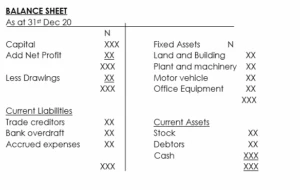
Steps for preparing a balance sheet
- Write the business name and the heading “Balance sheet as at” followed by the date.
- List the fixed assets and find their total.
- List the current assets and find their total.
- Add both totals to get the total assets.
- Write the capital, then any long-term liabilities, then the current liabilities.
- Add them to get total capital and liabilities.
- Check that the two totals are equal.
Worked example (illustrative figures)
| Item | Amount (₦) | Total (₦) |
|---|---|---|
| Fixed assets | ||
| Land and buildings | 500,000 | |
| Motor van | 300,000 | 800,000 |
| Current assets | ||
| Stock | 100,000 | |
| Trade debtors | 50,000 | |
| Cash at bank | 80,000 | |
| Cash in hand | 20,000 | 250,000 |
| Total assets | 1,050,000 | |
| Capital | 900,000 | |
| Current liabilities | ||
| Trade creditors | 100,000 | |
| Accrued expenses | 50,000 | 150,000 |
| Total capital and liabilities | 1,050,000 |
- Check: total assets (₦1,050,000) equal capital plus current liabilities (₦900,000 + ₦150,000).
Evaluation
- Define a balance sheet.
- List four examples of fixed assets.
- State three current liabilities.
- List three current assets.
- Give two reasons why a balance sheet is not an account.
General revision questions
- What is a trial balance?
- Where do you prove the accuracy of double-entry bookkeeping?
Assignment
Reading assignment
Read Business Studies for JSS 3 by O. A. Lawal, pages 86 to 90.
Weekend assignment
- Balance sheet is ____
- Assets and liabilities
- Income and expenditure of a business
- The principal book of account where all entries in the subsidiary books are posted to
- A statement showing the business’s assets and liabilities as of a given date.
- An example of a fixed asset is
- Debtors
- Creditors
- Motor van
- Bills receivable.
- ______ is a current asset
- Stock
- Furniture
- Drawings
- Bills payable.
- ______ is a current liability
- Stock
- Machinery
- Drawings
- Bills payable.
- The amount a business owes the owner(s) is called
- Assets
- Liabilities
- Capital
- Drawings.
Theory
- Write short notes on:
- (a) Assets
- (b) Liabilities
- (c) Drawings.
- Prepare a balance sheet format with at least ten items.
This term's Business Studies topics
JSS3 Second Term · 8 topics
Get Business Studies as PDF and Word
Every week of JSS3 Business Studies, Second Term, formatted and ready to print. Ad-free, and the copy lock comes off.
Get this term Card, bank transfer, USSD or OPay
JSS3 Business Studies Lesson Notes for Other Topics

Consumer Protection And Awareness
Read the full lesson note.
How To Make Complaints
Read the full lesson note.

Personal Finance
Read the full lesson note.
Trial Balance
Read the full lesson note.
Balancing The Ledger Account
Read the full lesson note.
Trading Profit And Loss Account
Read the full lesson note.
Bookkeeping Ethics
Read the full lesson note.
Office Procedures
Read the full lesson note.
Office Equipment
Read the full lesson note.
Transportation
Read the full lesson note.
Communication
Read the full lesson note.
Setting Clear Business Goals - SWOT Analysis
Read the full lesson note.
Simple Single Business Plan
Read the full lesson note.

Advertising
Read the full lesson note.

Keyboarding
Read the full lesson note.
Lesson Notes for Other Classes

JSS1 Lesson Note
The complete lesson note to guide your studies.

JSS2 Lesson Note
The complete lesson note to guide your studies.
