
Three Dimensional Shapes – JSS1 Mathematics Lesson Note (Third Term)
Download Lesson NoteLesson note at a glance
- Subject
- Mathematics
- Class
- JSS1
- Term
- Third Term
- Topic
- Three Dimensional Shapes
- Order
- Topic 4 of 7 this term
- Reading time
- 3 min
Solid figures are often called 3-dimensional shapes. A solid figure is simply anything that occupies space and has a definite shape.
Behavioural objectives
By the end of the lesson, students should be able to:
- define a face, an edge and a vertex of a solid;
- state the properties of common solid figures;
- explain what the surface area of a figure is;
- find the surface area of a triangular prism, a pyramid, a cylinder, a cube, a cuboid and a sphere.
What are faces, edges and vertices?
- Face: A face is the surface of a solid which is enclosed by edges.
- Edge: An edge of a solid is a line where two faces meet. An edge may be straight or curved.
- Vertex: A vertex of a solid is a point or corner where three or more edges meet.
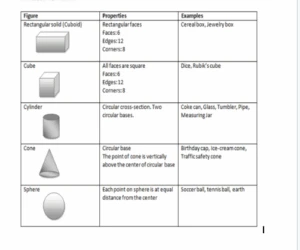
What are the types of solid and their properties?


Do these
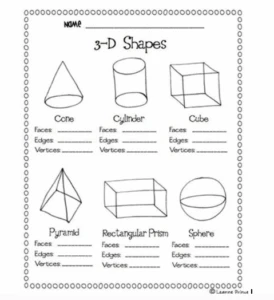
How do you find the surface area of a solid?
The surface area of a figure is the total area of all the sides of the figure.
Triangular prism (right-angled triangle)

To find the surface area of the prism above, follow the steps below.
- Divide the figure into smaller shapes.
- Find the area of each smaller shape.
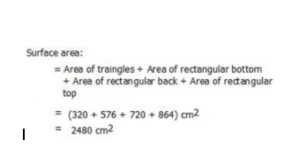
- Add the areas of the smaller shapes.
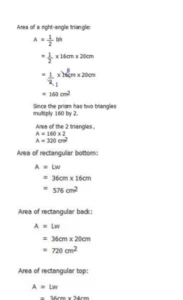
A right-angled triangular prism can be divided into five smaller shapes: two right-angled triangles and three rectangles.
Example
Find the surface area of the prism below.

Pyramid
A pyramid is an object that has a straight-sided base (for example a square, rectangular or triangular base) and triangular sides that meet at the top, called the apex.
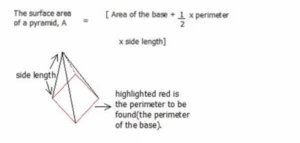
Example

Cylinder
To find the surface area of a cylinder, follow the steps below.
- Divide the figure into smaller shapes.
- Find the area of each smaller shape.
- Add the areas of the smaller shapes.
A cylinder can be divided into three parts: two circles and a curved surface.
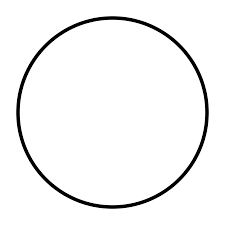
The area of a circle is A = πr².
Since there are two circles in a cylinder, multiply the above formula by 2, that is:
The area of the circles is A = 2πr²
The curved surface area, C.S.A. = 2πrh
The surface area of a cylinder, A = Area of the circles + C.S.A.
A = 2πr² + 2πrh
A = 2πr(r + h)
Cube
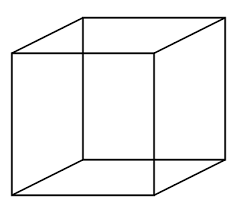
A cube has 6 sides (faces) of the same surface area. Each side (face) of the cube is a square. Recall that the area of a square is A = L².
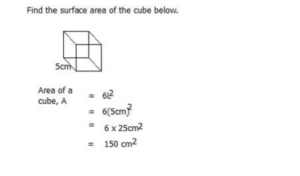
The surface area of a cube is A = 6L², where L is the length of a side of the cube (all the sides of a cube are the same length).
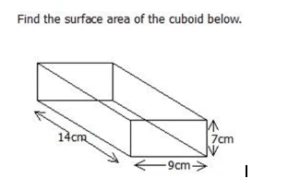
Cuboid
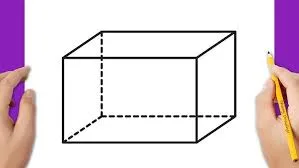
The surface area of a cuboid is A = 2Lw + 2Lh + 2wh, where:
- L is the length of the cuboid;
- w is the width of the cuboid;
- h is the height of the cuboid.
Example

Sphere
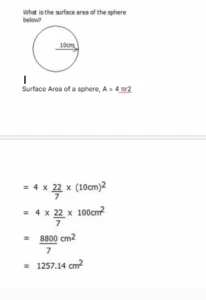
A sphere is a three-dimensional object (such as a ball or the earth) with every point on the surface at the same distance from the centre.
The surface area of a sphere is A = 4πr², where r is the radius of the sphere.
Evaluation
- Define a face, an edge and a vertex.
- Into which five smaller shapes can a right-angled triangular prism be divided?
- Write the formula for the curved surface area of a cylinder and the formula for its total surface area.
- Write the formula for the surface area of a cube and the formula for the surface area of a cuboid.
- What is a sphere? Write the formula for its surface area.
Assignment
- A cube has sides of length 4 cm. Find its surface area.
- State what L, w and h stand for in the formula A = 2Lw + 2Lh + 2wh.
This term's Mathematics topics
JSS1 Third Term · 7 topics
Third Term Mathematics Lesson Notes for Other Topics
Numbers 1-250
Read the full lesson note.
Data Collection
Read the full lesson note.
Numbers 241-250
Read the full lesson note.
Numbers 231-240
Read the full lesson note.
Two-Dimensional Shapes
Read the full lesson note.

Numbers 221-230
Read the full lesson note.
Weight
Read the full lesson note.
Numbers 211-220
Read the full lesson note.
Length Measurement
Read the full lesson note.
Numbers 201-210
Read the full lesson note.
Money (Continued)
Read the full lesson note.
Numbers 190-200
Read the full lesson note.
Nigerian Currencies
Read the full lesson note.
Numbers 181-190
Read the full lesson note.
Subtraction
Read the full lesson note.
Lesson Notes for Other Classes

Basic 1 Lesson Note
The complete lesson note to guide your studies.

Basic 2 Lesson Note
The complete lesson note to guide your studies.

Basic 3 Lesson Note
The complete lesson note to guide your studies.

Basic 4 Lesson Note
The complete lesson note to guide your studies.

Basic 5 Lesson Note
The complete lesson note to guide your studies.

Basic 6 Lesson Note
The complete lesson note to guide your studies.

