
Identification & Properties of Angles – JSS1 Mathematics Lesson Note (Third Term)
Download Lesson NoteLesson note at a glance
- Subject
- Mathematics
- Class
- JSS1
- Term
- Third Term
- Topic
- Identification & Properties of Angles
- Order
- Topic 6 of 7 this term
- Reading time
- 2 min
Angles are measured in degrees (°) and are named by their size: acute (between 0° and 90°), right (90°), obtuse (between 90° and 180°), straight (180°) and reflex (between 180° and 360°). Angles can also be named by how they relate to other angles, such as adjacent, complementary, supplementary, vertically opposite and corresponding angles.
Behavioural objectives
By the end of the lesson, students should be able to:
- identify straight, right, obtuse, acute and reflex angles by their measures;
- state the meaning of adjacent, complementary and supplementary angles;
- state the properties of vertically opposite angles and corresponding angles;
- identify obtuse-angled and acute-angled triangles.
What are the types of angles by size?
The symbol ϴ, called theta, is used to represent the size of an angle.
Straight angles
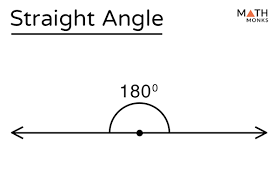
Angles that measure exactly 180° (degrees) are straight. Therefore, straight angles are straight lines. For straight angles, ϴ = 180°.
Right angles

Angles which measure exactly 90° are right angles, that is, ϴ = 90°.
Obtuse angles

Obtuse angles are those which are greater than 90° but less than 180°, that is, 90° < ϴ < 180°.
Acute angles

Acute angles are angles that are greater than 0° but less than 90°, that is, 0° < ϴ < 90°.
Reflex angles

Reflex angles are angles that are greater than 180° but less than 360°, that is, 180° < ϴ < 360°.
What are the pairs of angles and their properties?
Adjacent angles
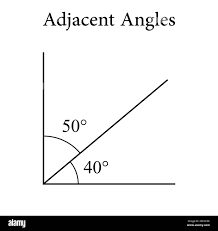
Two angles that share the same vertex (the centre point, usually labelled O) and have a common side (line) are called adjacent angles.
Complementary angles
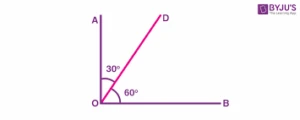
Complementary angles are two angles that, when summed, equal 90°.
Note: <A and <B are ‘angle A’ and ‘angle B’ respectively.
Supplementary angles

Supplementary angles are two angles that, when summed, equal 180°.
Vertically opposite angles
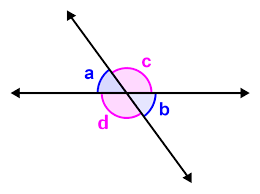
Vertically opposite angles are the angles opposite to each other when two straight lines intersect. Their defining property is that vertically opposite angles are equal in magnitude.
Corresponding angles
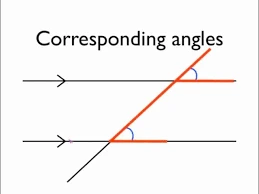
When two parallel lines are crossed by a line called the transversal, the angles formed in corresponding positions are called corresponding angles. Corresponding angles are equal in magnitude.
What are obtuse-angled and acute-angled triangles?
Obtuse-angled triangles
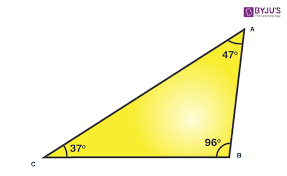
Obtuse-angled triangles are triangles with one of their angles greater than 90° but less than 180° (that is, an obtuse angle).
Acute-angled triangles
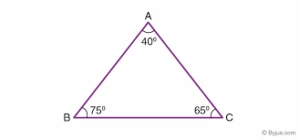
Acute-angled triangles are triangles in which all the angles are acute. That is, all angles are greater than 0° but less than 90°.
Evaluation
- What is the measure of a straight angle?
- State the range of values of ϴ for an obtuse angle and for a reflex angle.
- What is the sum of two complementary angles? What is the sum of two supplementary angles?
- What is the property of vertically opposite angles?
- Describe an obtuse-angled triangle.
Assignment
- Define adjacent angles.
- Two angles are complementary. One of them is 40°. Find the other angle.
- Two angles are supplementary. One of them is 120°. Find the other angle.
- When are the angles formed by a transversal called corresponding angles, and how do their sizes compare?
This term's Mathematics topics
JSS1 Third Term · 7 topics
Third Term Mathematics Lesson Notes for Other Topics
Numbers 1-250
Read the full lesson note.
Data Collection
Read the full lesson note.
Numbers 241-250
Read the full lesson note.
Numbers 231-240
Read the full lesson note.
Two-Dimensional Shapes
Read the full lesson note.

Numbers 221-230
Read the full lesson note.
Weight
Read the full lesson note.
Numbers 211-220
Read the full lesson note.
Length Measurement
Read the full lesson note.
Numbers 201-210
Read the full lesson note.
Money (Continued)
Read the full lesson note.
Numbers 190-200
Read the full lesson note.
Nigerian Currencies
Read the full lesson note.
Numbers 181-190
Read the full lesson note.
Subtraction
Read the full lesson note.
Lesson Notes for Other Classes

Basic 1 Lesson Note
The complete lesson note to guide your studies.

Basic 2 Lesson Note
The complete lesson note to guide your studies.

Basic 3 Lesson Note
The complete lesson note to guide your studies.

Basic 4 Lesson Note
The complete lesson note to guide your studies.

Basic 5 Lesson Note
The complete lesson note to guide your studies.

Basic 6 Lesson Note
The complete lesson note to guide your studies.

