
Israel in Bondage and the Birth of Moses Basic 6 Christian Religious Studies (CRS) Lesson Note
Download Lesson NoteTopic: Israel in Bondage and the Birth of Moses
MEANING OF BONDAGE
Bondage means slavery; being forced to work for others without freedom or pay. It means being under someone’s control and not being free.
ISRAELITES IN BONDAGE (Exodus 1)
How It Started:
Background:
- Jacob (Israel) and his family moved to Egypt during famine
- Joseph was second-in-command in Egypt
- The family numbered 70 people
- They settled in Goshen (best part of Egypt)
- They were treated well because of Joseph
After Joseph Died (Exodus 1:6-8):
- Joseph and all his generation died
- Years passed (about 400 years)
- A new Pharaoh (king) came who didn’t know Joseph
- The Israelites had multiplied greatly
- They became very numerous and strong
Pharaoh’s Fear (Exodus 1:9-10):
- He said: “Look, the Israelites are more numerous than we are”
- He feared they might join Egypt’s enemies
- He feared they might take over Egypt
- He decided to deal shrewdly with them
The Oppression Begins (Exodus 1:11-14):
- Hard Labor
- Set taskmasters over them
- Made them build cities: Pithom and Rameses
- Forced them to make bricks
- Made them work in the fields
- Made their lives bitter with hard bondage
- Cruel Treatment
- Worked them rigorously
- No rest or mercy
- Beat them if they were slow
- Treated them harshly
- The Evil Plan (Exodus 1:15-16)
- Pharaoh called the Hebrew midwives
- Their names: Shiphrah and Puah
- He ordered: “When you help Hebrew women give birth”
- “If it’s a boy, kill him”
- “If it’s a girl, let her live”
- This was genocide (killing a whole race)
- The Midwives’ Courage (Exodus 1:17-21)
- The midwives feared God
- They refused to kill the babies
- They let the boys live
- When Pharaoh asked, they said Hebrew women gave birth quickly
- God blessed the midwives for their obedience
- Pharaoh’s Final Order (Exodus 1:22)
- He commanded ALL his people
- “Every Hebrew boy born must be thrown into the Nile River”
- “But let every girl live”
- This was pure evil
THE SUFFERING OF ISRAELITES IN BONDAGE
Physical Suffering:
- Forced to work without pay
- Beaten by taskmasters
- No rest or breaks
- Made bricks in hot sun
- Bodies aching and exhausted
- Poor living conditions
- Insufficient food
Emotional Suffering:
- Watched their baby boys killed
- Lived in constant fear
- No hope for freedom
- Treated as less than human
- Families torn apart
- Lost dignity and respect
- Cried out in desperation
Spiritual Impact:
- Wondered if God had forgotten them
- Lost hope in God’s promises
- Some forgot about God
- Others cried out to God (Exodus 2:23-25)
God’s Response (Exodus 2:24-25):
- God heard their groaning
- God remembered His covenant with Abraham, Isaac, and Jacob
- God looked upon the Israelites
- God acknowledged them
- God was preparing to deliver them
THE BIRTH OF MOSES (Exodus 2:1-10)
Moses’ Parents:
- Father: Amram (from tribe of Levi)
- Mother: Jochebed (also from Levi)
- Sister: Miriam
- Brother: Aaron
The Birth (Exodus 2:1-2):
- A Levite man married a Levite woman
- She became pregnant and gave birth to a son
- When she saw he was beautiful/special
- She decided to hide him
- This was risky – Pharaoh’s order was to kill all boys
Hiding the Baby (Exodus 2:2-3):
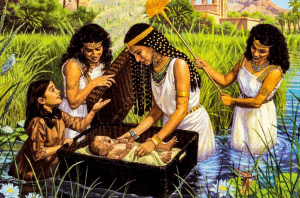
- She hid him for THREE MONTHS
- As he grew, it became harder to hide him
- He would cry louder
- Discovery meant death
The Basket Plan (Exodus 2:3):
- Jochebed got a basket (papyrus basket)
- She covered it with tar and pitch (to make it waterproof)
- She put baby Moses in it
- She placed it among the reeds by the Nile River
- It was like a little boat
- She trusted God to protect him
Miriam Watches (Exodus 2:4):
- Moses’ sister Miriam stood at a distance
- She watched to see what would happen
- She was ready to help if needed
- This showed family love and care
Pharaoh’s Daughter Finds Moses (Exodus 2:5-6):
- Pharaoh’s daughter came to bathe in the Nile
- Her attendants walked along the riverbank
- She saw the basket among the reeds
- She sent her slave girl to get it
- She opened it and saw the baby
- The baby was crying
- She felt sorry for him
- She said: “This is one of the Hebrew babies”
Miriam’s Quick Thinking (Exodus 2:7-8):
- Miriam approached Pharaoh’s daughter
- She said: “Shall I go and get a Hebrew woman to nurse the baby?”
- Pharaoh’s daughter said: “Yes, go”
- Miriam ran and got Moses’ own mother!
- God worked it perfectly
Moses Returns to His Mother (Exodus 2:9):
- Pharaoh’s daughter said to Jochebed:
- “Take this baby and nurse him for me”
- “I will pay you”
- Moses’ own mother got PAID to care for her own son!
- This was God’s miracle and provision
- Jochebed could now keep Moses safely
Moses Adopted (Exodus 2:10):
- When the child grew older
- Jochebed brought him to Pharaoh’s daughter
- She adopted him as her son
- She named him MOSES
- Moses means “I drew him out of the water”
- Moses grew up in Pharaoh’s palace
- He received the best education in Egypt
- But he knew he was Hebrew
God’s Plan:
- Moses was saved from death
- Raised by his own mother first (learned Hebrew ways)
- Educated in Egypt’s palace (learned Egyptian ways)
- Prepared to lead Israel out of Egypt
- God was in control all along
Lessons:
- God protects His people
- God has plans even in difficult times
- Faith requires action (Jochebed had to act)
- God can use anyone (even Pharaoh’s daughter)
- God turns evil into good
Homework: Describe how God protected baby Moses.
First Term Christian Religious Studies (CRS) Lesson Notes for Other Topics

Deliverance From Egypt
Explore lesson notes covering all topics.

Moses And The Bronze Serpent
Explore lesson notes covering all topics.
Moses And The Bronze Serpent II
Explore lesson notes covering all topics.

Entry Into The Promised Land
Explore lesson notes covering all topics.

Paul's Early Life
Explore lesson notes covering all topics.

Paul's Conversion
Explore lesson notes covering all topics.

The Call of Moses
Explore lesson notes covering all topics.

Crossing of the Red Sea
Explore lesson notes covering all topics.

Entry into the Promised Land
Explore lesson notes covering all topics.

The Twelve Stones
Explore lesson notes covering all topics.

The Twelve Tribes of Isreal
Explore lesson notes covering all topics.

Moderation in Christian Living
Explore lesson notes covering all topics.

Types of Prayer
Explore lesson notes covering all topics.

Jesus' Teachings On Prayer (Contd.)
Explore lesson notes covering all topics.
Types of Prayer (Contd.)
Explore lesson notes covering all topics.
Lesson Notes for Other Classes

Basic 1 Lesson Note
The complete lesson note to guide your studies.

Basic 2 Lesson Note
The complete lesson note to guide your studies.

Basic 3 Lesson Note
The complete lesson note to guide your studies.

Basic 4 Lesson Note
The complete lesson note to guide your studies.
Basic 5 Lesson Note
The complete lesson note to guide your studies.

JSS1 Lesson Note
The complete lesson note to guide your studies.