
Intonation Patterns, Stress, and Rhyme – Basic 5 English Lesson Note (First Term)
Download this term · ₦1,000Lesson note at a glance
- Subject
- English Studies
- Class
- Basic 5
- Term
- First Term
- Topic
- Intonation Patterns, Stress, and Rhyme
- Order
- Topic 1 of 45 this term
- Reading time
- 5 min
Behavioural Objectives
- Recognise and pronounce short vowel sounds in words.
- Identify and use intonation patterns, stress, and rhyme in speech.
- Improve diction through practice with sound sounds and speech patterns. Keywords: Vowel sounds, Intonation, Stress, Rhyme, Diction.
Prior knowledge:
- Sing a song with a fun rhyme or song that includes short vowel sounds. Ask students to listen carefully and identify the sounds. Entry Behaviour
- Students should already have basic knowledge of vowels and are able to pronounce simple words.
Learning Resources and Materials:
- Flashcards with short vowel sounds
- Audio recordings of intonation patterns
- Rhyming books and games Building Background Connections & Prior Knowledge
- Review the vowels i.e A E I O U and their sounds. Review the short vowel sounds to ensure students already know.
Embedded Core Skills:
- Listening skills
- Pronunciation
- Oral expression
Learning Materials:
- Flashcards
- Audio recordings
- Rhyming books, Reference Books:
- Lagos State Scheme of Work.
- English Grammar Textbooks for Primary 5 Instructional Materials
- Whiteboard and markers
- Audio player.
- Flashcards with sounds and sound examples Content:
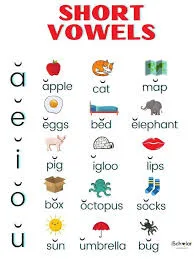
- Definition and Meaning of Short Vowel Sounds:
- Short sounds are sounds made by the sounds a, e, i, o, u in words, where the sound would be short. b. Examples: • e.g “bed” • e.g “sad” • e.g “sit” • e.g “dog”
- Intonation Patterns:
- Intonation is the rise and falling pitch while speaking.
- Examples include: • Rising intonation for questions (e.g. “Did you come?”) • Falling intonation for statements (e.g., “I am here.”)
- Stress in Speech:
- Stress is the emphasis placed on certain syllables or words. b. Example: Emphasizing “total” or “I can do it.”
- Rhyme:
- Rhyming words end with the same sound. b. Examples: “bad” and “dad”, “pat” and “hat.”
Evaluation:
- In words with a short vowel sound of “a” is a) gate b) able c) atone
- The vowel sound in “fee” is: a) long “e” b) long “a” c) long “i”
- Which of those words rhymes with “car” a) cry b) tie c) bar
- An example of using themselves is a word in a) “Who is here?” b) “Did you know?” c) “It’s coming” d) “The air”
- The stress in “special” is on: a) “cial” b) “tion” c) “nation” d) “spec”
- Which word has a short vowel sound “I” a) bite b) die c) sit d) rice
- The pattern of rising and falling pitch is called a) stress b) intonation c) rhyme d) diction
- Rhyming words like “fat” and “bat” have: a) different ending sounds b) same beginning sounds c) same ending sounds d) different middle sounds
- Short sound would in “gate” is: a) long “i” b) long “e” c) long “a” d) short “i”
- Stress is the word “displeased” is on: a) “plea” b) “dis” c) “sed”
- The vowel sound in “fell” is: a) long “i” b) long “e” c) long “u”
- Which of these words does not rhyme with “dog” a) Frog b) Log c) Cat d) Hog
- Intonation in that long mark so specially a) falling b) raising c) Play d) Grown
- A word that has a short vowel sound “o” is: a) Joke b) Tale c) Plan d) Code
- The rhyme pattern in “banana ” is: a) BA-NA-NA b) NA-NA-NA c) BAN-ANA-NA
Class Activity Discussion:
- What are short vowel sounds?
- Which vowel sounds are vowels and short vowel sounds in terms.
- Can you give examples of words with other vowel sounds? • Examples include “fan,” “feed,” “fee,” “foot,” “fog.”
- What is Intonation? • Intonation is how your word rises and falls what you speak.
- Why is stress important in speech? • Stress helps to emphasise important parts of words or sentences
- What is rhyme? • Rhyme is when words have the same ending sound.
- How do intonation patterns affect meaning? • They can show if a sentence is a question or a statement.
- Give an example of a rhyming word pair. • “cat” and “hat.”
- How do you identify stress in words? • Stress is indicated by emphasis on certain syllables
- What are some examples short vowel sounds? • Examples: /æ/ as in “cat”, /e/ as in “bed”.
- How does stress change the meaning of a sentence? • It highlights frequency of the sentences.
- Why is it important to practice short sounds? • It helps with correct pronunciation
- What is the difference between short and long vowels? • Short vowels are quick, while long vowels are extended.
- How can you practice intonation patterns? • By listening and repeating sentences with different intonation.
- What role does rhyme play in poems and songs? • Rhyme creates rhythm and makes it easier to remember
- How can stress help in understanding speech? • It makes important parts of speech stand out.
Visualization
Step 1: The teacher reviews the previous topic on vowel sounds and basic speech patterns.
Step 2: The teacher introduces the new topic, focusing on short vowel sounds, intonation patterns, stress, and rhymes.
Step 3: The teacher allows pupils to contribute examples and practices using new concepts, correcting them as needed.
Teacher’s Activities:
- Demonstrate pronunciation of short vowel sounds • Play audio examples of intonation patterns. • Create class in rhyming games and related class work
Teacher’s Activities:
- Identify and pronounce short vowel sounds • Practice using intonation in sentences • Participate in rhyming and various activities.
Assessment:
- Observe students’ pronunciation and intonation. • Review answers to evaluation questions. • Provide feedback and additional practice as needed.
Evaluation Questions:
- Define short vowel sounds and give real meanings.
- How does intonation affect the meaning of a sentence?
- Explain the purpose of stress in speech with an example.
- What is the role of rhyme in poetry?
- How can you practice improving vowel sounds?
- Describe an example of a rising intonation pattern.
- What are the different types of vowel sounds in English?
- How does stress help in understanding spoken English?
- Give examples of rhyming words.
- Why is correct pronunciation important?
This term's English Studies topics
Basic 5 First Term · 45 topics
- Intonation Patterns, Stress, and Rhyme
- Review of Tenses
- Reading to Comprehend Main Ideas
- Words Associated with Family Relations
- Essay Writing on “How I Spent My Last Holiday”
- Vowel Sounds /Æ/ and /A:/
- Making Sentences with Modal Auxiliaries
- Letter Writing: Guided Informal Letter
- Dictation for the Week
- The Consonant Sounds /W/, /N/, and /Ng/
- Active Voice and Passive Voice
Get English Studies as PDF and Word
Every week of Basic 5 English Studies, First Term, formatted and ready to print. Ad-free, and the copy lock comes off.
Get this term Card, bank transfer, USSD or OPay
Basic 5 English Studies Lesson Notes for Other Topics
Review Of Tenses
Read the full lesson note.
Reading To Comprehend Main Ideas
Read the full lesson note.

Words Associated With Family Relations
Read the full lesson note.
Essay Writing On "How I Spent My Last Holiday”
Read the full lesson note.

Vowel Sounds /Æ/ And /A:/
Read the full lesson note.

Making Sentences With Modal Auxiliaries
Read the full lesson note.
Letter Writing: Guided Informal Letter
Read the full lesson note.
Dictation For The Week
Read the full lesson note.
The Consonant Sounds /W/, /N/, And /Ng/
Read the full lesson note.
Active Voice And Passive Voice
Read the full lesson note.
Consumer Rights
Read the full lesson note.
Dictation For The Week
Read the full lesson note.

Speech Work :Sound /U/ And /U:/
Read the full lesson note.

Using Adjective In Speaking And Writing
Read the full lesson note.
Paragraph From Children'S Novel
Read the full lesson note.
Lesson Notes for Other Classes
Basic 1 Lesson Note
The complete lesson note to guide your studies.

Basic 2 Lesson Note
The complete lesson note to guide your studies.

Basic 3 Lesson Note
The complete lesson note to guide your studies.

Basic 4 Lesson Note
The complete lesson note to guide your studies.
Basic 6 Lesson Note
The complete lesson note to guide your studies.
