
Active Voice and Passive Voice – Basic 5 English Lesson Note (First Term)
Download this term · ₦1,000Lesson note at a glance
- Subject
- English Studies
- Class
- Basic 5
- Term
- First Term
- Topic
- Active Voice and Passive Voice
- Order
- Topic 11 of 45 this term
- Reading time
- 10 min
Behavioural Objectives: By the end of the lesson, pupils should be able to:
- Identify active and passive sentences.
- Change active sentences to passive sentences.
- Change passive sentences to active sentences.
- Analyze the features of active and passive voice.
Keywords: Active voice, Passive voice, Subject, Object, Verb, Sentence structure Set Induction: The teacher will start the lesson by asking the pupils to describe who performs actions in various sentences, emphasizing who does the action and who receives it.
Entry Behaviour: Pupils are familiar with sentence structure and basic grammar, including subjects, verbs, and objects.
Learning Resources and Materials:
- Flashcards with examples of active and passive sentences.
- Worksheets for practicing sentence conversion.
- Sentence strips for group activities.
Building Background/Connection to Prior Knowledge: The teacher will connect the lesson to the previous topic on modal auxiliaries, discussing how the subject’s position in a sentence affects meaning and focus.
Embedded Core Skills:
- Critical thinking in identifying sentence structure.
- Communication skills in constructing clear sentences.
Learning Materials:
- Flashcards
- Worksheets
- Sentence strips
Reference Books:
- Lagos State Scheme of Work
- Primary English Textbook
Instructional Materials:
- Whiteboard and markers
- Flashcards with examples of active and passive voice
- Worksheets with sentence exercises
Content
- Definition of Active Voice and Passive Voice:
Active Voice: The subject of the sentence performs the action.
Example: “The cat (subject) chased (verb) the mouse (object).”
Passive Voice: The subject of the sentence receives the action.
Example: “The mouse (subject) was chased (verb) by the cat (object).”
- Identifying Active and Passive Sentences:
Active Voice: The focus is on who is doing the action.
Example: “She (subject) writes (verb) a letter (object).”
Passive Voice: A letter (subject) is written (verb) by her (object).”
- Changing Active Sentences to Passive Sentences:
- Steps:
- Identify the subject, verb, and object in the active sentence.
- Move the object to the subject position.
- Use the correct form of “to-be” + past participle of the main verb.
- Add the original subject at the end with “by” (if necessary).
- Example: Active: “The teacher (subject) teaches (verb) the students (object).”
- Passive: “The students (subject) are taught (verb) by the teacher (object).”
- Changing Passive Sentences to Active Sentences:
- Steps:
- Identify the subject, verb, and object in the passive sentence.
- Move the subject to the object position.
- Use the correct tense of the main verb.
- Example: Passive: “The cake (subject) was eaten (verb) by John (object).”
- Active: “John (subject) ate (verb) the cake (object).”
- Analyzing Features of Active and Passive Voice:
- Active Voice:
- Direct and clear.
- Emphasizes the doer of the action.
- Passive Voice:
- Less direct, often used when the doer is unknown or unimportant.
- Emphasizes the action or the receiver of the action.
What is an active voice?
In grammar, the active voice is a type of sentence construction where the subject performs the action described by the verb. This is in contrast to the passive voice, where the subject receives the action described by the verb. Here are some examples of sentences in the active voice:
- Jane ate an apple. In this sentence, “Jane” is the subject who performs the action “ate” on “an apple.”
- The cat chased the mouse. Here, “the cat” is the subject who performs the action “chased” on “the mouse.”
- The company launched a new product. In this sentence, “the company” is the subject who performs the action “launched” on “a new product.”
- John wrote a book. Here, “John” is the subject who wrote on “a book.”
- The teacher graded the exams. In this sentence, “the teacher” is the subject who performs the action “graded” on “the exams.”
These sentences are in the active voice because the subjects are actively performing the actions described by the verbs.
What is a passive voice?
In grammar, the passive voice is a type of sentence construction where the subject is acted upon by the verb, rather than performing the action themselves. Here are some examples of sentences in the passive voice:
- The apple was eaten by Jane. In this sentence, “the apple” is the subject that receives the action “was eaten” by “Jane”. The subject is passive because it is not actively performing the action.
- The mouse was chased by the cat. Here, “the mouse” is the subject that receives the action “was chased” by “the cat.”
- A new product was launched by the company. In this sentence, “a new product” is the subject that receives the action “was launched” by “the company.”
- The book was written by John. Here, “the book” is the subject that receives the action “was written” by “John.”
- The exams were graded by the teacher. In this sentence, “the exams” is the subject that receives the action “were graded” by “the teacher.”
These sentences are in the passive voice because the subjects are not actively performing the actions described by the verbs. Instead, they are receiving the actions. The passive voice is often used to shift focus away from the subject and onto the action or object being acted upon.
Voice is a term that is used to explain whether the performer of an action comes before the action (verb) or whether it comes after the verb in a sentence. When the performer comes before the verb (action) we say the verb is in the active form e.g.
Dairo killed a snake. (Active voice) $$S \qquad V \qquad O$$
However, when the two nouns in the sentence above are swapped, we say the sentence is in the passive form.
A snake was killed by Dairo (Passive voice) $$S \qquad V \qquad O$$
Active Voice Passive Voice Bola prepared dinner. Dinner was prepared by Bola. Shade wrote a letter. A letter was written by Shade. Daddy is building a house. A house is being built by Daddy. Sola makes beads. Beads are made by Sola. John will kick the ball. The ball will be kicked by John.
Rules
- There is an exchange of positions between the subject and the object.
- The tense of both voices (active and passive) must be the same.
- There is an introduction of “by” in the passive voice
- A form of the verb ‘be’ is also introduced in the passive voice.
How to change from active voice to passive voice To change a sentence from active voice to passive voice, you generally need to follow these steps:
- Identify the subject, verb, and object in the active sentence.
- Move the object to the beginning of the sentence.
- Add a form of “be” (such as “is,” “was,” “are,” or “were”) and the past participle of the verb to create the passive voice.
Here are some examples to help illustrate this process. Active Voice: The teacher graded the exams. Passive Voice: The exams were graded by the teacher.
In this example, “the exams” is the object of the active sentence. To make it the subject of the passive sentence, we move it to the beginning. Then, we add “were” (a form of “be”) and “graded” (the past participle of “grade”) to create the passive voice.
Active Voice: She is writing a novel. Passive Voice: A novel is being written by her.
In this example, “a novel” is the object of the active sentence. To make it the subject of the passive sentence, we move it to the beginning. Then, we add “is being” (a form of “be” plus the present participle of “write”) and “written” (the past participle of “write”) to create the passive voice.
Active Voice: They built a house on the hill. Passive voice: A house was built on the hill by them.
In this example, “a house” is the object of the active sentence. To make it the subject of the passive sentence, we move it to the beginning. Then, we add “was” (a form of “be”) and “built” (the past participle of “build”) to create the passive voice. We also add “by them” to indicate who performed the action.
Here are ten examples of sentences that are in active voice and passive voice, tabulated for comparison.
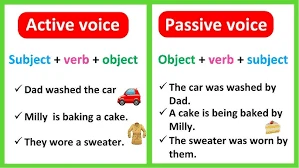
| Active Voice | Passive Voice |
| The cat chased the mouse. | The mouse was chased by the cat. |
| John is washing the dishes. | The dishes are being washed by John. |
| She wrote the report last night. | The report was written by her last night. |
| The dog ate the bone. | The bone was eaten by the dog. |
| They are discussing the project. | The project is being discussed by them. |
| The children played soccer in the park. | Soccer was played by the children in the park. |
| He fixed the car this morning. | The car was fixed by him this morning. |
| The company will launch a new product next month. | A new product will be launched by the company next month. |
| The teacher graded the exams. | The exams were graded by the teacher. |
| The storm destroyed the house. | The house was destroyed by the storm. |
In each pair of sentences, the first sentence is in active voice, while the second sentence is in passive voice.
EVALUATION
- In which type of sentence is the subject performing the action? a) Passive voice b) Active voice c) both
- What is the purpose of using passive voice in writing? a) To emphasize the subject b) To make the sentence more concise c) To shift focus onto the action or object being acted upon
- Which of the following is NOT a form of “be” used to form passive voice? a) Is b) Have c) Was d) Are
- Which of the following is a sentence in the passive voice? a) The cat chased the mouse. b) The mouse was chased by the cat. c) The book is on the table.
- What is the first step in changing a sentence from active voice to passive voice? a) Identify the subject, verb, and object in the active sentence. b) Add a form of “be” and the past participle. c) Move the object to the beginning of the sentence.
- Which of the following is the correct passive voice form of the sentence “She is cooking dinner”? a) Dinner is being cooked by her. b) She is being cooked dinner. c) Cooking is being done by her for dinner.
- Which of the following sentences is in active voice? a) The report was written by Jane. b) Jane wrote the report. c) The report had been written by Jane.
- Which of the following is a reason to use active voice in writing? a) To emphasize the action or object being acted upon b) To avoid using too many words c) To make the sentence more concise
- Which of the following sentences is in passive voice? a) The students are studying for the exam. b) The exam is being studied by the students. c) The teacher is grading the exams.
- What is the correct passive voice form of the sentence “They will finish the project tomorrow”? a) The project will be finished by them tomorrow. b) The project will have been finished by them tomorrow. c) The project will be finishing tomorrow by them.
Change the following sentences to the passive form.
- Amaka sings a song.
- Bukola was cooking a nice meal.
- Emmanuel has posted the letter.
- The principal granted me the permission.
- They offered him a nice job.
Here are the passive forms of the given sentences:
- A song is being sung by Amaka.
- A nice meal was being cooked by Bukola.
- The letter has been posted by Emmanuel.
- The permission was granted to me by the principal.
- He was offered a nice job by them.
Evaluation
- What is the active form of the sentence “Amaka sings a song”?
- What is the passive form of the sentence “Bukola was cooking a nice meal”?
- What is the passive form of the sentence “Emmanuel has posted the letter”?
- Who granted permission in the sentence “The principal granted me the permission”?
- What is the passive form of the sentence “They offered him a nice job”?
- presentation for the topic “Active and Passive Voice”.
This term's English Studies topics
Basic 5 First Term · 45 topics
- Vowel Sounds /Æ/ and /A:/
- Making Sentences with Modal Auxiliaries
- Letter Writing: Guided Informal Letter
- Dictation for the Week
- The Consonant Sounds /W/, /N/, and /Ng/
- Active Voice and Passive Voice
- Consumer Rights
- Dictation for the Week
- Speech Work:Sound /U/ and /U:/
- Using Adjective in Speaking and Writing
- Paragraph from Children’S Novel
Get English Studies as PDF and Word
Every week of Basic 5 English Studies, First Term, formatted and ready to print. Ad-free, and the copy lock comes off.
Get this term Card, bank transfer, USSD or OPay
Basic 5 English Studies Lesson Notes for Other Topics
Intonation Patterns, Stress, And Rhyme
Read the full lesson note.
Review Of Tenses
Read the full lesson note.

Reading To Comprehend Main Ideas
Read the full lesson note.

Words Associated With Family Relations
Read the full lesson note.

Essay Writing On "How I Spent My Last Holiday”
Read the full lesson note.

Vowel Sounds /Æ/ And /A:/
Read the full lesson note.

Making Sentences With Modal Auxiliaries
Read the full lesson note.
Letter Writing: Guided Informal Letter
Read the full lesson note.
Dictation For The Week
Read the full lesson note.
The Consonant Sounds /W/, /N/, And /Ng/
Read the full lesson note.
Consumer Rights
Read the full lesson note.
Dictation For The Week
Read the full lesson note.

Speech Work :Sound /U/ And /U:/
Read the full lesson note.

Using Adjective In Speaking And Writing
Read the full lesson note.

Paragraph From Children'S Novel
Read the full lesson note.
Lesson Notes for Other Classes

Basic 1 Lesson Note
The complete lesson note to guide your studies.
Basic 2 Lesson Note
The complete lesson note to guide your studies.

Basic 3 Lesson Note
The complete lesson note to guide your studies.

Basic 4 Lesson Note
The complete lesson note to guide your studies.
Basic 6 Lesson Note
The complete lesson note to guide your studies.
