
Melodic Patterns of Traditional Song – Basic 2 Cultural & Creative Arts Lesson Note (Third Term)
Lesson note at a glance
- Class
- Basic 2
- Subject
- Cultural & Creative Arts
- Term
- Third Term
- Reading time
- 2 min
Learning Objectives
By the end of the lesson, pupils should be able to:
- Identify and explain melodic pattern of music
- Create exercises using the modulator
- Compare a simple melody using solfa
Introduction
Every song has a melody – the tune that makes it special. Traditional songs have beautiful melodic patterns that have been sung for many years. Today we will learn about these patterns.
Content
What is a Melodic Pattern? A melodic pattern is:
- The tune or melody of a song
- How the notes go up and down
- The musical line that we sing
- What makes each song sound different
- The way musical sounds are organized
Types of Melodic Patterns:
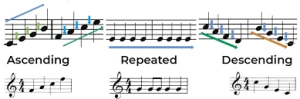
- Ascending – melody goes up (low to high)
- Descending – melody goes down (high to low)
- Repeated – same notes repeated
- Step-wise – notes move one step at a time
- Jumping – notes skip steps (leap)
The Modulator: The modulator is a tool that helps us see how melody moves:
- Do (1) – starting note
- Re (2) – second note
- Mi (3) – third note
- Fa (4) – fourth note
- So (5) – fifth note
- La (6) – sixth note
- Ti (7) – seventh note
- Do (8) – octave (same as 1 but higher)
Solfa Names: In music, we use special names for notes:
- Do, Re, Mi, Fa, So, La, Ti, Do
- These help us sing melodies correctly
- They show the relationship between notes
- Used in traditional and modern music
Melodic Patterns in Traditional Songs:
- Call and Response – leader sings, group responds
- Repetition – same melody repeated
- Echo patterns – melody echoes back
- Rising patterns – melody climbs up
- Falling patterns – melody comes down
Examples of Simple Melodic Patterns:
- Do, Re, Mi (going up)
- Mi, Re, Do (going down)
- Do, Do, So, So (repeated then jumping)
- Do, Re, Mi, Fa, So (step-wise up)
Activity
- Practice singing “Do, Re, Mi, Fa, So, La, Ti, Do”
- Listen to a traditional song and identify if melody goes up or down
- Create a simple melody using solfa names
- Clap the rhythm of a traditional song while singing the melody
Multiple Choice Exercise
- A melodic pattern is: a) The words of a song b) The tune of a song c) The rhythm only d) The instruments
- How many solfa names are there? a) 6 b) 7 c) 8 d) 9
- When melody goes from low to high, it is: a) Descending b) Ascending c) Repeated d) Jumping
- “Do, Re, Mi” shows a melody that: a) Goes down b) Stays same c) Goes up d) Jumps around
- The modulator helps us: a) Write words b) See melody movement c) Keep time d) Play instruments
Answers: 1(b), 2(c), 3(b), 4(c), 5(b)
This term's Cultural & Creative Arts topics
Basic 2 Third Term · 6 topics
- Colouring: Functional Artworks
- Festivals
- Traditional Festivals
- The Treble Staff
- The Bass Staff
- Melodic Patterns of Traditional Song
Get Cultural & Creative Arts (CCA) as PDF and Word
Every week of Basic 2 Cultural & Creative Arts (CCA), Third Term, formatted and ready to print. Ad-free, and the copy lock comes off.
Get this term Card, bank transfer, USSD or OPay
Instant PDF and Word download · Secure Paystack payment · Questions? WhatsApp us
Basic 2 Cultural & Creative Arts (CCA) Lesson Notes for Other Topics
Colouring - Functional Artworks
Read the full lesson note.

Festivals
Read the full lesson note.

Traditional Festivals
Read the full lesson note.

The Treble Staff
Read the full lesson note.

The Bass Staff
Read the full lesson note.
Shapes
Read the full lesson note.
Types Of Objects And Shapes
Read the full lesson note.
Colour & Types of Basic Colours
Read the full lesson note.
Organization Of Colour - Basic Colours
Read the full lesson note.
Colour Mixing
Read the full lesson note.

Traditional Songs
Read the full lesson note.
Traditional Dance
Read the full lesson note.

Importance Of Music
Read the full lesson note.
Introduction To Craft Making
Read the full lesson note.

Craft Making
Read the full lesson note.
Lesson Notes for Other Classes

Basic 1 Lesson Note
The complete lesson note to guide your studies.

Basic 3 Lesson Note
The complete lesson note to guide your studies.

Basic 4 Lesson Note
The complete lesson note to guide your studies.

Basic 5 Lesson Note
The complete lesson note to guide your studies.
Basic 6 Lesson Note
The complete lesson note to guide your studies.
