
Gymnastics – JSS3 Physical Education Lesson Note (Second Term)
Download this term · ₦1,000Lesson note at a glance
- Subject
- Physical Education
- Class
- JSS3
- Term
- Second Term
- Topic
- Gymnastics
- Order
- Topic 3 of 4 this term
- Reading time
- 5 min
Gymnastics is a set of physical exercises that develop strength, balance, flexibility, agility and coordination of the body.
Behavioural objectives
By the end of the lesson, students should be able to:
- define gymnastics;
- name the three classes of gymnastics floor activities;
- give examples of stunts, tumbling and balancing activities;
- describe the steps of a forward roll;
- state the values of gymnastics;
- state the safety rules to follow when doing gymnastics.
What is gymnastics?
Gymnastics is a set of physical exercises that improve strength, balance, flexibility, agility and coordination.
- Where it is done: on the floor, on a mat or on foam.
- Origin: it began in ancient Greece.
- Meaning of the word: it comes from a Greek word meaning “naked art”.
- Gymnast: a person who performs gymnastics.
- Spotter: a person who stands close to a performer to guide and protect them from falling or injury.
What are the classes of gymnastics floor activities?
There are three classes of gymnastics floor activities: stunts, tumbling and balancing.
- Stunts: short activities done alone or with a partner.
- Tumbling: activities that involve turning, twisting, rolling and springing.
- Balancing: activities in which the body is held steady in one position.
What are stunts?
Stunts are brief activities performed on the floor, mat or foam, alone or with a partner.
Individual stunts
- Frog jump: squat with hands on the floor, then spring forward like a frog.
- Rabbit jump: squat with hands on the floor, then jump the hands and feet forward in turn.
- Sit up: lie on the back with knees bent, then raise the upper body towards the knees.
- Trunk curl: lie on the back and curl the head and shoulders up off the mat.
- Push-up: lie face down, then push the body up with the arms, keeping it straight.
- Cycling in the air: lie on the back, raise the legs and pedal as if riding a bicycle.
- Bear walk: walk forward on the hands and feet with the hips raised.
- Cat spring: a light springing movement from a crouch, landing softly on the feet.
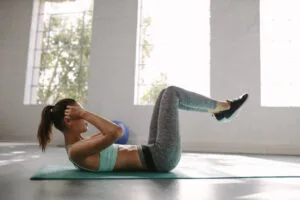
Image: Sit up
Stunts with a partner
- Seesaw: two partners face each other and hold hands, one squatting while the other stands, then they swap.
- Wheelbarrow walk: one partner walks on the hands while the other holds the legs and walks behind.
- Leg wrestling: two partners lie side by side, hook legs and try to roll the other over.

Image: Wheelbarrow walk
What is tumbling?
Tumbling is a gymnastics activity that involves turning, twisting, rolling and springing of the human body.
- Forward roll: roll forward over the shoulders with the body tucked into a ball.
- Backward roll: roll backward over the shoulders with the body tucked.
- Cartwheel: turn sideways with the body passing over the hands, like a wheel turning.
- Headstand: support the body upside down on the head and hands.
- Handspring: spring from the feet onto the hands and back to the feet in one movement.
- Front somersault: turn the whole body forward, head over heels, in the air.
- Back somersault: turn the whole body backward, head over heels, in the air.
What is balancing?
Balancing is a gymnastics activity in which the body is held steady in one position, often on a small base.
- Head stand balance: hold the body upside down on the head and hands.
- Handstand balance: hold the body upside down on the hands alone.
- Squat balance: hold a steady squatting position.
- Knee balance: kneel on one knee and hold the other leg and the arms steady.
- Crab balance: support the body on the hands and feet in a crab-like position.
- Chest balance: lie on the chest and lift the arms and legs off the mat.
- Side arm balance: support the body sideways on one arm.
What is the difference between stunts, tumbling and balancing?
Stunts are short exercises, tumbling is moving, and balancing is holding still. The table compares them.
| Class | Main feature | Examples |
|---|---|---|
| Stunts | Short activities, alone or with a partner | Frog jump, bear walk, seesaw |
| Tumbling | Turning, twisting, rolling and springing | Cartwheel, forward roll, somersault |
| Balancing | Holding the body steady in one position | Handstand balance, knee balance, crab balance |
How do you perform a forward roll?
A forward roll is a tumbling move in which the body rolls forward over the shoulders in a tucked position.
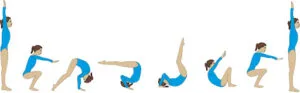
- Spread a mat and stand at the end of the mat, facing the direction of rolling.
- Take a squatting position, place the palms forward on the mat, shoulders wide apart, and knees between the arms.
- Tuck the chin to the chest, making a rounded back.
- Raise the buttocks and look between the legs as far back as possible.
- Roll over the neck and shoulders with the knees close to the chest.
- Roll out and stand up.
- Safety tip: keep the chin tucked so the weight does not fall on the top of the head.
What safety rules should you follow in gymnastics?
Safety rules protect gymnasts from falls, sprains and other injuries.
- Warm up: loosen the muscles and joints before any activity.
- Use a mat: perform floor activities on a mat or foam, not on bare concrete.
- Clear the space: remove objects and keep other students away from the area.
- Dress well: wear light, loose clothing and remove watches and jewellery.
- Use a spotter: have a spotter near you when learning a new or difficult move.
- Go step by step: master easy moves before trying harder ones.
What are the values of gymnastics?
The values of gymnastics are the benefits a person gains from taking part.
- Mental alertness: it improves alertness and quick reasoning, and helps participants create new movement patterns.
- Character: participants build courage, self-confidence, determination and endurance.
- Social values: participants learn cooperation, teamwork, loyalty and patriotism.
- Physical fitness: it develops the muscles and improves body posture, flexibility, agility and strength.
- Livelihood: it provides a means of earning a living.
Evaluation
- What is gymnastics?
- Name the three classes of gymnastics floor activities.
- Give three examples of tumbling activities.
- List the steps of a forward roll.
- State two values of gymnastics.
Assignment
Write short notes on a gymnast and a spotter, and state one reason why a spotter is needed.
This term's Physical Education topics
JSS3 Second Term · 4 topics
Get Physical Education as PDF and Word
Every week of JSS3 Physical Education, Second Term, formatted and ready to print. Ad-free, and the copy lock comes off.
Get this term Card, bank transfer, USSD or OPay
JSS3 Physical Education Lesson Notes for Other Topics
Career Guidance in Physical
Read the full lesson note.
The Basic Swimming Strokes & Facilities for Swimming
Read the full lesson note.

Officials Of Gymnastics And Their Duties
Read the full lesson note.
Lesson Notes for Other Classes

JSS1 Lesson Note
The complete lesson note to guide your studies.

JSS2 Lesson Note
The complete lesson note to guide your studies.
