
Advanced Hair Styling II – SS2 Beauty & Cosmetology Lesson Note (First Term)
Download this term · ₦1,000Lesson note at a glance
- Subject
- Beauty & Cosmetology
- Class
- SS2
- Term
- First Term
- Topic
- Advanced Hair Styling II
- Order
- Topic 2 of 7 this term
- Reading time
- 4 min
Chemical hair texturising changes the natural shape of hair by breaking the bonds that hold its shape, moving them into a new position and locking them back together. Relaxing straightens curly hair, perming adds curls or waves, and rebonding gives a very straight, shiny finish using chemicals and high-heat styling.
Behavioural objectives
By the end of the lesson, students should be able to:
- explain how chemical texturising changes the shape of hair;
- state the two main types of relaxer and one difference between them;
- describe the two steps of perming and say why the neutralizer is important;
- describe the rebonding process and the 72-hour rule;
- carry out the patch test and strand test, and use a colour indicator shampoo correctly.
How does chemical texturising change hair?
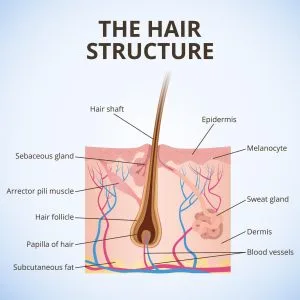
Before we touch a chemical, we have to understand what we are doing to the hair. Every strand of hair has “bonds” (think of them as tiny internal ladders) that hold its shape, whether curly or straight.
- The process: Chemical texturising works by breaking these “ladders” down, moving them into a new position, and then “locking” them back together.
- The risk: If you leave the “ladders” broken for too long, the hair falls apart (breakage).
- Porosity check: Always feel the hair first. If it is very dry or damaged, it is like a sponge. It will soak up the chemical too fast and could burn.
What is hair relaxing?
Relaxing is the most common chemical service in many salons. It is used to “relax” the natural curl pattern of the hair.
The two main types of relaxer
- Lye relaxers (sodium hydroxide): These work very fast and are very effective, but they can be harsh on the scalp. They are usually for professional use only.
- No-lye relaxers (calcium hydroxide): These are often sold in box kits. They are gentler on the scalp but can make the hair feel a bit dry over time.
Steps for success
- Base the scalp: Always apply petroleum jelly or “base cream” to the hairline and scalp to prevent chemical burns.
- Do not over-process: Never apply new relaxer to hair that has already been relaxed. Only touch the “new growth”.
What is perming?
Perming is the opposite of relaxing. We take straight hair and give it permanent waves or curls using “perm rods”.
How perming works
- Softening: We apply a waving lotion to break the hair bonds while the hair is wrapped around a rod.
- Setting: We apply a neutralizer. This is the most important step. It is the “glue” that hardens the hair into its new curly shape.
Teacher’s note: If you do not rinse the waving lotion out completely before neutralizing, the hair will smell like rotten eggs and the curl will not last.
What is hair rebonding?
Rebonding is an advanced technique, popular for getting a “pin-straight”, shiny, glass-like finish. It is a mix of chemical treatment and high-heat styling.
- The difference: Unlike a regular relaxer, rebonding uses a powerful cream followed by a very precise flat-ironing session at high temperatures.
- The time: This is a long process. It can take 4 to 6 hours, depending on the hair length.
- The 72-hour rule: After rebonding, the client must not wash their hair, tuck it behind their ears, or use a hair tie for 3 days. The hair is still “settling” into its new shape.
What safety checks must a stylist carry out?
As a stylist, you are handling strong chemicals. You must be responsible.
- The patch test: Apply a tiny bit of the chemical behind the ear 24 hours before the service to make sure the client is not allergic.
- The strand test: Test the chemical on one small piece of hair at the back of the head to see how long it takes to process.
- Neutralizing shampoo: When washing out a relaxer, use a shampoo with a “colour indicator”. If the suds are pink, there is still chemical in the hair. If the suds are white, the hair is safe.
Evaluation
- Why should we not scratch a client’s scalp before a relaxer service? (Answer: It creates tiny cuts that will burn.)
- What happens if you use a high-heat flat iron on hair that still has “softening” chemicals in it?
- Why is the neutralizer called the “most important” step in perming?
- Name the two main types of relaxer and state one difference between them.
- State the 72-hour rule after rebonding.
Assignment
- Write a short comparison of lye and no-lye relaxers.
- List the three safety checks a stylist should carry out when using strong chemicals, and say what each one is for.
This term's Beauty & Cosmetology topics
SS2 First Term · 7 topics
Get Beauty & Cosmetology as PDF and Word
Every week of SS2 Beauty & Cosmetology, First Term, formatted and ready to print. Ad-free, and the copy lock comes off.
Get this term Card, bank transfer, USSD or OPay
SS2 Beauty & Cosmetology Lesson Notes for Other Topics
Advanced Hair Styling I
Read the full lesson note.

Hair Colouring
Read the full lesson note.
Hair Cutting
Read the full lesson note.

Advanced Makeup II
Read the full lesson note.

Cosmetic Product Formulation I
Read the full lesson note.
Cosmetic Product Formulation II
Read the full lesson note.

Salon Management I
Read the full lesson note.
Salon Management II
Read the full lesson note.
Business Skills I
Read the full lesson note.
Business Skills II
Read the full lesson note.

Entrepreneurship in Cosmetology
Read the full lesson note.

Spa and Wellness Therapy I
Read the full lesson note.
Spa and Wellness Therapy II
Read the full lesson note.
Occupational Hazard in Cosmetology
Read the full lesson note.
Dermatology Basics for Beautician
Read the full lesson note.
Lesson Notes for Other Classes

SS1 Lesson Note
The complete lesson note to guide your studies.

SS3 Lesson Note
The complete lesson note to guide your studies.
