
Purchase of Business – SS3 Book Keeping Lesson Note (First Term)
Download this term · ₦1,000Lesson note at a glance
- Subject
- Book Keeping
- Class
- SS3
- Term
- First Term
- Topic
- Purchase of Business
- Order
- Topic 3 of 6 this term
- Reading time
- 4 min
Purchase of business is the process by which a company acquires an existing business from its owner, called the vendor, for an agreed price.
Behavioural objectives
By the end of the lesson, students should be able to:
- Explain the meaning of purchasing a business.
- List and explain the terms used in the purchase of a business account.
- Calculate the purchase consideration, goodwill and capital reserve from given figures.
- State the ways in which the purchase consideration can be paid.
- Show the layout of the business purchase account.
Instructional techniques
- Identification
- Explanation
- Questions and answers
- Demonstration
- Videos from source
Instructional materials
- Videos
- Loudspeaker
- Textbook
- Pictures
What is purchase of business?
Purchase of business is the process of acquiring an old business by a company.
- Vendor: the person who sells the business to another company.
- Purchase price: the money paid by the purchaser for the business.
- Agreement: the purchase must involve an agreement on terms between the parties.
- Promoters: they can acquire a business and sell it to another company at a profit.
- Viable business: a business that performs well is likely to sell for more than its present value.
- Weak business: a business with a not-too-impressive performance may sell at a lower price.
What does the purchaser take over?
The purchaser takes over the assets, the name and the connection of the business.
- Assets: items such as premises, stock and debtors, which are revalued to agreed values.
- Liabilities: the purchaser can assume trade liabilities as part of the consideration.
- Name and connection: these are paid for as goodwill.
- Vendor keeps liabilities: in some cases the purchaser takes all the assets without cash and leaves the vendor to discharge the liabilities.
How are goodwill and capital reserve treated in a business purchase?
Goodwill arises when the purchase consideration is higher than the net assets, and capital reserve arises when it is lower.
Goodwill
- Meaning: the excess of the purchase consideration over the net value of the assets.
- Why it arises: the purchaser pays for the name and connection of the business.
- Formula: goodwill = purchase consideration minus net assets.
Capital reserve
- Meaning: the advantage the purchaser gains when the purchase consideration is lower than the net assets.
- Formula: capital reserve = net assets minus purchase consideration.
Net assets
- Meaning: the value of the assets taken over less the liabilities taken over.
- Formula: net assets = assets taken over minus liabilities taken over.
What is the difference between goodwill and capital reserve?
Goodwill is the extra amount paid above net assets. Capital reserve is the gain when less than net assets is paid.
| Point | Goodwill | Capital reserve |
|---|---|---|
| Purchase consideration | Higher than net assets | Lower than net assets |
| Meaning | Payment for name and connection | Advantage gained by the purchaser |
| Position in business purchase account | Credit side (balancing figure) | Debit side (balancing figure) |
How can the purchase consideration be paid?
The purchase consideration can be paid in cash or in shares.
- Cash: the purchaser pays the vendor money, usually through the bank.
- Shares: the purchaser issues shares of the company to the vendor instead of money.
What is the layout of the business purchase account?
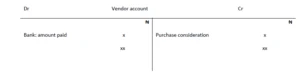
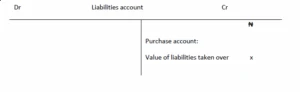
The business purchase account is a ledger account kept in the books of the purchasing company to find goodwill or capital reserve.
| Debit side | Credit side |
|---|---|
| Liabilities taken over | Assets taken over (at agreed values) |
| Vendor (purchase consideration) | Goodwill (balancing figure, if any) |
| Capital reserve (balancing figure, if any) |
What are the steps in recording a business purchase?
- Open a business purchase account in the books of the purchaser.
- Debit each asset account and credit the business purchase account with the agreed value of assets taken over.
- Debit the business purchase account and credit the liabilities taken over.
- Debit the business purchase account and credit the vendor with the purchase consideration.
- Find the balancing figure: a credit balance is goodwill and a debit balance is capital reserve.
- Settle the vendor: debit the vendor and credit bank (cash) or share capital (shares).
Worked example (illustrative figures)
A company buys a business with these agreed values.
| Item | Amount (N) |
|---|---|
| Premises | 500,000 |
| Stock | 200,000 |
| Debtors | 100,000 |
| Total assets | 800,000 |
| Less creditors taken over | 100,000 |
| Net assets | 700,000 |
- If the purchase consideration is N800,000: goodwill = 800,000 minus 700,000 = N100,000.
- If the purchase consideration is N650,000: capital reserve = 700,000 minus 650,000 = N50,000.
Illustrations



What terms are used in the purchase of a business account?
The main terms are vendor, purchaser, purchase price, goodwill, capital reserve and promoters.
- Vendor: the person who sells the business to another company.
- Purchaser: the company that buys the business.
- Purchase price (purchase consideration): the money the purchaser pays for the business. It can be paid in cash or shares.
- Goodwill: the excess of the purchase consideration over the net value of the assets.
- Capital reserve: the advantage the purchaser gains when the purchase consideration is lower than the net assets.
- Promoters: persons who can acquire a business and sell it to another company at a profit.
Evaluation
- Explain the meaning of purchase of a business.
- List and explain four terms used in the purchase of a business account.
- What is the format or layout of the account?
- Assets of N900,000 and liabilities of N150,000 are taken over for a purchase consideration of N800,000. Find the goodwill or capital reserve.
Classwork: As in the evaluation questions.
Assignment
- Explain how goodwill and capital reserve arise in the purchase of a business.
- State two ways in which the purchase consideration can be paid.
This term's Book Keeping topics
SS3 First Term · 6 topics
Get Book Keeping as PDF and Word
Every week of SS3 Book Keeping, First Term, formatted and ready to print. Ad-free, and the copy lock comes off.
Get this term Card, bank transfer, USSD or OPay
SS3 Book Keeping Lesson Notes for Other Topics

Business Organization
Read the full lesson note.

Business Organization II - Sole Trader, Partnership & Limited Liability Companies
Read the full lesson note.

Departmental and Branch Account
Read the full lesson note.

Hire Purchase
Read the full lesson note.

Product and Service Marketing
Read the full lesson note.

Joint Venture Account
Read the full lesson note.

Manufacturing Account
Read the full lesson note.

Partnership Account I
Read the full lesson note.

Partnership Account II
Read the full lesson note.

Introduction of Company Account
Read the full lesson note.

Contract Account
Read the full lesson note.
Lesson Notes for Other Classes

SS1 Lesson Note
The complete lesson note to guide your studies.

SS2 Lesson Note
The complete lesson note to guide your studies.
