
Joint Venture Account – SS3 Book Keeping Lesson Note (Second Term)
Download this term · ₦1,000Lesson note at a glance
- Subject
- Book Keeping
- Class
- SS3
- Term
- Second Term
- Topic
- Joint Venture Account
- Order
- Topic 1 of 6 this term
- Reading time
- 7 min
A joint venture is an arrangement in which two or more people, called co-venturers, join to carry out a business activity, such as selling a consignment of goods, and share the profits and losses in an agreed ratio. Each co-venturer records his own transactions, and a joint venture account and co-venturers’ accounts show the result.
Behavioural objectives
By the end of the lesson, students should be able to:
- Define a joint venture and state the key terms used in it.
- Describe the format of the joint venture account and the co-venturers’ accounts.
- List the steps for preparing a joint venture account.
- Solve exercises on the joint venture account, including the sharing of profit and final settlement.
Instructional techniques
- Identification
- Explanation
- Questions and answers
- Demonstration
- Videos from source
Instructional materials
- Videos
- Loudspeaker
- Textbook
- Pictures
What are the key terms in a joint venture?
The key terms are co-venturer, joint venture account, co-venturers’ accounts, profit-sharing ratio and commission agent.
- Co-venturer: a person who takes part in a joint venture and shares its profit or loss.
- Joint venture account: an account that collects all the costs and the income of the venture and shows the profit or loss.
- Co-venturers’ accounts: personal accounts showing what each co-venturer has put in, taken out and is owed.
- Profit-sharing ratio: the agreed proportion in which profit or loss is divided, for example equally or 3/5 and 2/5.
- Commission agent (broker): a person hired to sell the goods, who is paid a commission and may deduct his expenses.
- Octroi: a local tax charged on goods entering a town. It is treated as an expense of the venture.
What is the difference between a joint venture and a partnership?
A joint venture is a business arrangement for one particular project that ends when the project is completed.
A partnership is a business owned by two or more people that carries on from year to year.
| Point | Joint venture | Partnership |
|---|---|---|
| Purpose | One specific project | Continuing business |
| Duration | Ends when the project ends | Runs for an unlimited period |
| Accounts | Joint venture account and co-venturers’ accounts | Trading, profit and loss and appropriation accounts |
| Sharing of profit | Once, at the end of the venture | Yearly, at the end of each financial year |
What is the format of a joint venture account?
The joint venture account has a debit side for costs and a credit side for income, and the balance is the profit or loss.
| Debit side (costs) | Credit side (income) |
|---|---|
| Goods supplied by each co-venturer | Sales proceeds |
| Expenses paid by each co-venturer (freight, insurance, brokerage, sundry expenses) | Value of unsold goods or assets taken over by a co-venturer |
| Commission and expenses of the agent | Loss shared by the co-venturers (balancing figure) |
| Profit shared by the co-venturers (balancing figure) |
- Profit: credits exceed debits. The profit is shown on the debit side and shared in the agreed ratio.
- Loss: debits exceed credits. The loss is shown on the credit side and shared in the agreed ratio.
What is the format of the co-venturers’ accounts?
Each co-venturer’s account shows what he contributed on the credit side and what he received on the debit side.
| Debit side | Credit side |
|---|---|
| Sales proceeds he received | Goods he supplied |
| Assets or goods he took over | Expenses he paid |
| His share of any loss | His share of any profit |
| Cash he received in settlement | Cash he paid in settlement |
What are the steps in preparing a joint venture account?
A joint venture account is prepared by recording the costs and income, finding the profit or loss, sharing it and settling the balances.
- List the goods supplied and the expenses paid by each co-venturer.
- Debit the joint venture account with all goods, expenses, commission and agent’s expenses.
- Credit the joint venture account with the sales proceeds and any goods or assets taken over.
- Find the balancing figure. This is the profit or loss.
- Share the profit or loss in the agreed ratio.
- Credit each co-venturer’s account with his goods, expenses and share of profit.
- Debit the account of the co-venturer who received the sales proceeds.
- Find the balance on each account and settle it in cash. The balances should agree.
What are the general journal entries in a joint venture?
The general entries record contributions, sales proceeds, profit and final settlement.
| Transaction | Debit | Credit |
|---|---|---|
| Goods supplied and expenses paid by a co-venturer | Joint venture account | That co-venturer’s account |
| Sales proceeds received by a co-venturer | That co-venturer’s account | Joint venture account |
| Profit shared | Joint venture account | Each co-venturer’s account |
| Loss shared | Each co-venturer’s account | Joint venture account |
| Final settlement paid by the debtor co-venturer | Cash or bank | Co-venturer’s account |
How is a joint venture account prepared? Example 1
Ali of Lahore and Bilal of Karachi entered into a joint venture for the sale of a consignment of goods in March 2018, with profits and losses to be shared equally. Ali paid Rs. 10,000 for the purchase of goods and consigned them to Bilal for sale. He paid Rs. 400 for freight, Rs. 350 for brokerage and Rs. 100 for sundry expenses. Bilal received the goods and paid Rs. 600 for octroi, Rs. 200 for the warehouse and Rs. 90 for insurance. He sold the whole consignment for Rs. 16,000.
You are required to pass general entries, prepare the joint venture account and prepare the co-venturers’ accounts.
Solution


Key figures to check
| Item | Working | Amount (Rs.) |
|---|---|---|
| Ali’s goods and expenses | 10,000 + 400 + 350 + 100 | 10,850 |
| Bilal’s expenses | 600 + 200 + 90 | 890 |
| Total costs | 10,850 + 890 | 11,740 |
| Profit | 16,000 – 11,740 | 4,260 |
| Share of each (equal) | 4,260 ÷ 2 | 2,130 |
| Bilal pays Ali | 16,000 – 890 – 2,130 | 12,980 |
- Check: Ali’s credits are 10,850 + 2,130 = 12,980. This equals the amount Bilal pays.
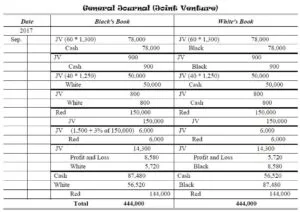
Example 2: Black and White
Black and White entered into a joint venture in September 2017 to consign 100 bales of cotton pieces. They hired a commission agent, Red, to sell the bales later on the joint risk of Black and White, sharing in the proportion of 3/5 and 2/5 respectively.
Black sent 60 bales at Rs. 1,300 each and paid Rs. 900 for freight and other charges. White sent 40 bales at Rs. 1,250 each and paid Rs. 800 for freight and other charges. The broker sold all the bales for Rs. 150,000. He deducted Rs. 1,500 for his expenses and his commission at 3 per cent, and remitted the balance to the consignors.
You are required to pass general entries, prepare the joint venture account and prepare the co-venturers’ accounts.
Solution
Workings
- Black’s goods: 60 × 1,300 = Rs. 78,000.
- White’s goods: 40 × 1,250 = Rs. 50,000.
- Commission: 3% of 150,000 = Rs. 4,500.
- Amount remitted by Red: 150,000 – 1,500 – 4,500 = Rs. 144,000.
Joint venture account
| Debit | Rs. | Credit | Rs. |
|---|---|---|---|
| Black: goods | 78,000 | Sales proceeds | 150,000 |
| Black: freight and charges | 900 | ||
| White: goods | 50,000 | ||
| White: freight and charges | 800 | ||
| Red: expenses | 1,500 | ||
| Red: commission | 4,500 | ||
| Profit to Black (3/5) | 8,580 | ||
| Profit to White (2/5) | 5,720 | ||
| Total | 150,000 | Total | 150,000 |
- Profit: 150,000 – 78,900 – 50,800 – 6,000 = Rs. 14,300.
Co-venturers’ accounts
| Account | Credit items (Rs.) | Total credit (Rs.) | Debit: cash received (Rs.) |
|---|---|---|---|
| Black | 78,000 + 900 + 8,580 | 87,480 | 87,480 |
| White | 50,000 + 800 + 5,720 | 56,520 | 56,520 |
- Check: 87,480 + 56,520 = 144,000, which is the amount Red remitted.
Evaluation
Question 1
Define a joint venture and state two items found on the debit side of the joint venture account.
Question 2
X and Y entered into a joint venture to ship goods abroad in July 2018. X sent goods to the value of $15,000, and paid freight of $1,500 and sundry expenses of $575. Y sent goods valued at $10,750, and paid freight and insurance of $1,200 and sundry expenses of $750. Y advanced $6,000 to X on account of the joint venture. X received the account sales and the remittance of net proceeds, amounting to $37,500 for the whole consignment.
Required: Show how the transactions would appear in the books of X and Y respectively, assuming a final settlement is made between them.

Question 3
A and B entered into a joint venture to take a building contract worth Rs. 240,000. They provided the following information about the expenses they incurred.
The plant was valued at Rs. 10,000 at the end of the contract and A agreed to take it at that value. B received the contract amount of Rs. 240,000. Pass the necessary journal entries in the books of A and B, and prepare the joint venture and co-venturers’ accounts, assuming profit-sharing ratios of 1/4th and 3/4th respectively.
Assignment
P and Q entered into a joint venture and agreed to share profit and loss equally. P supplied goods worth ₦200,000 and paid expenses of ₦10,000. Q paid expenses of ₦5,000 and sold all the goods for ₦260,000. Prepare the joint venture account and the co-venturers’ accounts, and state who pays whom in the final settlement.
This term's Book Keeping topics
SS3 Second Term · 6 topics
Get Book Keeping as PDF and Word
Every week of SS3 Book Keeping, Second Term, formatted and ready to print. Ad-free, and the copy lock comes off.
Get this term Card, bank transfer, USSD or OPay
SS3 Book Keeping Lesson Notes for Other Topics
Manufacturing Account
Read the full lesson note.

Partnership Account I
Read the full lesson note.
Partnership Account II
Read the full lesson note.
Introduction of Company Account
Read the full lesson note.

Contract Account
Read the full lesson note.
Business Organization
Read the full lesson note.

Business Organization II - Sole Trader, Partnership & Limited Liability Companies
Read the full lesson note.

Purchase of Business
Read the full lesson note.
Departmental and Branch Account
Read the full lesson note.

Hire Purchase
Read the full lesson note.

Product and Service Marketing
Read the full lesson note.
Lesson Notes for Other Classes

SS1 Lesson Note
The complete lesson note to guide your studies.

SS2 Lesson Note
The complete lesson note to guide your studies.
