
Mechanism of Transportation in Higher Mammals – SS2 Biology Lesson Note (Second Term)
Download Lesson NoteLesson note at a glance
- Subject
- Biology
- Class
- SS2
- Term
- Second Term
- Topic
- Mechanism of Transportation in Higher Mammals
- Order
- Topic 4 of 6 this term
- Reading time
- 4 min
Transport in plants is the movement of water, mineral salts and manufactured food to the parts of the plant that need them. Higher plants such as ferns and flowering plants carry out this movement through vascular bundles made up of xylem and phloem tissues. Xylem carries water from the soil, and phloem carries manufactured food from the leaves.
Behavioural objectives
By the end of the lesson, students should be able to:
- explain why higher plants need a transport system;
- state the functions of the xylem and the phloem;
- define translocation and transpiration;
- list the conditions that affect the rate of transpiration;
- state the importance of transpiration to plants;
- describe how water moves from the soil into the xylem and up the plant.
Why do higher plants need a transport system?
In simple unicellular plants, materials are exchanged by simple diffusion between the plants and their aquatic environment. Hence there is no need for an elaborate transport system. In higher plants such as ferns and flowering plants, there is a need for an elaborate transport system.
This system transports water and mineral salts from the soil to the various parts of the plant. It also transports manufactured food from the leaves to other parts where it is either used up or stored up.
What are vascular bundles?
The transport system of a plant is made up of vascular bundles consisting of the xylem and the phloem tissues.
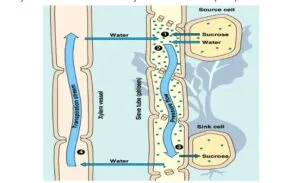
The xylem is responsible for conducting water with dissolved substances from the soil to other parts of the plant. The phloem is responsible for the transportation of manufactured food from the leaves to other parts of the plant (translocation).
In the roots and stems of dicotyledonous plants, a layer called cambium exists between the xylem and the phloem tissues. The vascular bundles are found in the roots, stems and leaves of flowering plants.
Processes which aid transportation in plants
The main processes supporting transportation in plants are translocation, transpiration, absorption of water and mineral salts, and water transport in the xylem.
Translocation
Translocation is the process by which manufactured food substances are transported through the phloem tissue from the site of production to plant tissues where they are used or stored. It is usually from the leaves to other plant parts.
What is transpiration?
Transpiration is the removal of excess water from plants into the atmosphere in the form of water vapour. The loss of water can be through the stomata (in leaves), the lenticels (in stems) or the cuticle of the leaf surface. The rate of transpiration is measured using an instrument called a potometer.
Conditions affecting the rate of transpiration
- Size of the stomatal pores: Flaccidity of the guard cells causes them to close, preventing transpiration. When turgidity occurs, the cells open for transpiration to take place.
- Humidity: The higher the humidity, the slower the rate of transpiration.
- Temperature: An increase in temperature leads to an increase in transpiration.
- Light: High light intensity causes a high photosynthetic rate, which in turn leads to an increase in temperature and so a high rate of transpiration.
- Wind: The higher the speed of wind, the higher the rate of transpiration.
- Soil water: A higher level of soil water leads to a higher rate of absorption, which results in a higher rate of transpiration.
Importance of transpiration to plants
- It helps plants to absorb water and mineral salts from the soil.
- It facilitates the movement of soil water.
- It cools the plant after water evaporation has taken place.
How do plants absorb water and mineral salts?
Water from the soil enters the plant through the root hairs by osmosis. This leads to increased turgor pressure of the vacuole of root cells. The water absorbed then gets into the xylem vessel.
How does water move in the xylem?
Water transport in the xylem tissue is due to the following:
- root pressure;
- suction pressure;
- capillary action, due to the attraction between the water molecules and the walls of the xylem vessel;
- transpiration pull.
Evaluation
- Why do unicellular plants not need an elaborate transport system?
- State the functions of the xylem and the phloem.
- Define transpiration and name three places where water can be lost from a plant.
- Explain how humidity and wind affect the rate of transpiration.
- List three things that help water move in the xylem tissue.
Assignment
- Define translocation.
- State three importance of transpiration to plants.
- Explain how the guard cells control the size of the stomatal pores.
This term's Biology topics
SS2 Second Term · 6 topics
- Digestive System
- Transport System
- Circulatory System in Mammals
- Mechanism of Transportation in Higher Mammals
- Cell Division
- Reproductive System in Vertebrates
Second Term Biology Lesson Notes for Other Topics

Chromosomes
Read the full lesson note.
Variation
Read the full lesson note.

Adaptation
Read the full lesson note.

Evolution
Read the full lesson note.
Biological diagrams/drawing
Read the full lesson note.
Spelling Drills of Biological Technical Terms
Read the full lesson note.
Reproductive System In Vertebrates
Read the full lesson note.

Cell Division
Read the full lesson note.
Digestive System
Read the full lesson note.
Circulatory System In Mammals
Read the full lesson note.
Transport System
Read the full lesson note.

Relevance Of Biology To Agriculture
Read the full lesson note.

Energy Transformation In Nature
Read the full lesson note.

Functions In Ecosystem
Read the full lesson note.
Basic Ecological Systems III
Read the full lesson note.
Lesson Notes for Other Classes

Basic 1 Lesson Note
The complete lesson note to guide your studies.

Basic 2 Lesson Note
The complete lesson note to guide your studies.

Basic 3 Lesson Note
The complete lesson note to guide your studies.

Basic 4 Lesson Note
The complete lesson note to guide your studies.

Basic 5 Lesson Note
The complete lesson note to guide your studies.

Basic 6 Lesson Note
The complete lesson note to guide your studies.


