
Introduction to Aquaculture – SS2 Livestock Farming Lesson Note (First Term)
Lesson note at a glance
- Class
- SS2
- Subject
- Livestock Farming
- Term
- First Term
- Reading time
- 4 min
Aquaculture is the breeding, rearing and harvesting of fish, prawns, crabs and water plants in a controlled environment, such as a pond or tank. It is practised in three systems: extensive, semi-intensive and intensive.
Behavioural objectives
By the end of the lesson, students should be able to:
- define aquaculture and explain the terms fry, fingerlings and table size;
- state the importance of fish farming;
- describe the extensive, semi-intensive and intensive systems of fish farming;
- compare the three systems in terms of feeding, cost, supervision and space;
- explain how a farmer can choose a system.
What is aquaculture?
Aquaculture is the farming of water animals and plants in a controlled environment, where the farmer looks after them until they are ready to eat or sell.
- Fish: the most common product, for example catfish and tilapia.
- Prawns and crabs: shellfish raised in ponds or tanks.
- Water plants: plants grown in water for food or other uses.
- Controlled environment: a pond, tank or fenced water space made or managed by the farmer.
- Difference from fishing: the farmer creates a home for the fish and rears them, instead of catching whatever nature provides.
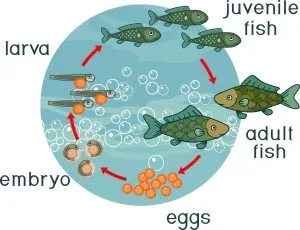
What are fry, fingerlings and table size?
Three terms describe the size of farmed fish: fry, fingerlings and table size.
- Fry: very young baby fish.
- Fingerlings: young fish about the size of a human finger, bigger than fry.
- Table size: fish big enough to be cooked, eaten or sold.
Why is fish farming important?
Fish farming supplies food, jobs and income, and it supports the economy and health of the people.
- Healthy protein: fish is low in “bad” fats and is good for the heart and brain.
- Job creation: pond builders, feed sellers, fish processors and traders all earn a living from it.
- Extra income: farmers sell fish to support their families.
- Food security: farmed fish gives a steady supply even when it is hard to catch fish in the wild.
- By-products: fish scales and bones can be used to make animal feed or fertiliser for crops.
What are the systems of fish farming?
There are three systems of fish farming: extensive, semi-intensive and intensive.
What is the extensive system?
The extensive system is a low-cost way of fish farming in a large water space, where the fish depend mainly on natural food.
- Space: a large earthen pond or a fenced-off part of a lake or river.
- Feeding: the fish find their own food, such as algae and water insects. The farmer rarely gives extra feed.
- Stocking density: very few fish are kept in a large area so they do not run out of natural food.
- Cost: very cheap, because little is spent on feed or equipment.
- Disadvantage: the fish grow slowly and the total harvest is small.
What is the semi-intensive system?
The semi-intensive system is a mix of natural food and extra feed given by the farmer, and it is the most common system among small-scale farmers.
- Space: man-made ponds of medium size.
- Feeding: the fish eat natural food in the pond and are topped up with extra feed, such as rice bran or fish pellets.
- Fertilisation: the farmer may add manure to help plankton (natural “green food”) grow.
- Stocking density: more fish can be kept than in the extensive system.
- Result: the fish grow faster and bigger because they feed well.
What is the intensive system?
The intensive system is a high-technology way of producing as many fish as possible in a very small space.
- Space: small units such as concrete or plastic tanks.
- Feeding: the fish depend 100% on the farmer for food, usually pellets.
- Equipment: machines are needed to pump in fresh water and oxygen, because many fish share one tank.
- Management: it needs constant attention. If the power fails or the water gets dirty, the fish can die quickly.
- Cost: very expensive to set up, but a large number of fish can be harvested in a short time.
How do the three systems compare?
The table below compares the three systems already described.
| Feature | Extensive | Semi-intensive | Intensive |
|---|---|---|---|
| Feeding | Natural food only | Natural food + extra feed | Pellets only |
| Cost | Very low | Moderate | High |
| Supervision | Very little | Moderate | Constant |
| Space | Large area | Medium | Small (tanks) |
| Number of fish kept | Few | More | Very many |
| Growth and output | Slow, small harvest | Faster, fair harvest | Fast, large harvest |
How does a farmer choose a fish farming system?
A farmer chooses a system according to the money available and the amount of fish he or she wants to sell.
- Capital: a farmer with little money starts with the extensive or semi-intensive system.
- Purpose: a farmer who wants fish for the family can use the extensive system.
- Business size: a farmer who wants a big business may choose the intensive system.
- Land: where land is small, tanks in the intensive system use less space.
- Skill and time: the intensive system needs close supervision and a farmer with the knowledge to run it.
Evaluation
- Define aquaculture.
- What is the difference between fry and fingerlings?
- State four reasons why fish farming is important.
- Describe how fish are fed in the semi-intensive system.
- Why does the intensive system need machines?
Assignment
Explain, using feeding, cost, supervision and space, why a small-scale farmer with limited money may choose the extensive or semi-intensive system instead of the intensive system.
Teacher's lesson plan
A ready-to-use lesson plan for this topic: objectives, previous knowledge, materials, step-by-step presentation, board summary and conclusion.
Included when you get this note, and inside your download. Sign in with your purchase to see it here.
Sign inThis term's Livestock Farming topics
SS2 First Term · 8 topics
SS2 Livestock Farming Lesson Notes for Other Topics

Fish Pond Construction
Read the full lesson note.

Fish Breeds and Fingerlings
Read the full lesson note.
Feed Nutrition and Feeding
Read the full lesson note.

Fish Health and Diseases
Read the full lesson note.

Fish Harvesting
Read the full lesson note.

Fish Marketing
Read the full lesson note.

Economics of Aquaculture
Read the full lesson note.
Snail Farming I
Read the full lesson note.
Snail Farming II
Read the full lesson note.
Honey Bee Keeping I
Read the full lesson note.
Honey Beekeeping II
Read the full lesson note.
Grasscutter Farming
Read the full lesson note.
Animal Health I
Read the full lesson note.

Animal Health II
Read the full lesson note.
Pasture and Forage Crop
Read the full lesson note.
Lesson Notes for Other Classes

SS1 Lesson Note
The complete lesson note to guide your studies.

SS3 Lesson Note
The complete lesson note to guide your studies.
