Fish Breeds and Fingerlings – SS2 Livestock Farming Lesson Note (First Term)
Download this term · ₦1,000Lesson note at a glance
- Subject
- Livestock Farming
- Class
- SS2
- Term
- First Term
- Topic
- Fish Breeds and Fingerlings
- Order
- Topic 3 of 8 this term
- Reading time
- 4 min
Fish breeds are the types of fish farmed in Nigeria, mainly the African catfish and tilapia. Fingerlings are young fish about 5 to 10 cm long, the stage at which most farmers buy fish. Fingerlings are produced in a hatchery by induced breeding, then the fry are nursed with clean water, fine feed and regular grading.
Behavioural objectives
By the end of the lesson, students should be able to:
- Name the two main fish farmed in Nigeria and give reasons why farmers keep them.
- Name other fish species farmed in Nigeria, including the hybrid Heteroclarias.
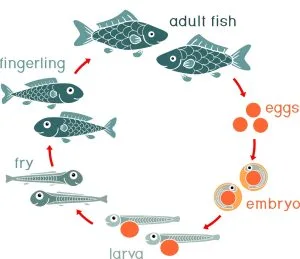
- List the life stages of a fish.
- Describe the steps of induced breeding.
- Explain how fry are cared for and why they are graded.
Which fish breeds are farmed in Nigeria?
If you visit a fish farm in Nigeria, you are very likely to see one of two types of fish. Just like we have different breeds of cows or chickens, we have specific fish that grow well in our climate.
African catfish (Clarias gariepinus)
This is the “King” of Nigerian aquaculture.
- Why farmers love it: It is very “tough”. It can breathe air directly from the surface, so it does not die easily if the water is a bit dirty.
- Growth: It grows very fast and can get very big (table size) in 4 to 6 months.
- Market: Nigerians love catfish for “Point and Kill”, pepper soup and dried fish.
Tilapia (Oreochromis niloticus)
This is the “Queen” of the ponds.
- Why farmers love it: It is very tasty and feeds mostly on plants and tiny water organisms, which makes it cheaper to feed.
- The problem: Tilapia breeds too fast. If you put a male and female together, they will fill the pond with tiny babies, and none of them will grow big because they are competing for food.
- Solution: Most farmers now grow only male tilapia (monosex) so the fish can focus on growing big instead of breeding.
Other fish species we farm
While catfish and tilapia are the most common, some farmers also keep these:
- Heterobranchus: This is a cousin to the catfish. It grows even bigger than the regular catfish but takes a bit more time.
- Carp: These are not as common but are farmed in some parts of the country. They are very bony but have a nice flavour.
- Heteroclarias (the hybrid): This is a “cross-breed” between Clarias and Heterobranchus. It is like a “super fish” because it combines the fast growth of one and the toughness of the other.
What is fingerling production?
You do not just wait for fish to appear in the pond. You have to produce them or buy them from a hatchery.
The life stages of a fish
- Egg: The starting point after spawning.
- Fry: Tiny babies that have just hatched. They look like little wiggling threads.
- Fingerling: This is the stage most farmers buy. They are about the size of a human finger (5 to 10 cm).
- Juvenile: Older than fingerlings, about the size of a pencil. They are stronger and survive better in big ponds.
Why produce fingerlings? It is a very profitable business. One mother fish can lay thousands of eggs at once.
How do we get fish to lay eggs (induced breeding)?
In the wild, fish wait for the rainy season to lay eggs. On a farm, we cannot wait for the rain, so we use a method called induced breeding.
- Selecting parents (broodstock): We pick a healthy male fish and a “ripe” female fish (her belly is swollen with eggs).
- The injection: We give the female fish a hormone injection (such as pituitary extract or synthetic hormones). This “tricks” her body into thinking it is time to lay eggs.
- Stripping: After some hours, the farmer gently presses the female’s belly to collect the eggs in a bowl.
- Fertilisation: We kill the male fish (usually) to get its “milt” (sperm) and mix it with the eggs using a feather or a clean plastic spoon.
- Incubation: The fertilised eggs are put in a tank with constant running water. In about 24 to 30 hours, they hatch into fry.
How are the babies cared for (nursing)?
The first few weeks are the most dangerous for fish. If you do not take care of the fry, they will all die.
- Feeding: Tiny babies cannot eat regular fish pellets. We feed them Artemia (tiny water shrimps) or very fine powder feed.
- Clean water: Their “nursery” must be very clean. Any small disease can kill the whole batch.
- Sorting (grading): Some babies grow faster than others. Catfish are cannibals: the big ones will eat the small ones. Farmers must use a “grader” (a tray with holes) to separate the big ones from the small ones.
Note to students: Fingerling production is like a “hospital” for fish. It requires a lot of patience, clean hands and very close observation. One mistake with the water temperature can ruin a whole month’s work.
Evaluation
- Can you identify a catfish and a tilapia? State two reasons why farmers keep each one.
- Why do tilapia ponds often fill with small fish, and what is the solution?
- List the four life stages of a fish in order.
- Why do we inject the female fish during induced breeding?
- Explain why we grade or sort fingerlings.
Assignment
Write out the five steps of induced breeding in order, and explain in one sentence what happens at each step.
This term's Livestock Farming topics
SS2 First Term · 8 topics
Get Livestock Farming as PDF and Word
Every week of SS2 Livestock Farming, First Term, formatted and ready to print. Ad-free, and the copy lock comes off.
Get this term Card, bank transfer, USSD or OPay
First Term Livestock Farming Lesson Notes for Other Topics

Introduction to Animal Biotechnology
Read the full lesson note.

Reproductive Technologies
Read the full lesson note.

Animal Welfare and Ethics
Read the full lesson note.
Farm Project Development
Read the full lesson note.
Sustainable Livestock Farming
Read the full lesson note.
Livestock Business Planning
Read the full lesson note.

Entrepreneurship in Livestock
Read the full lesson note.

Genetic Improvement
Read the full lesson note.

Economics of Aquaculture
Read the full lesson note.

Fish Marketing
Read the full lesson note.

Fish Harvesting
Read the full lesson note.

Fish Health and Diseases
Read the full lesson note.
Feed Nutrition and Feeding
Read the full lesson note.

Fish Pond Construction
Read the full lesson note.
Introduction to Aquaculture
Read the full lesson note.
Lesson Notes for Other Classes

Basic 1 Lesson Note
The complete lesson note to guide your studies.
Basic 2 Lesson Note
The complete lesson note to guide your studies.

Basic 3 Lesson Note
The complete lesson note to guide your studies.

Basic 4 Lesson Note
The complete lesson note to guide your studies.

Basic 5 Lesson Note
The complete lesson note to guide your studies.

Basic 6 Lesson Note
The complete lesson note to guide your studies.