
Data Model – SS2 Data Processing Lesson Note (First Term)
Lesson note at a glance
- Class
- SS2
- Subject
- Data Processing
- Term
- First Term
- Reading time
- 4 min
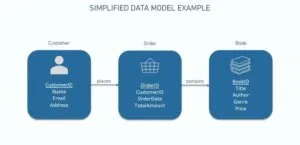
Data modelling is the process of structuring and organising data so that it can be implemented in a database management system (DBMS).
- A data model describes structured data, such as the data held in relational databases.
- It may also place constraints on the data stored in its structure.
- It does not describe unstructured data such as emails or pictures.
Behavioural objectives
By the end of the lesson, students should be able to:
- define data modelling;
- state the difference between structured and unstructured data in relation to data models;
- explain the concepts of data modelling;
- describe data structure and data organisation as the two meanings of the term data model;
- name and describe the conceptual, logical and physical approaches to data modelling.
What is data modelling?
Data modelling is the process of structuring and organising data, and the data structures are then typically implemented in a DBMS.
- Defining data: it states what data is needed and in what form it is kept.
- Organising data: it arranges the data into a clear structure.
- Constraints: it may also impose limits on the data placed within the structure.
- Main use: managing large quantities of data is a primary function of information systems.
What is the difference between structured and unstructured data?
Structured data is data arranged in a fixed format, such as rows and columns, so that a DBMS can store and search it easily.
Unstructured data is data that has no fixed format, such as documents, messages, pictures, sound and video.
| Point | Structured data | Unstructured data |
|---|---|---|
| Format | Fixed and organised | No fixed format |
| Described by a data model? | Yes | No |
| Where it is stored | Data management systems such as relational databases | Files such as documents, emails, pictures, audio and video |
| Example | A school register with name, class and age columns | A word-processing document, an email message or a photograph |
Why was data modelling developed?
Data modelling was developed because early information systems focused on processing rather than on data.
- Early focus: the main effort in the system development life cycle (SDLC) was to produce programs that automate a business process.
- Key driver: processing, rather than data or information, drove information systems.
- Growth: technology and system complexity increased over time.
- Response: methodologies and modelling techniques were invented.
- Quality: these techniques improved the quality of the deliverables.
- Repeatable processes: they made sure that inexperienced programmers could follow repeatable SDLC processes.
What are the concepts of data modelling?
The concepts of data modelling are the main ideas that explain what a data model does for an information system.
- Blueprint: modelling techniques and tools capture complex system designs and turn them into easily understood representations of data flows and processes. This creates a blueprint for construction and re-engineering.
- Structure: a data model gives the data used in the information system a specific definition and format.
- Relationships: the model shows the data flow and the logical interrelationship among different data elements.
- Compatibility: data can be compatible across systems if the same data model is used consistently.
What are the basic building blocks of a data model?
The basic building blocks of a data model are entities, attributes and relationships.
- Entity: a person, place, thing or event about which data is kept, such as a student or a teacher.
- Attribute: a property that describes an entity, such as a student’s name, age or class.
- Relationship: a link between entities, such as a student offering a subject.
What are the two meanings of the term data model?
The term data model refers to two different things: a description of data structure and a description of how data is organised using a DBMS.
What is data structure?
- A data model describes the structure of the data within a given domain.
- By implication, it also describes the underlying structure of that domain itself.
What is data organisation?
- A data model also describes how to organise data using a database management system.
What are the approaches to data modelling?
There are three approaches to data modelling: conceptual, logical and physical.
Conceptual data modelling
- It identifies the highest-level relationships between different entities.
- It is the first step in organising the data requirements.
Logical data modelling
- It illustrates the specific entities, attributes and relationships involved in a business function.
- It serves as the basis for the creation of the physical data model.
Physical data modelling
- It represents an application and database-specific implementation of a logical data model.
- It describes the physical means used to store data.
| Approach | What it shows | Purpose |
|---|---|---|
| Conceptual | Highest-level relationships between entities | First step in organising data requirements |
| Logical | Specific entities, attributes and relationships | Basis for the physical data model |
| Physical | Application and database-specific implementation | Describes the physical means used to store data |
Evaluation
- Define data modelling.
- Give three examples of unstructured data that a data model does not describe.
- State two concepts of data modelling.
- Which approach to data modelling is the first step in organising data requirements?
- Explain how logical data modelling is related to physical data modelling.
Assignment
Explain the two meanings of the term data model, then describe the conceptual, logical and physical approaches to data modelling in your own words.
This term's Data Processing topics
SS2 First Term · 8 topics
SS2 Data Processing Lesson Notes for Other Topics
Database Management System I
Read the full lesson note.

Database Management System II - How to Create Database
Read the full lesson note.
Data Model II - Types of Data Modelling
Read the full lesson note.
Data Modeling
Read the full lesson note.
Data Modeling II - Standard Data Model & Examples
Read the full lesson note.
Normalization
Read the full lesson note.

Entity-Relationship Models
Read the full lesson note.
Relational Models II
Read the full lesson note.
Data Security
Read the full lesson note.
Role Of Database Administration In Nigeria
Read the full lesson note.
File Organisation
Read the full lesson note.
Presentation Packages
Read the full lesson note.
Graphic Packages
Read the full lesson note.
Web Design
Read the full lesson note.
Internet
Read the full lesson note.
Lesson Notes for Other Classes

SS1 Lesson Note
The complete lesson note to guide your studies.

SS3 Lesson Note
The complete lesson note to guide your studies.
