
Sets II: Operation of Set & Venn Diagrams – SS1 Further Mathematics Lesson Note (First Term)
Download this term · ₦1,000Lesson note at a glance
- Subject
- Further Mathematics
- Class
- SS1
- Term
- First Term
- Topic
- Sets II: Operation of Set & Venn Diagrams
- Order
- Topic 2 of 8 this term
- Reading time
- 4 min
A Venn diagram is a diagram that uses circles inside a rectangle to show sets and how they overlap.
Behavioural objectives
- Define union, intersection and complement of sets.
- Name the eight regions of a Venn diagram of three sets in set notation.
- Represent information about three sets on a Venn diagram.
- Use an unknown (y) for the number in all three sets to find the number in each region.
- Solve word problems involving three sets using a Venn diagram.
What are the operations on sets?
There are three main operations on sets: union, intersection and complement.
- Universal set (µ): the set of all items under discussion. It is drawn as the rectangle.
- Union (A∪B): the set of elements that are in A, or in B, or in both.
- Intersection (A∩B): the set of elements that are in both A and B.
- Complement (A′): the set of elements in µ that are not in A.
- Cardinal number n(A): the number of elements in set A.
Example of the operations
Let µ = {1, 2, 3, 4, 5, 6, 7, 8}, A = {1, 2, 3, 4} and B = {3, 4, 5, 6}.
- A∪B: {1, 2, 3, 4, 5, 6}.
- A∩B: {3, 4}.
- A′: {5, 6, 7, 8}.
- (A∪B)′: {7, 8}.
What is the formula for the number of elements in the union of two or three sets?
The formulae count each element once, by taking away the overlaps that were counted twice.
- Two sets: n(A∪B) = n(A) + n(B) – n(A∩B).
- Three sets: n(A∪B∪C) = n(A) + n(B) + n(C) – n(A∩B) – n(B∩C) – n(A∩C) + n(A∩B∩C).
How do you use Venn diagrams to solve problems involving three sets?
A Venn diagram with three overlapping sets divides the universal set into eight regions.
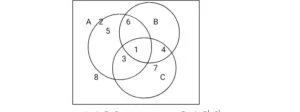
What are the eight regions of a three-set Venn diagram?
Each region is written in set notation using intersection (∩) and complement (′).
| Region | Set notation |
|---|---|
| 1 | A∩B∩C |
| 2 | A∩B∩C′ |
| 3 | A∩B′∩C |
| 4 | A′∩B∩C |
| 5 | A∩B′∩C′ |
| 6 | A′∩B∩C′ |
| 7 | A′∩B′∩C |
| 8 | (A∪B∪C)′ |
What are the steps for solving a three-set problem?
- Name the sets and write down all the given numbers using n( ).
- Let the number in all three sets, n(A∩B∩C), be y.
- Write each “two sets only” region as the pair total minus y.
- Write each “one set only” region as the set total minus the three regions inside that set.
- Add all the regions, including the region outside the circles, and make the sum equal to the total.
- Solve for y, then substitute y to find every region.
- Answer the question that was asked.
Worked example: teacher vacancies
A school has 37 vacancies for teachers: 22 for English, 20 for History and 17 for Fine Art. Of these, 11 are for both English and History, 8 for both History and Fine Art and 7 for English and Fine Art. Using a Venn diagram, find the number of teachers who must be able to teach:
- all the three subjects
- Fine Art only
- English and History but not Fine Art.
Solution: write the sets and data
- µ: {all vacancies for teachers}.
- E: {English vacancies}.
- H: {History vacancies}.
- F: {Fine Art vacancies}.
- Given: n(µ) = 37, n(E) = 22, n(H) = 20, n(F) = 17, n(E∩H) = 11, n(H∩F) = 8, n(E∩F) = 7.
- Unknown: let n(E∩H∩F) = y.
Step 1: find the regions for two sets only
- English and History only: n(E∩H∩F′) = 11 – y.
- History and Fine Art only: n(E′∩H∩F) = 8 – y.
- English and Fine Art only: n(E∩H′∩F) = 7 – y.
Step 2: find each region that belongs to only one set
- English only: n(E∩H′∩F′) = n(E) – (7 – y + y + 11 – y) = 22 – (18 – y) = 4 + y.
- History only: n(E′∩H∩F′) = n(H) – (11 – y + y + 8 – y) = 20 – (19 – y) = 1 + y.
- Fine Art only: n(E′∩H′∩F) = n(F) – (7 – y + y + 8 – y) = 17 – (15 – y) = 2 + y.
Step 3: add all the regions to find y
- µ = (4 + y) + (11 – y) + (1 + y) + y + (8 – y) + (7 – y) + (2 + y)
- 37 = 33 + y
- y = 37 – 33
- y = 4
Step 4: answer each part
- n(E∩H∩F) = 4 teachers.
- Fine Art only: n(E′∩H′∩F) = 2 + y = 2 + 4 = 6 teachers.
- English and History but not Fine Art: n(E∩H∩F′) = 11 – y = 11 – 4 = 7 teachers.
Value of every region when y = 4
| Region | In terms of y | Number |
|---|---|---|
| E∩H∩F | y | 4 |
| E∩H∩F′ | 11 – y | 7 |
| E∩H′∩F | 7 – y | 3 |
| E′∩H∩F | 8 – y | 4 |
| E only | 4 + y | 8 |
| H only | 1 + y | 5 |
| F only | 2 + y | 6 |
| Total | 37 |
Check with the three-set formula
- Working: 22 + 20 + 17 – 11 – 8 – 7 + 4 = 37.
- Result: this equals n(µ), so y = 4 is correct.
Evaluation
- Write region 5 of the three-set Venn diagram in set notation.
- In the worked example, how many vacancies are for History only?
- In the worked example, how many teachers must be able to teach History and Fine Art but not English?
- Given n(P) = 12, n(Q) = 9 and n(P∩Q) = 4, find n(P∪Q).
Assignment
- At a meeting of 35 teachers, every teacher drank at least one of Fanta, Coke and Pepsi. 15 drank Fanta, 6 drank both Fanta and Coke, 18 drank Coke, 8 drank both Coke and Pepsi, 20 drank Pepsi, and 2 drank all three types of drink. How many of the teachers drank:
(a) Coke only
(b) Fanta and Pepsi but not Coke? - Given n(X∪Y) = 50, n(X) = 20 and n(Y) = 40, determine n(X∩Y).
This term's Further Mathematics topics
SS1 First Term · 8 topics
- Sets
- Sets II: Operation of Set & Venn Diagrams
- Indices and Logarithm
- Surds
- Linear Inequalities
- Binary Operations
- Sequence and Series
- Sequence and Series II
Get Further Mathematics as PDF and Word
Every week of SS1 Further Mathematics, First Term, formatted and ready to print. Ad-free, and the copy lock comes off.
Get this term Card, bank transfer, USSD or OPay
SS1 Further Mathematics Lesson Notes for Other Topics
Sets
Read the full lesson note.
Indices And Logarithm
Read the full lesson note.
Surds
Read the full lesson note.
Linear Inequalities
Read the full lesson note.
Binary Operations
Read the full lesson note.
Sequence And Series
Read the full lesson note.
Sequence And Series II
Read the full lesson note.

Trigonometric Ratio Of Special Angles And Logical Reasoning
Read the full lesson note.

Calculating And Processing Devices
Read the full lesson note.

Vectors In Two Dimensions
Read the full lesson note.
The Straight Line on Coordinate Geometry
Read the full lesson note.
Location - Measurement of Central Tendency
Read the full lesson note.
History And Nature Of Operations And Research
Read the full lesson note.
Models
Read the full lesson note.
Gravitational Field
Read the full lesson note.
Lesson Notes for Other Classes

SS2 Lesson Note
The complete lesson note to guide your studies.

SS3 Lesson Note
The complete lesson note to guide your studies.
