
Occupation – SS1 Commerce Lesson Note (First Term)
Download this term · ₦1,000Lesson note at a glance
- Subject
- Commerce
- Class
- SS1
- Term
- First Term
- Topic
- Occupation
- Order
- Topic 2 of 5 this term
- Reading time
- 2 min
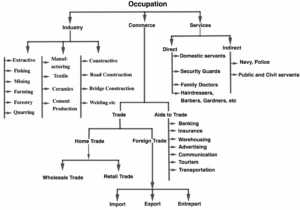
An occupation is any legal job in which people are engaged to earn a living. Occupations are classified into six divisions: extractive, manufacturing, constructive, commercial, direct services and indirect services. Several factors, such as education, talent, remuneration and government policy, influence the occupation a person chooses.
Behavioural objectives
By the end of the lesson, students should be able to:
- Define occupation.
- Name the six classes of occupation.
- Explain each class of occupation and give examples.
- State the factors that influence the choice of occupation.
What is an occupation?
Occupation can be defined as any job that is legal in which people are engaged to earn a living.
How are occupations classified?
Occupations are classified into six major divisions, namely extractive occupation, manufacturing occupation, constructive occupation, commercial occupation, direct services and indirect services.
Extractive occupation
This involves all kinds of work concerned with the extraction of natural resources from the soil, the sea or the forest, e.g. farming, fishing, hunting, lumbering, mining and quarrying.
Manufacturing occupation
Workers in this occupation change the form of raw materials extracted from the soil or sea into finished or semi-finished products, e.g. raw rubber to vehicle tyres and raw cotton to textile material.
Constructive occupation
Workers in this occupation assemble the various components from the extractive and manufacturing industries and build them into organised, usable structures, e.g. bringing iron rods, cement, planks, sand and corrugated iron sheets together to make a building.
Commercial occupation
This is referred to as tertiary occupation. It comprises the groups of people who make it possible for goods and services produced to be made available to the people who need them, e.g. insurance, transport, advertising, warehousing, communication, banking and finance.
Direct services
These include those whose economic activities involve giving satisfaction, amusement and entertainment, and rendering personal services to others. The services are rendered directly and paid for directly, e.g. barbers, musicians, doctors, stewards, drivers and actors.
Indirect services
These involve those who earn their living by rendering services to the public. The workers are paid by the government for the services they render, e.g. civil servants, policemen, soldiers, customs officers and fire service personnel.
What factors influence the choice of occupation?
- Education and training
- Natural skills and talent
- Remuneration
- Government policy
- Personal interest
- Nature of the job available
- Age
- Sex
- Customs and family background
- Geographical features
- Natural resources endowment
- Extraneous factors, e.g. health, life ambitions and peer pressure
Evaluation
- Define occupation.
- List the six classes of occupation.
- Explain extractive occupation and give three examples.
- State the difference between direct services and indirect services.
- Mention five factors that influence the choice of occupation.
Assignment
- Explain manufacturing occupation and constructive occupation, with two examples of each.
- List any six factors that influence a person’s choice of occupation.
This term's Commerce topics
SS1 First Term · 5 topics
Get Commerce as PDF and Word
Every week of SS1 Commerce, First Term, formatted and ready to print. Ad-free, and the copy lock comes off.
Get this term Card, bank transfer, USSD or OPay
First Term Commerce Lesson Notes for Other Topics
Introduction To Commerce
Read the full lesson note.

National Consciousness
Read the full lesson note.
Foreign Trade
Read the full lesson note.

Trade - Retailers & Retail Trade
Read the full lesson note.
Production
Read the full lesson note.

Business Law
Read the full lesson note.

Types of Contract
Read the full lesson note.

Law of Agency
Read the full lesson note.

Contract of Sales Of Goods
Read the full lesson note.

Hire Purchase/Instalment Payment/ Deferred Payment
Read the full lesson note.

Contract of Employment
Read the full lesson note.
Government Regulation of Business
Read the full lesson note.

Structure of Business - Organisation Chart
Read the full lesson note.
Introduction to Business Management
Read the full lesson note.
Lesson Notes for Other Classes

Basic 1 Lesson Note
The complete lesson note to guide your studies.

Basic 2 Lesson Note
The complete lesson note to guide your studies.

Basic 3 Lesson Note
The complete lesson note to guide your studies.

Basic 4 Lesson Note
The complete lesson note to guide your studies.

Basic 5 Lesson Note
The complete lesson note to guide your studies.
Basic 6 Lesson Note
The complete lesson note to guide your studies.


