
Introduction to Commerce – SS1 Commerce Lesson Note (First Term)
Download Lesson NoteLesson note at a glance
- Subject
- Commerce
- Class
- SS1
- Term
- First Term
- Topic
- Introduction to Commerce
- Order
- Topic 1 of 5 this term
- Reading time
- 3 min
Commerce is the study of the production, distribution and exchange of goods and services to satisfy human wants and earn a living. It has two divisions, trade and aids to trade. Aids to trade include transport, insurance, banking and finance, advertising, warehousing, communication and tourism.
Behavioural objectives
By the end of the lesson, students should be able to:
- define commerce;
- state the importance (functions) of commerce;
- outline the stages in the history and development of commerce;
- list the factors that delayed and the factors that helped the growth of commerce in Nigeria and West Africa;
- name the divisions of commerce and the subdivisions of aids to trade.
What is commerce?

Commerce is the study of the production, distribution and exchange of goods and services aimed at satisfying human wants to earn a living.
What are the importance (functions) of commerce?
- It provides employment opportunities for the people.
- It makes the production and exchange of goods and services possible.
- It improves the standard of living of people by making modern goods available.
- It aids national and international cooperation by ensuring the interdependence of nations.
- It facilitates the division of labour and specialisation.
- It brings technological innovation and aids infrastructural development.
What are the stages in the history and development of commerce?
- Earliest time: production was for subsistence.
- Exchange of goods and services by barter.
- Exchange of goods and services through the use of commodity money.
- Introduction of money notes and coins as a medium of exchange.
- Improvement in aids to trade.
What factors delayed the development of commerce in Nigeria and West Africa?
- Political instability
- Low savings
- Absence of developed markets
- Poor communication system
- Illiteracy
- Inadequate capital
- Low level of technology
- Inadequate or poor infrastructural facilities
- Low national income
What factors have contributed to the growth of commerce in Nigeria and West Africa?
- Development of modern techniques of production
- Political stability
- Development of financial institutions
- Development of efficient means of transportation and communication
- Availability of warehousing facilities
- Improvements in aids to trade, for example insurance and advertising
- Advancement in levels of education and literacy
What are the divisions of commerce?
Commerce can be grouped into two main branches or divisions, namely:
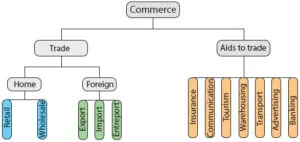
- Trade
- Aids to trade
Subdivisions of aids to trade
The aids to trade can be subdivided into:
- Transport
- Insurance
- Banking and finance
- Advertising
- Warehousing
- Communication
- Tourism
Evaluation
- Define commerce.
- State four functions of commerce.
- List the stages in the history and development of commerce.
- State three factors that delayed the development of commerce in Nigeria and West Africa.
- Name the two divisions of commerce and list the subdivisions of aids to trade.
Assignment
- The main divisions of commerce are (a) Home trade and foreign trade (b) Transportation and warehousing (c) Trade and aids to trade (d) Wholesale and retail trade
- Which of the following is not a benefit of commerce? It (a) Facilitates the movement of goods and services (b) Provides employment to people (c) Increases the cost of living (d) Makes funds available for business activities
- All are aids to trade except (a) Advertising (b) Transportation (c) Retailing (d) Banking
- Which of the following can be defined as trade and aid to trade? (a) Advertising (b) Commerce (c) Warehousing (d) Retailing
- Which of the following is not a basic want of man? (a) Transport (b) Food (c) Water (d) Clothing
This term's Commerce topics
SS1 First Term · 5 topics
- Introduction to Commerce
- Occupation
- Production
- Trade: Retailers & Retail Trade
- Foreign Trade
First Term Commerce Lesson Notes for Other Topics

National Consciousness
Read the full lesson note.
Foreign Trade
Read the full lesson note.

Trade - Retailers & Retail Trade
Read the full lesson note.

Production
Read the full lesson note.

Occupation
Read the full lesson note.
Business Law
Read the full lesson note.

Types of Contract
Read the full lesson note.

Law of Agency
Read the full lesson note.

Contract of Sales Of Goods
Read the full lesson note.

Hire Purchase/Instalment Payment/ Deferred Payment
Read the full lesson note.

Contract of Employment
Read the full lesson note.
Government Regulation of Business
Read the full lesson note.

Structure of Business - Organisation Chart
Read the full lesson note.

Introduction to Business Management
Read the full lesson note.
Lesson Notes for Other Classes

Basic 1 Lesson Note
The complete lesson note to guide your studies.

Basic 2 Lesson Note
The complete lesson note to guide your studies.

Basic 3 Lesson Note
The complete lesson note to guide your studies.

Basic 4 Lesson Note
The complete lesson note to guide your studies.

Basic 5 Lesson Note
The complete lesson note to guide your studies.

Basic 6 Lesson Note
The complete lesson note to guide your studies.


