
Mining – SS1 Economics Lesson Note (Third Term)
Download this term · ₦1,000Lesson note at a glance
- Subject
- Economics
- Class
- SS1
- Term
- Third Term
- Topic
- Mining
- Order
- Topic 3 of 5 this term
- Reading time
- 5 min
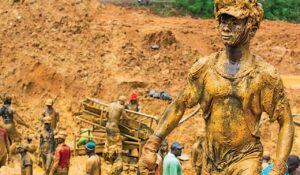
Mining is the process of getting coal, gold and other minerals from under the ground by digging deep holes. It is one of the major occupations in Nigeria and can be traced to our forefathers. Nigeria’s mining industry extracts minerals such as petroleum, coal, iron ore, tin, columbite, limestone, marble and gold, which provide jobs, revenue and raw materials.
Behavioural objectives
By the end of the lesson, students should be able to:
- define mining;
- state where the major minerals are found in Nigeria;
- name the mining industries in Nigeria and their locations;
- state the types of minerals and their uses;
- list the importance of mining to Nigeria;
- state the problems facing mining in Nigeria.
What is mining?
Mining is the process of getting coal, gold and other minerals from under the ground by making a deep hole or holes where these minerals are dug. That is, it is the extraction of minerals from under the ground through the digging of deep holes into the ground. Mining is one of the major occupations in Nigeria and can be traced to our forefathers.
The arrival of the European colonial masters in the early 19th century led to a decline in local participation in the industry. The decline was due to factors such as the monopoly of exploitation by Europeans, inadequate technology on the part of the Nigerian miners, and the superiority of European finished products and their competition with those of the local mining industries.
What are the components of the Nigerian mining industry?
The components of the Nigerian mining industry consist of different mining industries set up for the extraction of minerals in different locations within the country. Most of the mineral fuels (natural gas, petroleum and coal) are located in the Southern states, namely Rivers, Bayelsa, Cross River, Akwa Ibom, Delta, Anambra and Ebonyi, while the major deposits of coal are located in Enugu and Imo states. Gold, columbite and tin are located mainly near Jos in Plateau state.
There are deposits of tin, gold and limestone in Osun state. Other minerals of less importance include lignite clay, marble, thorium, mica and uranium. These are either completely untouched or are exploited on a small scale by local enterprises.
Mining industries in Nigeria
The following mining industries are set up in Nigeria:
- Petroleum industry: It is for the extraction of crude oil in Port Harcourt and the Niger Delta area.
- Coal mining industry: It is for the mining of coal in Enugu and Benue states.
- Iron and steel industry: It extracts iron ore and feeds it into the Iron and Steel Complex at Ajaokuta in Kogi State and Aladja in Delta State.
- Tin and columbite mining industry: It mines tin and columbite in Jos in Plateau State.
- Limestone cement industry: It turns limestone into cement in Ewekoro and Sagamu in Ogun State, Calabar in Cross River State and Nkalagu in Ebonyi State.
- Marble mining industry: Its main source of supply is at Jakura in the Lokoja area of Kogi State. The marble is cut and polished for the building industry and monuments.
- Lead and zinc mining industry: It mines lead and zinc in Abakaliki in Ebonyi State.
What are the types of minerals and their uses?
- Petroleum (crude oil): It is a liquid mineral called black gold, from which petrol, kerosene, diesel and other petrochemical products are derived. It originates from dead plants and animal matter deposited and transformed over time by heat and pressure into sedimentary matter.
- Coal: It is a major source of power and comes from a sedimentary rock. It is suitable for the production of tar and synthetic fertiliser, for ordinary steam raising including the generation of electricity, and for the manufacture of chemicals and liquid fuels, because it is rich in hydrocarbons, waxes and resins.
- Iron ore: It is a basement complex rock mineral fed into the iron and steel complex to make iron and steel.
- Tin and columbite: These are basement complex rock minerals of silvery, malleable elements that resist corrosion. They are used for manufacturing heat-resistant steel used in jet engines.
- Limestone: It is a sedimentary mineral rock used for manufacturing cement. It provides the necessary raw materials for the country’s cement factories.
- Lead and zinc: These are sedimentary mineral rocks used in industry locally.
- Marble: It is a hard crystalline metamorphic rock that takes a high polish. It is used for sculpture, building materials and monuments.
- Gold: It is a soft, yellow, malleable and ductile metallic element which occurs mainly as nuggets in rocks and alluvial deposits. It is very valuable among the precious stones.
- Natural gas: It is a fossil fuel in the gaseous state, produced during petroleum refining. It is used for cooking, heating homes and industrial purposes.
What is the importance of minerals to Nigeria?
- Mining of minerals provides employment for people.
- It serves as a source of revenue for the government.
- It provides raw materials for our local industries.
- It enhances economic growth and development.
- It helps Nigerians to acquire technical skills.
- It makes a laudable contribution to Gross Domestic Product (GDP).
- It is a source of foreign exchange earnings for the government.
- It helps to improve the standard of living of the people.
- It helps to supply fuel and energy.
What are the problems facing mining in Nigeria?
- Inadequate capital for exploration.
- Poor transportation network.
- Inadequate technical personnel needed for mineral exploration.
- Fluctuation in the world prices of minerals.
- Environmental pollution through oil spillage and degradation.
Evaluation
- Define mining.
- Name four mining industries in Nigeria and state where each is located.
- State two uses of coal.
- Mention three problems facing mining in Nigeria.
Assignment
- The basement complex rock minerals used for manufacturing of heat-resistant steel are ____
(a) limestone (b) lead and zinc (c) tin and columbite (d) natural gas - The process of digging deep holes into the ground to extract deposited mineral resources from the earth’s crust is known as ____
(a) farming (b) manufacturing (c) mining (d) lumbering - A liquid mineral resource called black gold is ____
(a) petroleum (b) coal (c) gold (d) limestone - The extraction of iron ore serves as raw material being used to feed the Iron and Steel Complex at ____
(a) Ewekoro and Sagamu (b) Ajaokuta and Aladja (c) Jos and Enugu (d) Ebonyi and Nkalagu - All the following are environmental problems caused by mining except ____
(a) air pollution (b) oil spillage (c) land pollution (d) fumigation - Mention at least five states in Nigeria and the types of minerals found in them.
- State five contributions of mining to economic development in Nigeria.
This term's Economics topics
SS1 Third Term · 5 topics
Get Economics as PDF and Word
Every week of SS1 Economics, Third Term, formatted and ready to print. Ad-free, and the copy lock comes off.
Get this term Card, bank transfer, USSD or OPay
Third Term Economics Lesson Notes for Other Topics

Inflation
Read the full lesson note.

Financial Institutions
Read the full lesson note.

Public Finance
Read the full lesson note.

Money
Read the full lesson note.

Budget
Read the full lesson note.

Capital Market
Read the full lesson note.

National Income
Read the full lesson note.

Theory Of Income Determination
Read the full lesson note.

Theory Of Multiplier
Read the full lesson note.

Financial Institutions
Read the full lesson note.

The Nature Of Nigerian Economy
Read the full lesson note.

Agriculture
Read the full lesson note.

Channels Of Distribution
Read the full lesson note.
Lesson Notes for Other Classes

Basic 1 Lesson Note
The complete lesson note to guide your studies.

Basic 2 Lesson Note
The complete lesson note to guide your studies.

Basic 3 Lesson Note
The complete lesson note to guide your studies.

Basic 4 Lesson Note
The complete lesson note to guide your studies.

Basic 5 Lesson Note
The complete lesson note to guide your studies.

Basic 6 Lesson Note
The complete lesson note to guide your studies.
