
Ghana Empire – JSS2 Nigerian History Lesson Note (Third Term)
Lesson note at a glance
- Class
- JSS2
- Subject
- Nigerian History
- Term
- Third Term
- Reading time
- 8 min
The Ghana Empire was a powerful West African kingdom that lasted from around 300 CE to 1200 CE, founded by the Soninke people and made rich by trans-Saharan trade in gold and salt.
- Location: its lands lay in what is now Mali, Mauritania and Senegal.
- Capital: Koumbi Saleh.
Behavioural objectives
By the end of the lesson, students should be able to:
- State when and where the Ghana Empire existed and explain where the name “Ghana” came from.
- Describe the government and army of the Ghana Empire.
- Explain how trade and taxation made Ghana wealthy.
- Describe the social classes, religion and towns of the empire.
- State the causes of Ghana’s decline and its legacy.
What was the Ghana Empire?
The Ghana Empire was one of the first great kingdoms of West Africa, and it grew rich by controlling trade across the Sahara Desert.
- Period: from around 300 CE to 1200 CE, long before Europeans came to Africa.
- Area: parts of modern Mali, Mauritania and Senegal.
- Modern Ghana: the empire has no direct link with the modern country of Ghana, which lies further south-east on the coast.
- Nickname: “Land of Gold”, because so much gold passed through the empire.
- Strengths: great wealth, organised government and a strong army.
- Rule: the kings commanded thousands of soldiers and ruled many peoples who paid taxes and tribute.
- Trade link: Ghana joined the gold-producing lands of West Africa to North African traders who brought salt and other goods across the desert.
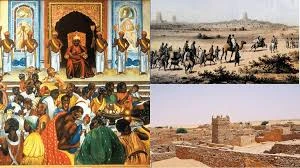
Where did the name “Ghana” come from?
The name “Ghana” came from the title of the king, who was called the “Ghana”.
- Arab and North African writers: they later used the king’s title for the whole kingdom.
- The people’s name: the people called their country “Wagadou”.
How did the Ghana Empire begin?
The Ghana Empire began as a small kingdom founded by the Soninke people.
Early beginnings
- The Soninke: farmers and traders who spoke a Mande language.
- Homeland: villages along the upper parts of the Niger and Senegal rivers.
- Dinga Cisse: oral tradition says he united several Soninke clans and set up the Wagadou kingdom around 300 CE.
- Growth: the kingdom became stronger as it gained control of local gold mines and trade routes.
Why was the location of Ghana good for trade?
Ghana lay between the gold-producing lands of the south and the salt mines of the Sahara, so it could control trade between them.
- Between gold and salt: gold lands lay to the south and Saharan salt mines to the north.
- Rivers: it controlled parts of the Senegal and Niger rivers, used for transport and communication.
- Sahel: the empire lay in the Sahel, the transition zone between the Sahara Desert and the forests to the south.
- Control of movement: Ghana could control goods and people moving between these regions.
- Water for farming: the rivers supported farming in a dry region.
How was the Ghana Empire governed?
The Ghana Empire was ruled by a king who held both political and religious power.
The king and the royal court
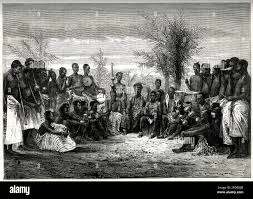
- Role of the king: he was believed to have divine connections and kept harmony between the people and the spirit world.
- Palace: the king lived in a palace complex built of stone.
- Dress: he wore fine clothes decorated with gold and sat on a raised platform.
- Attendants: counsellors, guards and court officials surrounded him during audiences.
- Music: royal musicians and praise-singers announced his appearance.
- Royal symbols: swords and gold ornaments passed from king to king and showed the ruler’s authority.

How was the empire administered?
The empire had a well-organised government with officials who helped the king rule.
- Governors: the king appointed them to rule provinces.
- Council of ministers: it advised the king on important matters.
- Tax collectors: they gathered wealth from traders and subjects.
- Judges: they settled disputes according to traditional law.
- Messengers: they carried the king’s orders across the kingdom.
- Local chiefs: in conquered lands, chiefs often kept their power if they paid tribute and stayed loyal.
This allowed Ghana to control a large area without replacing every local leader.
How was the army organised?
The army protected trade routes, defended the empire and conquered neighbouring peoples.
- Size: some accounts say the king could gather an army of 200,000 men.
- Core force: full-time soldiers loyal to the king.
- Extra warriors: more men were called up from across the empire when needed.
- Units: infantry on foot and cavalry on horses.
- Weapons: bows and arrows, spears and swords.
- Elite soldiers: some wore metal armour and carried shields.
How did the Ghana Empire earn its wealth?
Ghana earned its wealth mainly from trans-Saharan trade, taxes and tribute, while most people lived by farming.
What was trans-Saharan trade?
Trans-Saharan trade was the exchange of goods between West Africa and North Africa across the Sahara Desert.
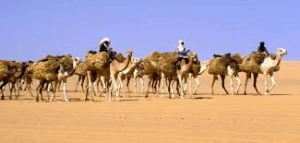
| Goods | Source |
|---|---|
| Gold | Mines in regions south of Ghana (modern Ghana and Ivory Coast, according to the original note) |
| Salt | Mines in the Sahara Desert, especially Taghaza |
| Copper, cloth, tools, weapons and luxury goods | North African traders |
- Crossing points: Ghana controlled where the trade routes crossed the Niger and Senegal rivers.
- Middleman: the empire taxed goods moving in every direction.
- Value of salt: salt was needed in the hot climate to preserve food and replace salt lost through sweating.
- Salt for gold: salt was so valuable that it was exchanged for gold.
How did the kings collect taxes and wealth?
The Ghana kings grew rich by taxing trade and collecting tribute from conquered peoples.
- Trade taxes: all traders passing through Ghana paid taxes on their goods.
- Gold nuggets: the king claimed all gold nuggets found in the empire, but gold dust could be traded freely.
- Tribute: conquered peoples paid food, livestock and luxury goods.
- Collection points: royal officials collected taxes at major markets and border crossings.
- Weighing: special officials weighed gold dust and measured other goods.
- Use of wealth: taxes supported the court, officials and army.
- Royal treasury: it stored gold, salt, ivory and other valuables.
What did farming and local production add?
Most people in the Ghana Empire were farmers, and their food supported everyone else.
- Crops: millet, sorghum, rice and vegetables.
- Livestock: cattle, sheep and goats.
- Crafts: pottery, leather working and weaving.
- Iron work: iron smelting and blacksmithing were important technologies.
- Fishing: common along the rivers.
- Why it mattered: farming fed traders, officials, soldiers and craft workers who did not grow their own food.
What was life like in the Ghana Empire?
Life in the Ghana Empire was shaped by social class, traditional religion and town life.
What were the social classes?
The Ghana Empire had five social classes, listed here from highest to lowest.
- Royal family and nobles: the highest class.
- Wealthy merchants and religious leaders: important traders and religious leaders.
- Craftspeople and skilled workers: the middle class.
- Farmers: the largest group in society.
- Slaves: often captured in wars, they worked for the upper classes.
- Status: a person’s birth family usually decided their position.
- Moving up: skilled traders or warriors could sometimes rise by serving the king.
What religion did the people follow?
The original religion of Ghana was the worship of ancestors and nature spirits.
- Chief priest: the king was the chief religious leader.
- Shrines: sacred groves and shrines were kept across the kingdom.
- Ceremonies: they included music, dance and animal sacrifices.
- Divination: spiritual practitioners used it to communicate with the spirit world.
- Ancestor worship: an important part of family life.
- Islam: trade with North Africa brought Islam, and Muslim traders built mosques in trading cities.
- Royal court: some members studied Islamic learning.
- Ordinary people: most kept their traditional religion.
What were the towns like?
The empire had large trading towns and many small villages, and the capital was Koumbi Saleh.
- Koumbi Saleh: the capital, with an estimated 15,000 to 20,000 people.
- Two sections: the royal town where the king lived, and the Muslim traders’ quarter.
- Buildings: stone or sun-dried brick, some with several storeys.
- Common homes: round huts with thatched roofs.
- Public places: markets, mosques and shrines.
Why did the Ghana Empire decline?
The Ghana Empire began to decline around 1100 CE because of drought, attack, rebellion and changes in trade.
- Drought: a series of droughts weakened farming and trade.
- Almoravid attack: the Almoravids, a North African Muslim dynasty, attacked Ghana around 1076 CE.
- Rebellions: conquered peoples rose up to seek independence.
- New trade routes: they bypassed Ghana’s territory.
- Rival states: competition from rising states like Mali increased.
- Land damage: overuse of land may have harmed the environment.
- Result: by 1200 CE, Ghana had lost most of its power and territory.
What was the legacy of the Ghana Empire?
The legacy of the Ghana Empire is the trade patterns, government ideas and example of organised statehood that later West African states inherited.
- Trade: it set patterns of Saharan trade that lasted for centuries.
- Government: its system influenced later kingdoms such as Mali and Songhai.
- Civilisation: it showed that African states could build advanced societies long before European colonisation.
- Fame: Arab writers described its kings as among the richest on Earth, and its wealth inspired later explorers and traders.
- Continuity: cultural practices and social structures continued in successor states.
- Mali Empire: it followed Ghana and built on many of its achievements.
Evaluation
- Where did the name “Ghana” come from, and what did the people call their country?
- Name three things that gave the Ghana Empire a good location for trade.
- Describe how the Ghana kings collected taxes and tribute.
- Describe the army of the Ghana Empire.
- State four reasons why the Ghana Empire declined.
Assignment
- Explain how trans-Saharan trade made the Ghana Empire rich.
- Describe the social classes of the Ghana Empire, starting with the highest class.
This term's Nigerian History topics
JSS2 Third Term · 3 topics
- Ghana Empire
- Mali Empire
- Songhai Empire
JSS2 Nigerian History Lesson Notes for Other Topics
Mali Empire
Read the full lesson note.
Songhai Empire
Read the full lesson note.
Major Non-Centralized States In Pre-Colonial Nigeria
Read the full lesson note.
Non-Centralized States - The Tiv
Read the full lesson note.
Non-Centralized States: The Igbo
Read the full lesson note.
Non-Centralized States: The Idoma
Read the full lesson note.
Relationship Between People From Different Centres Of Civilization In Precolonial Nigeria: Ife/Benin
Read the full lesson note.
Relationship Between People From Different Centers Of Civilization In Precolonial Nigeria: Igbo/Ibibio
Read the full lesson note.
Inter-Relationships Of Some Centres Of Civilisation In Pre-Colonial Nigeria
Read the full lesson note.
Lesson Notes for Other Classes

JSS1 Lesson Note
The complete lesson note to guide your studies.

JSS3 Lesson Note
The complete lesson note to guide your studies.
