
Polygon – JSS2 Basic Technology Lesson Note (Second Term)
Download this term · ₦1,000Lesson note at a glance
- Subject
- Basic Technology
- Class
- JSS2
- Term
- Second Term
- Topic
- Polygon
- Order
- Topic 2 of 9 this term
- Reading time
- 8 min
A polygon is a plane figure with at least three sides, all of them straight.
Behavioural objectives
By the end of the lesson, students should be able to:
- define a polygon and give examples of shapes that are not polygons;
- explain the terms equilateral, equiangular and regular;
- classify triangles and quadrilaterals by their sides and angles;
- calculate the area and perimeter of triangles and common quadrilaterals;
- name polygons with five to twelve sides;
- name the parts of a circle and state the formula for its area.
What is a polygon?
A polygon (POL-ee-gone) is a plane figure whose edges are all straight lines.
- Plane figure: any shape that can be drawn on a flat surface.
- Fewest sides: a polygon has at least three sides, so the triangle has the fewest.
- Naming: polygons are named by their number of sides, such as quadrilateral (four), pentagon (five) and hexagon (six).
- Not polygons: circles, semicircles and ellipses, because they have curved sides.
What do equilateral, equiangular and regular mean?
A regular polygon is one that has all its sides equal and all its angles equal.
| Term | Meaning | Example |
|---|---|---|
| Equilateral (ee-quee-LAH-teh-roll) | All sides are equal. | Rhombus (angles not all equal) |
| Equiangular (ee-quee-ANG-ger-lah) | All angles are equal. | Rectangle (sides not all equal) |
| Regular | Both equilateral and equiangular. | Square, equilateral triangle |
- Remember: an equilateral shape may not be equiangular.
- Remember: an equiangular shape may not be equilateral.
- Exception: an equilateral triangle is always both.
What are area and perimeter?
Perimeter is the distance around a plane figure, and area is the amount of surface it covers.
| Feature | Perimeter | Area |
|---|---|---|
| It measures | The length around the shape | The size of the surface inside the shape |
| Usual units | cm, m | cm², m² |
| Formula | Different for each shape | Different for each shape |
What are triangles?
A triangle is a polygon with three sides and three angles.
- Classification: a triangle can be classified by its sides or by its angles.
- Number of kinds: there are three kinds in each classification.
What are the types of triangle by sides?
There are three types of triangle by sides: equilateral, isosceles and scalene.
- Equilateral triangle: three equal sides and three equal angles, so it is also equiangular. Each angle is 60°.
- Isosceles triangle: two equal sides. The two angles opposite the equal sides are also equal.
- Scalene triangle: no equal sides and no equal angles.
What are the types of triangle by angles?
There are three types of triangle by angles: right, obtuse and acute.
- Right triangle: has one right angle (90°). Its longest side is called the hypotenuse.
- Obtuse triangle: has one obtuse angle (more than 90°).
- Acute triangle: has no right angle and no obtuse angle. All three angles are less than 90°.
What is the sum of the interior angles of a triangle?
The interior angles of a triangle add up to 180°.
Worked example: in triangle ABC, angle A is 60° and angle B is 70°. Find angle C.
- Write the rule: A + B + C = 180°.
- Substitute: 60° + 70° + C = 180°.
- Add the known angles: 130° + C = 180°.
- Subtract: C = 180° minus 130° = 50°.
What are the base and height of a triangle?
The base is the side of the triangle that we choose to treat as its bottom, and the height is the perpendicular distance from the base to the opposite corner.
- Base: usually drawn horizontally. Any side can be the base if you turn the paper.
- Furthest point: the corner that is not on the base and lies furthest from it.
- Height: the line from that corner, perpendicular to the base.
- Altitude: another name for the height. It means the same thing.
How do you find the area and perimeter of a triangle?
The area of a triangle is half of its base multiplied by its height.
- Area: A = ½ × base × height. Only the base and the height are needed.
- Perimeter of any triangle: add all three sides.
- Equilateral triangle: multiply one side by three.
- Isosceles triangle: multiply one equal side by two, then add the third side.
Worked example: a triangle has a base of 8 cm and a height of 5 cm.
- Write the formula: A = ½ × base × height.
- Substitute: A = ½ × 8 × 5.
- Calculate: A = 20 cm².
What are quadrilaterals?
A quadrilateral is a polygon with four sides.
- Groups: the main groups are parallelograms, trapeziums, kites and irregular quadrilaterals.
What are parallelograms?
A parallelogram is a quadrilateral whose opposite sides are parallel, with opposite sides and opposite angles equal.
- Rectangle: a parallelogram with all angles 90°. Width (or breadth) is the shorter side and length is the longer side.
- Rhombus: a parallelogram with all sides equal and opposite angles equal.
- Square: a parallelogram that is both a rectangle and a rhombus. All angles are right angles and all sides are equal.

What are trapeziums?
A trapezium is a quadrilateral with one pair of parallel opposite sides.
- American English: it is called a trapezoid.
- Bases: the parallel sides are sometimes called the upper and lower bases.
- Right-angle trapezium: a trapezium with a right angle.
- Isosceles trapezium: a trapezium whose lateral (non-parallel) sides are equal.
- Scalene trapezium: a trapezium that fits neither of the two types above.

What is a kite?
A kite is a quadrilateral with two pairs of equal adjacent sides.
- Sides: each pair of equal sides meets at a corner.
- Angles: one pair of opposite angles is equal.

What are irregular quadrilaterals?
An irregular quadrilateral is any four-sided figure that does not fit into the groups above.
How do you find the area of a quadrilateral?
The area of a parallelogram is its base multiplied by its height.
- Rectangle: length × width.
- Parallelogram: base × height. This is the triangle rule without dividing by two.
- Square: side × side (square the length of one side).
- Trapezium: ½ × (sum of the parallel sides) × height.
- Other shapes: cut the shape into smaller pieces, find each area and add them.
- Example of cutting: a right-angle trapezium splits into a right-angled triangle and a rectangle.
How do you find the perimeter of a quadrilateral?
The perimeter of any quadrilateral is the sum of its four sides.
- Rectangle: add the length and the width, then multiply by two.
- Square: multiply the length of one side by four.
- Isosceles trapezium: multiply one lateral side by two, then add the other two sides.
- Kite: add the two different sides and multiply by two.
- Other quadrilaterals: add up all the sides.
What are the names of polygons with five to twelve sides?
Polygons with five to twelve sides are the pentagon, hexagon, heptagon, octagon, nonagon, decagon, hendecagon and dodecagon.
| Number of sides | Name |
|---|---|
| 5 | Pentagon |
| 6 | Hexagon |
| 7 | Heptagon (or septagon) |
| 8 | Octagon |
| 9 | Nonagon |
| 10 | Decagon |
| 11 | Hendecagon (or undecagon), extra |
| 12 | Dodecagon, extra |
How do you find the perimeter and area of these polygons?
The perimeter of any polygon is the sum of all its sides.
- Equilateral polygon: multiply one side by the number of sides.
- Other polygons: you may need to work out some lengths yourself.
- Tip: look for equal lengths and equal angles to make the problem easier.
There are two main ways of finding the area of these shapes: dissecting and filling.
- Dissecting: cut the figure into parallelograms, squares and triangles, then add their areas.
- Filling: add extra parts to make the shape look like shapes you know.
Example of filling: finding the area of a triangle when its altitude is not known.
- Draw a rectangle around the triangle so that its corners touch the rectangle.
- Three surrounding triangles are formed between the triangle and the rectangle.
- Find the area of the rectangle and of each surrounding triangle.
- Subtract the three surrounding areas from the rectangle to get the area of the original triangle.
What are circles and other plane figures?
A circle is a plane figure made of all the points that are the same distance from its centre.
- Circumference: the perimeter of a circle.
- Other curved figures: the ellipse and the semicircle. They are not polygons.
- Formulae: each of these shapes has its own formulae, which you must learn.
What are the parts of a circle?
The main parts of a circle are the diameter, radius, chord and arc.
- Diameter: the line from one side of the circle, through the centre, to the other side.
- Radius: the line from the centre to any point on the circumference.
- Chord: a line joining two points on the circumference without passing through the centre.
- Arc: any part of the circumference.

What is π (pi)?
Pi (π, pronounced “pie”) is the number you get when you divide the circumference of any circle by its diameter.
- Value: slightly larger than 3. Use 3.14 or 22/7 at this level.
- Diameter: circumference ÷ π.
- Circumference: diameter × π.
- Area of a circle: πr², where r is the radius.
What are ellipses and semicircles?
You only need to know the names and basic features of these two shapes at this level.
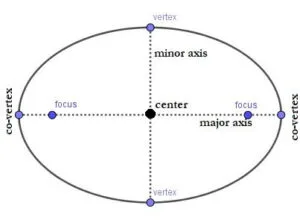
- Ellipse: an oval shape drawn by a stricter rule than a crushed circle. It has two centres called foci.
- Semicircle: half of a circle, cut along the diameter.
- Angle in a semicircle: join a point on the curved edge to both ends of the diameter and you always get a right angle.
Evaluation
- What is a polygon? Give one reason why a circle is not a polygon.
- State the difference between an equilateral shape and an equiangular shape. Give one example of each that is not both.
- Name the three types of triangle classified by sides and the three classified by angles.
- A triangle has a base of 10 cm and a height of 6 cm. Find its area.
- Define diameter, radius and chord.
Assignment
Answer these three parts in your exercise book.
- Write the names of the polygons with five, six, seven, eight, nine and ten sides.
- A rectangle has a length of 8 cm and a width of 5 cm. Find its perimeter and its area.
- Write the formula for the area of a circle. State what the circumference divided by the diameter gives.
This term's Basic Technology topics
JSS2 Second Term · 9 topics
Get Basic Technology as PDF and Word
Every week of JSS2 Basic Technology, Second Term, formatted and ready to print. Ad-free, and the copy lock comes off.
Get this term Card, bank transfer, USSD or OPay
JSS2 Basic Technology Lesson Notes for Other Topics
Quadrilaterals
Read the full lesson note.

Area Of Plane Figures
Read the full lesson note.

WoodWork Machines
Read the full lesson note.

MetalWork Machine
Read the full lesson note.

Friction
Read the full lesson note.

Friction - Reducing Friction
Read the full lesson note.
Building Material And Types Of Building Materials
Read the full lesson note.

Free Hand Sketching
Read the full lesson note.

Rescue Operation
Read the full lesson note.
Material Used And Their Common Uses
Read the full lesson note.

Material Used And Their Common Uses; Ceramic, Glass And Rubber
Read the full lesson note.
Geometric Construction
Read the full lesson note.

Angles
Read the full lesson note.

Triangles
Read the full lesson note.

Circle
Read the full lesson note.
Lesson Notes for Other Classes

JSS1 Lesson Note
The complete lesson note to guide your studies.

JSS3 Lesson Note
The complete lesson note to guide your studies.
