
Gears – JSS2 Basic Technology Lesson Note (Third Term)
Download this term · ₦1,000Lesson note at a glance
- Subject
- Basic Technology
- Class
- JSS2
- Term
- Third Term
- Topic
- Gears
- Order
- Topic 3 of 7 this term
- Reading time
- 5 min
A gear (or cogwheel) is a rotating machine part with cut teeth, called cogs, that mesh with another toothed part to transmit torque.
Behavioural objectives
By the end of the lesson, students should be able to:
- define a gear;
- state what geared devices can change in a power source;
- explain what a gear train, a rack and a gear ratio are;
- name and describe at least five types of gear.
What is a gear and how does it work?
A gear works by meshing its teeth with the teeth of another gear, so that turning one makes the other turn.
- Torque: the turning force that a gear passes from one shaft to another.
- Meshing: the teeth of two gears fit into each other. The teeth on both gears have the same shape.
- No slipping: the teeth lock together, so gears do not slip as belts and pulleys can.
- What gears can change: the speed, the torque and the direction of a power source.
- Simple machine: gears almost always change torque through their gear ratio, so they give a mechanical advantage.
What are a gear train and a rack?
A gear train is two or more meshing gears working in a sequence, and it is also called a transmission.
- Gear train: a group of meshing gears that passes motion along from one shaft to the next.
- Rack: a straight (linear) toothed part that meshes with a gear.
- Rack and gear action: the gear turns, but the rack moves in a straight line. This gives translation instead of rotation.
- Comparison with belts: the gears in a transmission are like the wheels in a cross-belt pulley system, but the teeth prevent slippage.
What is a gear ratio?
A gear ratio is the number of teeth on the driven gear divided by the number of teeth on the driver gear.
- Driver gear: the gear that is turned by the power source.
- Driven gear: the gear that is turned by the driver.
- Bigger driven gear: it turns more slowly but gives more torque.
- Smaller driven gear: it turns faster but gives less torque.
- Direction: two external gears that mesh turn in opposite directions.
Worked example
- A driver gear has 20 teeth and the driven gear has 40 teeth.
- Gear ratio = 40 ÷ 20 = 2, written as 2 : 1.
- The driven gear turns at half the speed of the driver.
- The driven gear gives twice the torque.
What does the word “gear” mean in a bicycle or car?
In a bicycle, motorcycle or car, “gear”, as in “first gear”, means a gear ratio and not one physical gear.
- Examples: first gear, second gear and top gear on a car or motorcycle.
- Continuous ratios: the word is also used for devices whose ratio changes smoothly.
- No gears at all: it is used even for a continuously variable transmission, which does not contain gears.
What are the types of gear?
There are many types of gear, and this note covers nine: spur, helical, rack, bevel, spiral bevel, screw, miter, worm and internal gears.
Spur gears
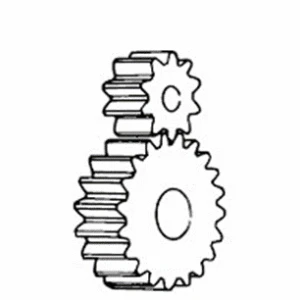
Spur gears are the most common and easiest to produce of all gears.
- Shafts: they join parallel shafts.
- Shape: they are cylindrical gears with straight teeth.
- Names in a pair: the larger gear is called the gear and the smaller one is the pinion.
Helical gears
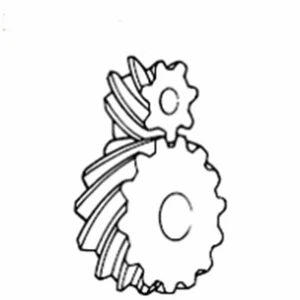
Helical gears are cylindrical gears with spiral-shaped tooth traces.
- Noise: they are quiet.
- Torque: they can transmit larger torque than spur gears.
Gear rack
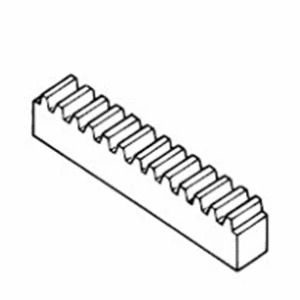
A gear rack changes rotary motion to linear motion.
- Parts: a rectangular or circular rod-shaped gear and a small mating gear (the pinion).
- Action: the turning pinion moves the rack in a straight line.
Bevel gear
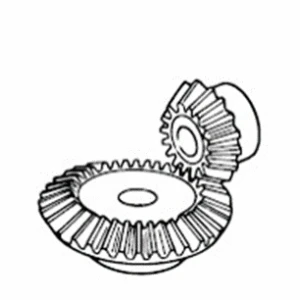
Bevel gears are cone-shaped gears used where shafts intersect.
- Straight bevel gears: the teeth are straight.
- Spiral bevel gears: a related type with spiral-shaped tooth traces.
Spiral bevel gear
A spiral bevel gear is a cone-shaped gear with spiral-shaped tooth traces, used where shafts intersect.
- Shafts: intersecting shafts, as with other bevel gears.
- Teeth: curved, unlike the straight teeth of straight bevel gears.
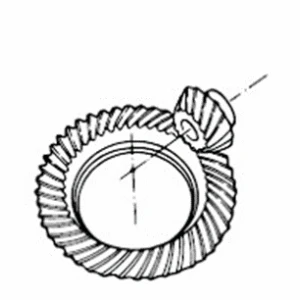
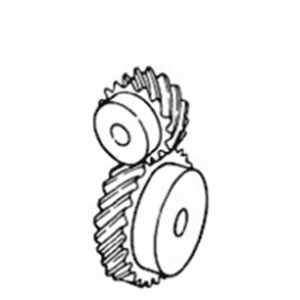
Screw gear
Screw gears are used where the shafts are offset.
- Shape: the same as helical gears.
- Use: offset shaft applications.
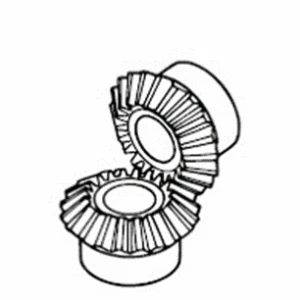
Miter gear
A miter gear is a bevel gear in which both gears of the pair have the same number of teeth.
- Gear ratio: 1 : 1, so the speed does not change.
- Use: where speed reduction or increase is not needed.
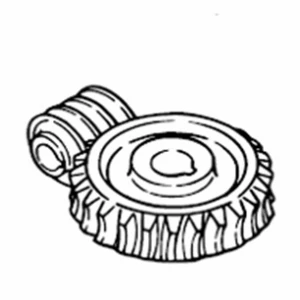
Worm gear
Worm gears are used when a large speed reduction is needed.
- Parts: a worm and a worm gear, sold as a set.
- Materials: different materials are normally used for the worm and the worm gear.
Internal gear
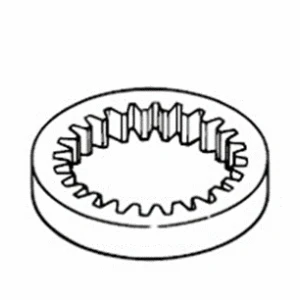
An internal gear has its teeth cut on the inside surface of a hollow cylindrical form.
- Use: planetary gear systems.
- Making: the teeth are cut on gear shaper machines.
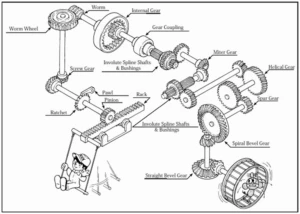
Which gear is used for which job?
Each type of gear suits a particular shaft arrangement or job, as the table shows.
| Gear | Shaft arrangement or job | Key point |
|---|---|---|
| Spur | Parallel shafts | Most common, easy to make |
| Helical | Parallel shafts | Quiet, carries larger torque |
| Gear rack | Rotary to linear motion | Rack moves in a straight line |
| Bevel | Intersecting shafts | Cone-shaped |
| Spiral bevel | Intersecting shafts | Spiral-shaped teeth |
| Screw | Offset shafts | Same shape as helical gears |
| Miter | Intersecting shafts | Equal number of teeth |
| Worm | Large speed reduction | Worm and worm gear set |
| Internal | Planetary gear systems | Teeth cut inside a hollow form |
Evaluation
- Define a gear.
- Mention five types of gear.
- What is a gear train?
- Which type of gear is used when a large speed reduction is needed?
- A driver gear has 15 teeth and the driven gear has 45 teeth. State the gear ratio.
Assignment
In one or two sentences each, describe the helical gear, the gear rack and the internal gear.
This term's Basic Technology topics
JSS2 Third Term · 7 topics
Get Basic Technology as PDF and Word
Every week of JSS2 Basic Technology, Third Term, formatted and ready to print. Ad-free, and the copy lock comes off.
Get this term Card, bank transfer, USSD or OPay
JSS2 Basic Technology Lesson Notes for Other Topics

Belt And Chain Drive
Read the full lesson note.

Belt And Chain Drive: Uses, Advantages and Disadvantages
Read the full lesson note.

Gear Ratio And Speed
Read the full lesson note.

Hydraulics And Pneumatic Machines
Read the full lesson note.

Site Preparation And Setting Out
Read the full lesson note.

Building Services - Taps & Water Supply
Read the full lesson note.

Rescue Operation
Read the full lesson note.

Material Used And Their Common Uses
Read the full lesson note.

Material Used And Their Common Uses; Ceramic, Glass And Rubber
Read the full lesson note.

Geometric Construction
Read the full lesson note.

Angles
Read the full lesson note.

Triangles
Read the full lesson note.

Circle
Read the full lesson note.

Quadrilaterals
Read the full lesson note.

Polygon
Read the full lesson note.
Lesson Notes for Other Classes

JSS1 Lesson Note
The complete lesson note to guide your studies.

JSS3 Lesson Note
The complete lesson note to guide your studies.
