
Theories of Music – JSS1 Cultural & Creative Arts Lesson Note (Third Term)
Download Lesson NoteLesson note at a glance
- Subject
- Cultural & Creative Arts
- Class
- JSS1
- Term
- Third Term
- Topic
- Theories of Music
- Order
- Topic 3 of 9 this term
- Reading time
- 6 min
Music theory is the study of the building blocks and patterns that make up music. It includes the rules, symbols, and language musicians use to write, read, and understand music. Music theory helps us understand how sounds are organised to create melodies, rhythms, and harmonies.

Behavioural objectives
By the end of the lesson, students should be able to:
- state the four properties of musical sound
- draw and describe the staff, and name the lines and spaces of the treble and bass staves
- identify the treble clef and the bass clef and say what each is used for
- name the common note values and rests and give the number of beats for each
- explain what a time signature, a scale, a key signature, an interval and a chord are
- explain common tempo, dynamic and expression terms
What are the basic elements of music theory?
Sound
- Sound is vibration that travels through air.
- Musical sound has four main properties:
- Pitch (high or low)
- Duration (long or short)
- Volume (loud or soft)
- Timbre (quality or colour of sound)
Notes
- Notes are symbols that represent musical sounds.
- Each note has a specific pitch and duration.
- Notes are named using letters: A, B, C, D, E, F, G.
- These seven letters repeat at higher or lower pitches.
The musical alphabet
- It consists of seven letters: A, B, C, D, E, F, G.
- After G, the pattern starts again with A.
- Each repetition is called an octave.
What is the staff (stave)?
The staff is a set of five horizontal lines and four spaces where musical notes are written.
Components of the staff
- Five parallel horizontal lines
- Four spaces between the lines
- Notes can be placed on lines or in spaces
- Each line and space represents a different pitch
Types of staff
- Treble staff: used for higher-pitched instruments and voices
- Bass staff: used for lower-pitched instruments and voices
What are musical clefs?
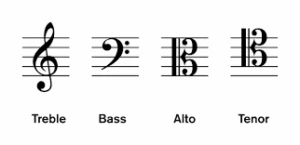
Treble clef (G clef)
- Symbol: 𝄞
- It shows that the second line from the bottom represents the note G.
- Used for:
- Soprano and alto voices
- Violin, flute, trumpet
- Right hand on piano
Bass clef (F clef)
- Symbol: 𝄢
- It shows that the fourth line from the bottom represents the note F.
- Used for:
- Bass voices
- Tuba, trombone, bassoon
- Left hand on piano
What are the lines and spaces on the treble and bass staves?
Treble staff
Lines (from bottom to top):
- E, G, B, D, F
- Memory aid: “Every Good Boy Does Fine”
Spaces (from bottom to top):
- F, A, C, E
- Memory aid: “FACE”
Bass staff
Lines (from bottom to top):
- G, B, D, F, A
- Memory aid: “Good Boys Do Fine Always”
Spaces (from bottom to top):
- A, C, E, G
- Memory aid: “All Cows Eat Grass”
What are note values and duration?
| Note | Symbol | Duration | Remark |
|---|---|---|---|
| Whole note (semibreve) | ○ | 4 beats | Longest common note value |
| Half note (minim) | 𝅗𝅥 | 2 beats | Half the duration of a whole note |
| Quarter note (crotchet) | ♩ | 1 beat | Quarter the duration of a whole note |
| Eighth note (quaver) | ♪ | ½ beat | Eighth the duration of a whole note |
| Sixteenth note (semiquaver) | ♬ | ¼ beat | Has two flags or beams |
What are rests?
Rests are symbols showing silence in music. Each rest corresponds to a note value:
- Whole rest: 4 beats of silence (hangs below the line)
- Half rest: 2 beats of silence (sits on the line)
- Quarter rest: 1 beat of silence (looks like a squiggly line)
- Eighth rest: ½ beat of silence (has one flag)
- Sixteenth rest: ¼ beat of silence (has two flags)
What are time signatures?
A time signature is a pair of numbers at the beginning of music showing how many beats are in each measure.
Common time signatures
- 4/4 time: four quarter-note beats per measure (most common)
- 3/4 time: three quarter-note beats per measure (waltz time)
- 2/4 time: two quarter-note beats per measure (march time)
- 6/8 time: six eighth-note beats per measure
Reading time signatures
- Top number: how many beats in each measure
- Bottom number: what type of note gets one beat
What are scales?
A scale is a series of notes arranged in ascending or descending order.
Major scale
- Eight notes following a specific pattern
- Pattern of whole steps (W) and half steps (H): W-W-H-W-W-W-H
- Example: C major scale: C-D-E-F-G-A-B-C
- Sounds happy and bright
Minor scale
- Eight notes with a different pattern
- Natural minor pattern: W-H-W-W-H-W-W
- Example: A minor scale: A-B-C-D-E-F-G-A
- Sounds sad or serious
What are key signatures?
A key signature is a set of sharps or flats placed at the beginning of music showing which notes are always sharp or flat.
- Sharp (#): raises a note by one half step
- Flat (♭): lowers a note by one half step
- Natural (♮): cancels a sharp or flat
What are the basic musical terms?
Tempo terms
| Term | Meaning |
|---|---|
| Largo | Very slow |
| Adagio | Slow |
| Andante | Walking pace |
| Moderato | Moderate speed |
| Allegro | Fast |
| Presto | Very fast |
Dynamic markings (volume)
| Marking | Meaning |
|---|---|
| pp (pianissimo) | Very soft |
| p (piano) | Soft |
| mp (mezzo-piano) | Medium soft |
| mf (mezzo-forte) | Medium loud |
| f (forte) | Loud |
| ff (fortissimo) | Very loud |
Expression terms
| Term | Meaning |
|---|---|
| Crescendo | Gradually getting louder |
| Diminuendo | Gradually getting softer |
| Legato | Smooth and connected |
| Staccato | Short and detached |
What are musical intervals?
An interval is the distance between two notes.
| Interval | Distance |
|---|---|
| Unison | Same note |
| Second | One step apart |
| Third | Two steps apart |
| Fourth | Three steps apart |
| Fifth | Four steps apart |
| Octave | Seven steps apart (the eighth note, with the same letter name, higher or lower) |
What are chords?
A chord is three or more notes played together.
- Major chord: sounds happy (C-E-G)
- Minor chord: sounds sad (A-C-E)
- Diminished chord: sounds tense
- Augmented chord: sounds mysterious
What are rhythm patterns?
- Beat: the steady pulse in music
- Meter: how beats are grouped (in 2s, 3s, or 4s)
- Syncopation: emphasis on weak beats
- Polyrhythm: multiple rhythms played together
How is music theory used in practice?
- Reading music: using theory to read sheet music
- Writing music: creating your own melodies
- Playing instruments: understanding what you play
- Singing: reading vocal music
- Music appreciation: understanding how music works
Why is music theory important?
- It provides a common language for musicians.
- It helps in learning instruments faster.
- It enables music composition.
- It improves listening skills.
- It enhances musical creativity.
- It builds a foundation for advanced music studies.
Evaluation
- What is music theory?
- Name the four properties of musical sound.
- Write the notes on the lines and in the spaces of the treble staff, from bottom to top.
- State the number of beats for a whole note, a half note and a quarter note.
- What do the top and bottom numbers of a time signature tell you?
Assignment
- Write out the C major scale and the A minor scale, and state the step pattern of each.
- List the six tempo terms in order from the slowest to the fastest.
- Explain the difference between a sharp, a flat and a natural.
This term's Cultural & Creative Arts topics
JSS1 Third Term · 9 topics
Third Term Cultural & Creative Arts (CCA) Lesson Notes for Other Topics

Creating a Drama Sketch from a Story
Read the full lesson note.
Types of Lines and Uses of Lines
Read the full lesson note.
Musical Notes
Read the full lesson note.
Musical Notes - Values and Rest Signs
Read the full lesson note.
Drawing
Read the full lesson note.
Methods of Moulding Objects
Read the full lesson note.
Introduction to Recorder Playing
Read the full lesson note.
Fashion Accessories - Singing Songs About Wearing Clothes
Read the full lesson note.

Definition of Music
Read the full lesson note.

Mode of Greeting
Read the full lesson note.
Element of Design
Read the full lesson note.
Definition of Drama and Theatre
Read the full lesson note.

Definition of Dance
Read the full lesson note.
Impersonation
Read the full lesson note.

Melodic Patterns Of Traditional Song
Read the full lesson note.
Lesson Notes for Other Classes

Basic 1 Lesson Note
The complete lesson note to guide your studies.

Basic 2 Lesson Note
The complete lesson note to guide your studies.
Basic 3 Lesson Note
The complete lesson note to guide your studies.

Basic 4 Lesson Note
The complete lesson note to guide your studies.

Basic 5 Lesson Note
The complete lesson note to guide your studies.
Basic 6 Lesson Note
The complete lesson note to guide your studies.

