
Position, Distance, Displacement – SS1 Physics Lesson Note (First Term)
Download this term · ₦1,000Lesson note at a glance
- Subject
- Physics
- Class
- SS1
- Term
- First Term
- Topic
- Position, Distance, Displacement
- Order
- Topic 2 of 7 this term
- Reading time
- 4 min
Position, distance and displacement describe where an object is and how far, and in what direction, it has moved.
Behavioural objectives
By the end of the lesson, students should be able to:
- define position and give the position of an object using co-ordinates;
- define distance and displacement;
- state the formulae for distance and displacement;
- say which of distance and displacement is a scalar and which is a vector;
- state the two ways of specifying a bearing and write a bearing in both forms.
What is position?
Position is the point at which an object can be located, or the place where the object is found.
- Co-ordinates: the signed distances of a point from two perpendicular axes, OX and OY.
- Origin (O): the point where the two axes meet. Positions are measured from it.
- Abscissa: the x co-ordinate, the distance along the OX axis.
- Ordinate: the y co-ordinate, the distance along the OY axis.
- Order of writing: the x co-ordinate is written first, then the y co-ordinate, that is, (X, Y).
- Example: a point at (3, 4) is 3 m along OX and 4 m along OY from the origin.

What are distance and displacement?
Distance is the total length of path covered between two positions, while displacement is the distance between two positions measured in a specific direction.
Distance
- Meaning: the total length of path travelled between two positions.
- Symbol: S.
- Unit: metre (m).
- Type: scalar quantity. It has size (magnitude) only, with no direction.
- Formula: distance = average speed × time.
Displacement
- Meaning: the distance between two positions measured in a specific direction.
- Symbol: X.
- Unit: metre (m).
- Type: vector quantity. It has both size and direction.
- Formula: displacement = average velocity × time.
- Direction: the direction of motion of a body can be found by using a compass.
What are scalar and vector quantities?
A scalar quantity has magnitude only, while a vector quantity has both magnitude and direction.
- Scalar examples: distance, speed, mass and time.
- Vector examples: displacement, velocity and force.
What is the difference between distance and displacement?
| Feature | Distance | Displacement |
|---|---|---|
| Type of quantity | Scalar | Vector |
| Direction | Not needed | Needed |
| Symbol | S | X |
| Unit | metre (m) | metre (m) |
| Formula | average speed × time | average velocity × time |
| Can it be zero after a journey? | No, if the body has moved | Yes, if the body returns to its start |
How are distance and displacement calculated?
Distance and displacement are found by multiplying speed or velocity by time, or by using the path and the start and end points.
- Distance: a car moves at an average speed of 5 m/s for 10 s. Distance = 5 × 10 = 50 m.
- Displacement: a boy runs at an average velocity of 5 m/s due east for 10 s. Displacement = 5 × 10 = 50 m east.
- Round trip: a student walks 60 m north and then 60 m south. Distance = 120 m. Displacement = 0 m, because she is back at the start.
- Two-leg journey: a man walks 4 m east and then 3 m north. Distance = 4 + 3 = 7 m. Displacement is the straight line from start to end. By Pythagoras, it is √(4² + 3²) = 5 m.
What is a bearing?
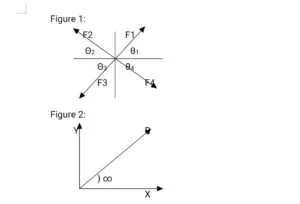
A bearing is the angle which the direction of an object from the origin makes with the north direction, measured in the clockwise sense.
- Reference line: the north direction is the starting line for every bearing.
- Use: a bearing together with a distance fixes the displacement of an object.
What are the two ways of specifying a bearing?
There are two ways of specifying a bearing: cardinal points and three-digit notation.
- Cardinal points: uses N (North), S (South), W (West) and E (East).
- Three-digit notation: gives the clockwise angle from north using three figures, for example 045°.
- Note: bearings given by cardinal points are measured from North or South, towards East or West.
What are the main directions in three-digit form?
| Direction | Three-digit bearing |
|---|---|
| North | 000° |
| East | 090° |
| South | 180° |
| West | 270° |
How do you change cardinal points to three digits?
| Cardinal form | Working | Three-digit form |
|---|---|---|
| N30°E | 30° clockwise from north | 030° |
| S40°E | 180° − 40° | 140° |
| S50°W | 180° + 50° | 230° |
| N20°W | 360° − 20° | 340° |
How do you change three digits to cardinal points?
| Three-digit form | Working | Cardinal form |
|---|---|---|
| 060° | Between N and E, so 60° from north | N60°E |
| 120° | Between E and S, so 180° − 120° = 60° from south | S60°E |
| 200° | Between S and W, so 200° − 180° = 20° from south | S20°W |
| 300° | Between W and N, so 360° − 300° = 60° from north | N60°W |
How do you write a bearing?
- Mark the north direction at the starting point.
- Draw the line from the starting point to the object.
- Measure the angle from north to this line, going clockwise.
- Write the angle with three digits, adding zeros in front if needed (for example 045°).
Evaluation
- Define position. How is the position of an object on a plane given?
- Which co-ordinate is called the abscissa, and which one is written first?
- Define distance and displacement, and write the formula for each.
- A man walks 6 m east and then 8 m north. Find the distance he covers and his displacement.
- State the two ways of specifying a bearing. Write S30°E in three-digit form.
Assignment
Write short notes on distance and displacement. For each, state the symbol, the unit, the formula, and whether it is a scalar or a vector quantity.
This term's Physics topics
SS1 First Term · 7 topics
- Fundamentals and Derived Quantities and Units
- Position, Distance, Displacement
- Time
- Motion
- Speed and Velocity
- Rectilinear Acceleration
- Scalars and Vectors
Get Physics as PDF and Word
Every week of SS1 Physics, First Term, formatted and ready to print. Ad-free, and the copy lock comes off.
Get this term Card, bank transfer, USSD or OPay
SS1 Physics Lesson Notes for Other Topics

Fundamentals And Derived Quantities And Units
Read the full lesson note.

Time
Read the full lesson note.

Motion
Read the full lesson note.

Speed And Velocity
Read the full lesson note.
Rectilinear Acceleration
Read the full lesson note.
Scalars And Vectors
Read the full lesson note.

Work, Energy And Power
Read the full lesson note.

Heat Energy
Read the full lesson note.

Electric Charges
Read the full lesson note.
Description And Property Of Fields
Read the full lesson note.
Electric Field
Read the full lesson note.

Particulate Nature Of Matter
Read the full lesson note.
Fluids At Rest And In Motion - Surface Tension
Read the full lesson note.

Units Of Measurements And Electrical Continuity Testing
Read the full lesson note.
Lesson Notes for Other Classes

SS2 Lesson Note
The complete lesson note to guide your studies.

SS3 Lesson Note
The complete lesson note to guide your studies.
