
Time – SS1 Physics Lesson Note (First Term)
Download this term · ₦1,000Lesson note at a glance
- Subject
- Physics
- Class
- SS1
- Term
- First Term
- Topic
- Time
- Order
- Topic 3 of 7 this term
- Reading time
- 5 min
Time is the period in which a process, action or event takes place. Its SI unit is the second (s). It is measured with the ticker-tape timer, stopwatch, simple pendulum and sand-clock, and with natural events such as the heartbeat.
Behavioural objectives
By the end of the lesson, students should be able to:
- define time and state its SI unit;
- state the relationship between day, hour, minute and second, and convert between them;
- describe the ticker-tape timer, stopwatch, simple pendulum, heartbeat and sand-clock as ways of measuring time;
- calculate the period of a simple pendulum;
- explain what a repetitive event is and give examples.
What is time?
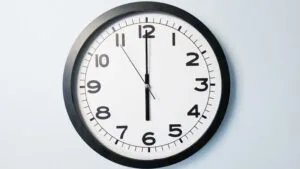
Time is the period in which a process, action or event takes place, or the point at which something occurs.
- Meaning: time tells us when an event happens and how long it lasts.
- Use in Physics: many quantities, such as velocity and acceleration, are calculated using time.
- Use in daily life: time keeps school periods, work, travel and sports events in order.
- Type of quantity: time is a fundamental quantity, and its SI unit is the second.
What are the units of time?
The SI unit of time is the second (symbol: s).
What is a solar day?
A solar day is the time the Earth takes to rotate once on its axis, which gives one day and one night.
- Solar day: the most natural unit of time, shown by the passing of day and night.
- Length: one solar day is 24 hours.
How are the units of time related?
| Larger unit | Equals |
|---|---|
| 1 day | 24 hours |
| 1 hour | 60 minutes |
| 1 minute | 60 seconds |
| 1 hour | 3600 seconds (60 × 60) |
| 1 day | 86 400 seconds (24 × 3600) |
How do we convert units of time?
To change to a smaller unit, multiply by the number linking the two units.
- Example 1: convert 1 day to minutes. 1 day = 24 hours, so 24 × 60 = 1440 minutes.
- Example 2: convert 2 hours to seconds. 2 × 60 = 120 minutes, then 120 × 60 = 7200 seconds.
What are the ways of measuring time?
There are five common ways of measuring time in this lesson: the ticker-tape timer, stopwatch, simple pendulum, heartbeat and sand-clock.
1. What is a ticker-tape timer?
A ticker-tape timer is a device that marks dots on a paper tape at equal time intervals to measure short times.
- Power: it works on an A.C. supply.
- Vibration: a steel strip with a stylus vibrates 50 times in 1 second.
- Time between dots: each dot is made after 1/50 s, which is 0.02 s.
- Tape: the body being studied pulls a paper tape through the timer.
- Dots: the space between dots shows the distance moved by the body in each 0.02 s.
- Close dots: the body moves slowly.
- Wide dots: the body moves fast.
- Use: it is commonly used in the study of motion.
2. What is a stopwatch?
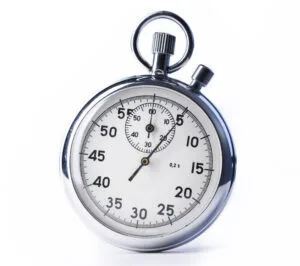
A stopwatch is an instrument used to measure the time taken for an event, starting and stopping at will.
- Where used: in the laboratory and on the field during sporting activities.
- Reading: it measures minutes and seconds.
- Analogue type: the second hand makes one revolution in one minute.
- Digital type: it shows the time as numbers on a screen.
3. What is a simple pendulum?
A simple pendulum is a small heavy bob hung from a fixed point by a light string, which swings to and fro.
- Oscillation: one complete to-and-fro swing of the bob.
- Period (T): the time taken for one complete oscillation.
- Use: in the laboratory, the time for many oscillations is measured with a stopwatch.
- Pendulum clock: a clock whose hands are regulated by a swinging pendulum.
The period is found by dividing the total time by the number of oscillations.
- Formula: T = total time ÷ number of oscillations.
- Example: a pendulum makes 20 oscillations in 30 s.
- Answer: T = 30 ÷ 20 = 1.5 s.
4. How is the heartbeat used to measure time?
The heartbeat is a natural way of counting time, because the heart beats at a fairly steady rate.
- Pulse: the beat can be felt at the wrist and counted.
- Medical use: doctors and nurses count the pulse rate over a minute.
- Limitation: the rate changes after exercise, fear or illness, so it is not very accurate.
5. What is a sand-clock?
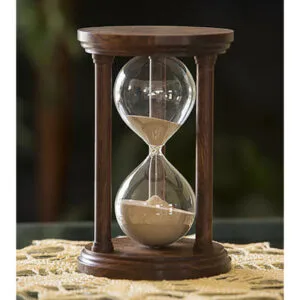
A sand-clock, also called an hourglass, is an instrument that measures a fixed time using sand running through a narrow neck.
- The sand starts in the top bulb.
- It runs through a small neck into the lower bulb.
- When all the sand has run down, the fixed time has passed.
- The glass is turned over to measure again.
- Time measured: it depends on the amount of sand and the size of the neck.
- Common design: some sand-clocks run for one hour, others for shorter times.
How do the five ways compare?
| Method | What it measures | Where it is used |
|---|---|---|
| Ticker-tape timer | Very short intervals (0.02 s steps) | Motion experiments in the laboratory |
| Stopwatch | Time taken for an event | Laboratory and sports field |
| Simple pendulum | Period of oscillation | Laboratory |
| Heartbeat | Rough time and pulse rate | Medical work |
| Sand-clock | A fixed time interval | Timing set periods |
What are repetitive events?
A repetitive event is an event that happens again and again at regular intervals.
- Day and night: after 24 hours the event recurs to give another day.
- Pendulum swing: each oscillation takes the same time as the one before.
- Heartbeat: the heart beats again and again at a steady rate.
- Ticker-tape vibration: the strip vibrates 50 times every second.
- Use in timing: counting repetitive events gives a measure of time, such as days, months and years.
Evaluation
- Define time and state its SI unit.
- How many minutes are in one day?
- Name the five ways of measuring time in this lesson.
- How many times does the ticker-tape timer vibrate in 1 second, and what is the time between two dots?
- What is a repetitive event? Give two examples.
Assignment
Convert 3 hours to seconds, showing each step.
This term's Physics topics
SS1 First Term · 7 topics
Get Physics as PDF and Word
Every week of SS1 Physics, First Term, formatted and ready to print. Ad-free, and the copy lock comes off.
Get this term Card, bank transfer, USSD or OPay
SS1 Physics Lesson Notes for Other Topics
Fundamentals And Derived Quantities And Units
Read the full lesson note.
Position, Distance, Displacement
Read the full lesson note.

Motion
Read the full lesson note.

Speed And Velocity
Read the full lesson note.
Rectilinear Acceleration
Read the full lesson note.
Scalars And Vectors
Read the full lesson note.

Work, Energy And Power
Read the full lesson note.

Heat Energy
Read the full lesson note.
Electric Charges
Read the full lesson note.

Description And Property Of Fields
Read the full lesson note.
Electric Field
Read the full lesson note.

Particulate Nature Of Matter
Read the full lesson note.
Fluids At Rest And In Motion - Surface Tension
Read the full lesson note.
Units Of Measurements And Electrical Continuity Testing
Read the full lesson note.
Lesson Notes for Other Classes

SS2 Lesson Note
The complete lesson note to guide your studies.

SS3 Lesson Note
The complete lesson note to guide your studies.
