
Heat Energy – SS1 Physics Lesson Note (Second Term)
Download this term · ₦1,000Lesson note at a glance
- Subject
- Physics
- Class
- SS1
- Term
- Second Term
- Topic
- Heat Energy
- Order
- Topic 2 of 3 this term
- Reading time
- 7 min
Heat is a form of energy that moves from a hotter body to a colder body because of a difference in temperature.
Behavioural objectives
By the end of the lesson, students should be able to:
- explain the difference between heat and temperature;
- state the effects of heat on a body;
- name common thermometers and their thermometric substances;
- state the advantages and disadvantages of mercury and alcohol as thermometric substances;
- define the upper fixed point, the lower fixed point and the fundamental interval;
- give examples of the effects, advantages and disadvantages of thermal expansion of solids.
What is heat?
Heat is energy that is transferred from one body to another because of a temperature difference.
- Direction of flow: heat flows from the body at higher temperature to the body at lower temperature.
- Unit: the joule (J), because heat is a form of energy.
- Example: a hot pot of soup gives heat to the cooler air around it.
What is temperature?
Temperature is the degree of hotness or coldness of a body.
- Type of quantity: temperature is a scalar quantity, so it has size but no direction.
- SI unit: the Kelvin (K). The degree Celsius (°C) is also used.
- Conversion: T (in K) = θ (in °C) + 273.
- Instrument: a thermometer measures temperature.
What are the differences between heat and temperature?
Heat is energy in transit, while temperature tells how hot or cold a body is.
| Heat | Temperature |
|---|---|
| Energy transferred from one body to another because of a temperature difference. | The degree of hotness or coldness of a body. |
| Heat flows from one body to another. | Temperature tells how hot or cold a body is. It does not flow. |
| Measured in joules. | Measured in Kelvin or Celsius. |
What are the effects of heat?
When heat is applied to a body, one or more of these effects may occur.
- Expansion: the volume of the body increases and its density decreases.
- Change in temperature: when heat is added to a body, its temperature rises.
- Change of state: melting, freezing, condensation, evaporation and so on.
- Thermionic emission: heating a metal may cause electrons to leave its surface.
What are thermometers and thermometric substances?
A thermometer is an instrument for measuring temperature, and a thermometric substance is a substance with a physical property that changes steadily with temperature.
The table shows five types of thermometer.
| SN | Thermometer | Thermometric substance | Physical property |
|---|---|---|---|
| 1 | Liquid in glass | Mercury or alcohol | Change in volume with temperature |
| 2 | Constant volume gas thermometer | Gas | Change in pressure with temperature |
| 3 | Thermocouple thermometer | Two different metals (iron and copper) | Change in potential difference due to temperature difference |
| 4 | Resistance thermometer | Resistance wire | Change in resistance with temperature |
| 5 | Bimetallic thermometer | Two dissimilar metals (brass and iron) | Differential expansion of the two metals of the bimetallic strip |
What are the advantages and disadvantages of mercury as a thermometric substance?
Mercury is a liquid metal widely used in liquid-in-glass thermometers.
Advantages of mercury
- Does not wet glass: the thread moves freely and leaves no film on the tube.
- Quick response: it reacts fast to a slight change in temperature.
- Low vaporisation: it does not vaporise easily.
- Opaque: the thread is easy to see.
- Uniform expansion: it expands regularly as temperature rises.
Disadvantages of mercury
- Cost: mercury is expensive.
- High freezing point: it freezes at -39°C, so it cannot measure very low temperatures.
What are the advantages and disadvantages of alcohol as a thermometric substance?
Alcohol is a liquid used in thermometers that measure low temperatures.
Advantages of alcohol
- Cheaper: it is less expensive than mercury.
- Large expansion: it expands more than mercury on heating (about 6 times more).
- Low temperatures: it can be used to measure very low temperatures.
Disadvantages of alcohol
- Not opaque: it must be coloured so that it can be seen.
- Vaporises easily: some of it escapes as vapour.
- Wets glass: it clings to the tube wall.
- Irregular expansion: it does not expand uniformly.
- Low boiling point: it boils at 78°C.
What are the advantages and disadvantages of the constant volume gas thermometer?
The constant volume gas thermometer measures temperature from the change in pressure of a gas kept at constant volume.
Advantages
- Accuracy: it gives a more accurate measurement than other thermometers.
- Sensitivity and range: it is very sensitive and measures a wide range of temperature.
Disadvantages
- Cost: it is very expensive and needs special care.
- Size: it is very cumbersome.
What are the fixed points of a thermometer?
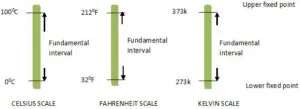
Fixed points are two reference temperatures chosen when preparing a scale for reading temperatures.
- Upper fixed point: the temperature of steam from pure boiling water at normal atmospheric pressure (100°C).
- Lower fixed point: the temperature of a mixture of pure ice and water at normal pressure (0°C).
- Fundamental interval: the interval between the upper and lower fixed points.
How is an unknown temperature found from the fixed points?
- Mark the length of the thread at the lower fixed point (L0).
- Mark the length of the thread at the upper fixed point (L100).
- Measure the length of the thread at the unknown temperature (Lθ).
- Use: θ = (Lθ – L0) ÷ (L100 – L0) × 100°C.
- Example: L0 = 2 cm, L100 = 22 cm, Lθ = 12 cm.
- Working: θ = (12 – 2) ÷ (22 – 2) × 100 = 50°C.
Why is water not used as a thermometric substance?
Water is not used because it has several properties that make it a poor thermometric liquid.
- Wets glass: it clings to the tube wall.
- Colourless: the thread is hard to see.
- Non-uniform expansion: it does not expand evenly.
- Small range: it is liquid only between 0°C and 100°C.
What is a clinical thermometer?
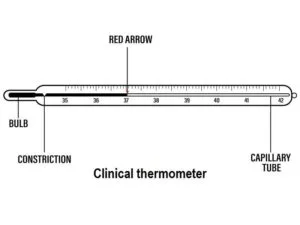
A clinical thermometer is a mercury-in-glass thermometer used for measuring the temperature of the human body.
- Normal body temperature: about 37°C.
- Range: short, about 35°C to 43°C.
- Constriction: a narrow part of the tube near the bulb keeps the mercury thread in place after reading.
- Sterilising: never use boiling water, because the mercury would expand excessively and break the thermometer.
What are the effects and applications of thermal expansion of solids?
Thermal expansion of a solid is the increase in its size when it is heated.
Effects and applications
- Glass tumbler: it may crack when hot water is poured in, because the inner wall expands before the outer wall.
- Zinc roofs: they make cracking noises as they expand in the day and contract at night.
- Bridges: one end is fixed and the other rests on rollers to allow for expansion.
- Bottle stopper: a tight glass stopper can be loosened because the glass expands when warmed.
- Concrete pavements: small spaces are left in the concrete to allow for expansion.
- Railway tracks: gaps are left between rails to give room for expansion.
- Thermostats: bimetallic strips control or regulate the flow of electric current.
What are the advantages of thermal expansion of solids?
- Fire alarm: a bimetallic strip bends when hot and completes the circuit of an electric bell.
- Fitting wheels in rims: a heated metal rim expands, slips over the wheel, then contracts to grip it.
- Bimetallic thermometer: it works by the unequal expansion of two metals.
- Red hot rivet in shipbuilding: the rivet contracts on cooling and holds the metal plates tightly.
- Thermostats: bimetallic strips are used in electric cookers to control temperature.
What are the disadvantages of thermal expansion of solids?
- Cracking of glass: a drinking glass cracks when hot liquid is poured inside.
- Watch error: if the balance wheel expands, the watch runs slow. If it contracts, the watch runs fast.
- Bridge damage: repeated expansion of the metal can cause damage after a long period.
- Sagging wires: overhead wires sag in hot weather.
- Distorted tracks: expansion of railway tracks bends them out of shape.
- Bursting pipes: metal water pipes may burst.
Evaluation
- Define temperature.
- State two differences between heat and temperature.
- Give two advantages of mercury as a thermometric substance.
- Give two reasons why water is not used as a thermometric substance.
- Define the upper fixed point and the lower fixed point.
Assignment
Complete this worksheet on thermal expansion of solids.
- Gaps are left in the construction of railway tracks to give room for ______.
- A. contraction
- B. evaporation
- C. expansion
- D. vaporisation
- When hot water is poured into a glass tumbler, it might crack due to ______ of the inner walls of the tumbler.
- A. even expansion
- B. uneven expansion
- C. uneven contraction
- D. even contraction
- The stopper of a bottle can be removed due to the ______ of the glass.
- A. contraction
- B. expansion
- C. evaporation
- D. none of the above
- The following are advantages of thermal expansion of solids except ______.
- A. bimetallic thermometer
- B. fire alarm
- C. sagging of overhead wire
- D. fitting of wheels in rims
- If heat is removed from solids, they ______.
- A. contract
- B. evaporate
- C. expand
- D. none of the above
- Mention four effects of the thermal expansion of a solid.
- Mention four advantages and four disadvantages of the thermal expansion of a solid.
This term's Physics topics
SS1 Second Term · 3 topics
- Work, Energy and Power
- Heat Energy
- Electric Charges
Get Physics as PDF and Word
Every week of SS1 Physics, Second Term, formatted and ready to print. Ad-free, and the copy lock comes off.
Get this term Card, bank transfer, USSD or OPay
SS1 Physics Lesson Notes for Other Topics

Work, Energy And Power
Read the full lesson note.

Electric Charges
Read the full lesson note.
Fundamentals And Derived Quantities And Units
Read the full lesson note.
Position, Distance, Displacement
Read the full lesson note.

Time
Read the full lesson note.

Motion
Read the full lesson note.

Speed And Velocity
Read the full lesson note.

Rectilinear Acceleration
Read the full lesson note.
Scalars And Vectors
Read the full lesson note.

Description And Property Of Fields
Read the full lesson note.
Electric Field
Read the full lesson note.

Particulate Nature Of Matter
Read the full lesson note.
Fluids At Rest And In Motion - Surface Tension
Read the full lesson note.

Units Of Measurements And Electrical Continuity Testing
Read the full lesson note.
Lesson Notes for Other Classes

SS2 Lesson Note
The complete lesson note to guide your studies.

SS3 Lesson Note
The complete lesson note to guide your studies.
