
ṢÍṣe Nnkan – Basic 1 Yoruba Lesson Note (Second Term)
Download this term · ₦1,000Lesson note at a glance
- Subject
- Yoruba
- Class
- Basic 1
- Term
- Second Term
- Topic
- ṢÍṣe Nnkan
- Order
- Topic 12 of 12 this term
- Reading time
- 3 min
This lesson teaches Basic 1 pupils to follow and give simple action commands in Yoruba, such as jókòó (sit down) and gbé (carry). It also covers greetings for different times of the day, the importance of greetings, and three play songs that pupils sing and dance to under a tree.
Behavioural objectives
By the end of the lesson, students should be able to:
- Follow and use the action words in Yoruba as commands
- Greet correctly at different times of the day
- Explain the importance of greetings
- Sing the play songs together under a tree
- Dance to the songs with clapping
- Answer questions correctly
Language (Èdè): what are the action words?
Basic actions
- Jókòó (Sit down)
- Dìde (Stand up)
- Rìn (Walk)
- Sáré (Run)
- Fò (Jump)
- Jó (Dance)
- Kọrin (Sing)
- Wọlé (Enter)
- Jáde (Go out)
- Dúró (Stop)
New instructions
- Gbé (Carry/Lift)
- Fi sílẹ̀ (Put down)
- Mú (Hold/Take)
- Pàdé (Meet)
- Bẹ̀rẹ̀ (Start/Begin)
- Parí (Finish/End)
- Tún (Again)
- Yára (Quickly)
Following commands
- Teacher says: “Jókòó!” (Sit!) Pupil: Sits down
- Teacher says: “Gbé ìwé rẹ!” (Carry your book!) Pupil: Carries the book
- Teacher says: “Rìn yára!” (Walk quickly!) Pupil: Walks fast
Simon Says game (Olùdarí Sọ)
- Olùdarí sọ pé ẹ jókòó
- Olùdarí sọ pé ẹ dìde
- Olùdarí sọ pé ẹ fò
Practice sentences
- Mo gbọ́ ọ̀rọ̀ olùkọ́ (I heard the teacher’s words)
- Mo ṣe ohun tó sọ (I did what he/she said)
- Ẹ jọ̀wọ́ tún sọ (Please say it again)
Culture (Àsà): how do we greet at different times?
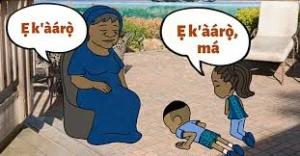
Topic: Ìtẹ̀síwájú Ìkíní (Advanced Greetings)
Greetings for different times
| Time of day | Hours | Greeting | Response |
|---|---|---|---|
| Morning (Òwúrọ̀) | 6:00 AM to 11:59 AM | Ẹ kú àárọ̀ o | À á bọ̀ |
| Afternoon (Ọ̀sán) | 12:00 PM to 3:59 PM | Ẹ kú ọ̀sán o | À á bọ̀ |
| Evening (Ìrọ̀lẹ́) | 4:00 PM to 6:59 PM | Ẹ kú ìrọ̀lẹ́ o | À á bọ̀ |
| Night (Alẹ́) | 7:00 PM onwards | Ẹ kú alẹ́ o / Ẹ kú órí ire | À á bọ̀ |
Special greetings
- Ẹ kú iṣẹ́ (Greeting for work)
- Ẹ kú àbọ̀ (Welcome back)
- Ẹ kú ìsinmi (Greeting for rest)
- Ẹ kú oúnjẹ (Greeting when eating)
- Ẹ kú àìkú (Condolence)
- Ẹ kú ìrírá (Well done for suffering)
Why are greetings important?
- Shows respect (Ìbọ̀wọ̀)
- Shows good manners (Ìwà rere)
- Brings blessings (Ìbùkún)
- Makes people happy
- Is part of Yoruba culture
- Opens doors of favour
Literature (Lítírẹ́ṣọ̀): what are the play and game songs?
Topic: Orin Eré Ìdárayá (Play/Game Songs)
Song 1: Orin Ìdárayá
Ẹ wá ká ṣeré lábẹ́ igi
Ẹ wá ká ṣeré lábẹ́ igi
À ń jó, à ń yọ̀
À ń kọrin pẹ̀lú ọ̀rẹ́ wa
Eré ìdárayá dára!
Translation: Come, let’s play under the tree / We dance, we rejoice / We sing with friends / Entertainment is good!
Song 2: Orin Ọ̀rọ́mbọ
Lábẹ́ igi ọ̀rọ́mbọ
À ń jókòó
À ń kọrin
À ń pa ìtàn
Òjìjì ò ní bá wa!
Translation: Under the orange tree / We sit / We sing / We tell stories / Sun won’t affect us!
Song 3: Àtẹ̀wọ́ (clapping song)
Lù ọwọ́, lù ọwọ́
Àtẹ̀wọ́ dùn o
Lù sọ́tún, lù sósì
Gbogbo wa jọ kọrin!
Translation: Clap hands, clap hands / Clapping is sweet / Clap right, clap left / All of us sing together!
Dance movements
- Clap hands rhythmically
- Move side to side
- Form a circle
- Jump together
- Turn around
Evaluation
Multiple choice. Choose the correct answer.
- “Jókòó” túmọ̀ sí _____ (a) Stand (b) Sit (c) Run
- Ẹ kú àárọ̀ fún _____ (a) Morning (b) Afternoon (c) Night
- “Gbé” túmọ̀ sí _____ (a) Carry (b) Drop (c) Sit
- À ń ṣeré lábẹ́ _____ (a) Ilé (b) Igi (c) Omi
- Ẹ kú ọ̀sán fún _____ (a) Morning (b) Afternoon (c) Evening
- “Dúró” túmọ̀ sí _____ (a) Go (b) Come (c) Stop
- Ìkíní ṣe _____ (a) Pàtàkì (b) Búburú (c) Àìdára
- Àtẹ̀wọ́ túmọ̀ sí _____ (a) Jumping (b) Clapping (c) Running
- Ẹ kú alẹ́ fún _____ (a) Morning (b) Afternoon (c) Night
- “Yára” túmọ̀ sí _____ (a) Slowly (b) Quickly (c) Never
Assignment
- Practise the 10 action words.
- Greet your family at different times of the day.
- Sing a play song.
- Follow instructions at home.
- Play safely under a tree.
This term's Yoruba topics
Basic 1 Second Term · 12 topics
Get Yoruba as PDF and Word
Every week of Basic 1 Yoruba, Second Term, formatted and ready to print. Ad-free, and the copy lock comes off.
Get this term Card, bank transfer, USSD or OPay
Basic 1 Yoruba Lesson Notes for Other Topics
Káàbọ̀ sí Sáà Kejì
Read the full lesson note.
Àgbéyẹ̀wò Iṣẹ́ Sáà Kínní
Read the full lesson note.
Nnkan Àyíká Ilé-Ìwé
Read the full lesson note.
Ìtẹ̀síwájú Alífábẹ́Ètì (H-Q)
Read the full lesson note.
Onka Láti 11-20
Read the full lesson note.
Alífábẹ́etì (P-Y)
Read the full lesson note.
Ìdánrawọ́ (Mid-Term Break)
Read the full lesson note.

Alífábẹ́etì Létà Nlá Àti Kékeré
Read the full lesson note.
Ọrọ̀ Àti Ìdákejì
Read the full lesson note.
Ìrọ̀ Èdè Pípe
Read the full lesson note.
Àgbéyẹ̀wò IṣẸ́ Sàá Kejì
Read the full lesson note.
Ònkà Yorùbá (1-10)
Read the full lesson note.

Alífábẹ́etì (A-E)
Read the full lesson note.
Ìsọ̀rọ̀
Read the full lesson note.
ṢÍṣe Ǹnkan
Read the full lesson note.
Lesson Notes for Other Classes

Basic 2 Lesson Note
The complete lesson note to guide your studies.

Basic 3 Lesson Note
The complete lesson note to guide your studies.

Basic 4 Lesson Note
The complete lesson note to guide your studies.

Basic 5 Lesson Note
The complete lesson note to guide your studies.

Basic 6 Lesson Note
The complete lesson note to guide your studies.
