Mock Exam – SS3 Solar Photovoltaic Installation & Maintenance Lesson Note (Third Term)
Download Lesson NoteLesson note at a glance
- Subject
- Solar Photovoltaic Installation & Maintenance
- Class
- SS3
- Term
- Third Term
- Topic
- Mock Exam
- Order
- Topic 4 of 5 this term
- Reading time
- 3 min
Class: SS3
Subject: Solar Photovoltaic Installation and Maintenance
Topic: Final Mock Revision – Bridging Theory and Practice
The “Why” Behind the Mock Exam
The Mock Exam is not a punishment; it is your “Flight Simulator.” Before a pilot flies a real plane, they practice in a machine that looks and feels like the real thing. This Mock helps you identify your “Blind Spots”—those topics you think you know, but struggle to explain under pressure.
The Three Pillars of the SSCE Solar Exam:
- Technical Knowledge: Understanding the components (The “Hardware”).
- Calculations: Sizing the system correctly (The “Math”).
- Field Application: Troubleshooting and Safety (The “Hands-on”).
Pro-Tip: In the exam, the marker is looking for clarity. Use short sentences. Use diagrams. Show that you don’t just memorize, but you understand.
Reviewing the “Heart” – Solar Cells & Panels
You will almost certainly see a question about types of panels. Don’t just list them; explain the “trade-off” (giving up one thing to get another).
- Monocrystalline: High efficiency, black color, works better in low light, but costs more. Best for small roofs.
- Polycrystalline: Lower efficiency, blue marbled color, cheaper, but needs more space. Best for large, open areas.
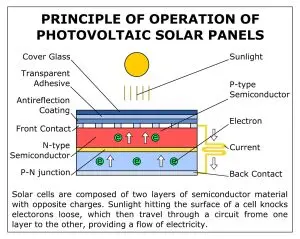
The Science Check: Remember the Photovoltaic Effect. This is simply the process where sunlight hits silicon, moves electrons, and creates Direct Current (DC).
Exam Question Alert: “Why do we tilt panels at 15 degrees in Nigeria?” The Answer: Because Nigeria is near the Equator. This angle ensures the sun hits the panel directly for the most hours of the day.
The Energy Management Path
Many students fail because they don’t understand the sequence of power. Follow the energy from the sun to the bulb:
- Production: The panels make DC power.
- Regulation: The Charge Controller (PWM or MPPT) tames the power so the battery doesn’t “overeat” and get damaged.
- Storage: The Battery Bank keeps the energy for the night.
- Transformation: The Inverter changes DC to AC (220V) so your household fans and TVs can work.
Key Difference to Memorize:
- Series Connection: Increases Voltage (linking + to -).
- Parallel Connection: Increases Capacity/Amps (linking + to +).
Load Calculation (Avoiding the Math Trap)
The examiners want to see if you can size a system without wasting the client’s money. Always use the “Power × Time” rule.
The Formula: Watts×Hours=Watt-hours (Wh)
Example Scenario for Practice: A student has:
- 4 LED bulbs (10W each) for 5 hours.
- 1 Standing Fan (50W) for 4 hours.
The Calculation:
- Bulbs: 40W×5h=200Wh
- Fan: 50W×4h=200Wh
- Total Load: 400Wh per day.
Mock Hint: If the question asks for the battery size, remember the 50% Rule for Lead-Acid batteries. If you need 400Wh, your battery should be at least 800Wh so you don’t drain it to zero!
Troubleshooting & Safety (The Practical Theory)
SSCE often uses “Scenario Questions” to test your troubleshooting skills.
Common Scenarios:
- Scenario: The inverter is beeping and showing an “Overload” error.
- Solution: The customer has plugged in too many appliances at once. Turn off heavy loads and restart the inverter.
- Scenario: The battery is full during the day but dies 30 minutes after sunset.
- Solution: The battery is “sulfated” or has a dead cell. It can no longer hold a charge. It needs replacement.
Safety Reminders:
- Never work on a roof when it is raining (Slippery and lightning risk).
- Always connect the Battery to the Controller FIRST before connecting the panels.
Use Insulated Tools (tools with rubber handles) to prevent accidental sparks.
This term's Solar Photovoltaic Installation & Maintenance topics
SS3 Third Term · 5 topics
Third Term Solar Photovoltaic Installation & Maintenance Lesson Notes for Other Topics
Final SSCE Presentation
Read the full lesson note.
Final Project Presentation
Read the full lesson note.
Comprehensive Revision II
Read the full lesson note.
Comprehensive Revision I
Read the full lesson note.
Practical: Business Simulation
Read the full lesson note.
Case Study of Nigerian Solar Projects
Read the full lesson note.

Project Management in Solar Installation
Read the full lesson note.
Customer Service and Support
Read the full lesson note.
Costing and Pricing Solar System
Read the full lesson note.

Business Skill in Solar Sector
Read the full lesson note.
Introduction to Solar Entrepreneurship
Read the full lesson note.
System Testing and Commissioning
Read the full lesson note.

PV System Installation Steps II
Read the full lesson note.
PV System Installation Steps I
Read the full lesson note.
Practical PV System Designs
Read the full lesson note.
Lesson Notes for Other Classes

Basic 1 Lesson Note
The complete lesson note to guide your studies.
Basic 2 Lesson Note
The complete lesson note to guide your studies.

Basic 3 Lesson Note
The complete lesson note to guide your studies.

Basic 4 Lesson Note
The complete lesson note to guide your studies.

Basic 5 Lesson Note
The complete lesson note to guide your studies.

Basic 6 Lesson Note
The complete lesson note to guide your studies.