
Qur’an – SS3 Islamic Studies Lesson Note (Second Term)
Download this term · ₦1,000Lesson note at a glance
- Subject
- Islamic Studies
- Class
- SS3
- Term
- Second Term
- Topic
- Qur’an
- Order
- Topic 1 of 7 this term
- Reading time
- 7 min
This note covers five short surahs of the Qur’an: An-Nasr, Al-Lahab (Al-Masad), Al-Ikhlas, Al-Falaq and An-Nas, with their transliteration, translation and lessons.
Behavioural objectives
- Read the transliteration and give the English translation of the five surahs.
- State whether each surah is a Makkan or Madinah Surah, where the note gives this.
- Explain the lessons taught by each surah.
- List the attributes of Allah mentioned in Surah Al-Ikhlas and Surah An-Nas.
- Explain how a Muslim should respond to a favour from Allah and to evil.
What is the Qur’an?
The Qur’an is the holy book of Islam, the word of Allah revealed to Prophet Muhammad (SAW) through Angel Jibril.
- Number of surahs: the Qur’an has 114 surahs (chapters).
- Verses: each surah is made up of verses called ayat (singular: ayah).
- Source of guidance: it guides Muslims in belief, worship and daily conduct.
- Surahs in this note: they are short, so they are easy to memorise and are often recited in Salah.
What is the difference between a Makkan and a Madinah Surah?
- Makkan Surah: a surah revealed before the Hijrah (the migration of the Prophet to Madinah).
- Madinah Surah: a surah revealed after the Hijrah.
| Point | Makkan Surah | Madinah Surah |
|---|---|---|
| Time of revelation | Before the Hijrah | After the Hijrah |
| Common themes | Belief in one God, the hereafter, good character | Laws, community life, relations with others |
| Example in this note | Al-Lahab, Al-Falaq, An-Nas | An-Nasr |
What are the five surahs in this note?
| Surah | Number in the Qur’an | Verses | Main theme |
|---|---|---|---|
| An-Nasr | 110 | 3 | Thanking Allah for help and victory |
| Al-Lahab (Al-Masad) | 111 | 5 | The fate of an enemy of Islam |
| Al-Ikhlas | 112 | 4 | The oneness of Allah |
| Al-Falaq | 113 | 5 | Seeking protection from outside evil |
| An-Nas | 114 | 6 | Seeking protection from evil whispers |
How should a Muslim recite the Qur’an?
A Muslim should recite the Qur’an with cleanliness, respect and a clear voice.
- Cleanliness: be in a state of purity and wear clean clothes.
- Seek refuge: begin by asking Allah’s protection from Satan.
- Bismillah: begin each surah with “Bismil-Lahir-Rahmanir-Rahim”.
- Clear recitation: read slowly and pronounce each word correctly.
- Understanding: learn the meaning and act on it.
What does Surah An-Nasr teach?
Surah An-Nasr is the 110th surah of the Qur’an, and it teaches us to praise and thank Allah when He gives us help and victory.
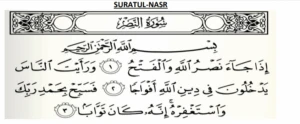
Transliteration
Bismil-Lahir-Rahmanir-Rahim
- Idha ja a nasrul-lahi wal-fath
- Wa ra aytan-nasa yadkhuluna fi dini-Llahi afwaja
- Fasabbih bihamdi Rabbika wastaghfirhu innahu kana tawwaba
Translation
In the name of Allah the Beneficent, the Merciful.
- When Allah’s help and victory come.
- And you see people entering Allah’s Religion (Islam) in crowds.
- So glorify the praises of your Lord, and seek His forgiveness. Certainly, He is ever ready to forgive.
What are the lessons of Surah An-Nasr?
- Type of surah: it is a Madinah Surah.
- Response to a favour: whenever we receive a favour or grant from Allah, we should do three things:
- praise Him;
- thank Him;
- seek forgiveness for any shortcomings we might have committed while looking for such a thing.
- Patience and prayer: we should be patient and ask Allah for help whenever things are difficult.
- Truth prevails: truth will overcome falsehood. It is only a matter of time.
- Source of victory: help and victory come from Allah.
What does Surah Al-Lahab teach?
Surah Al-Lahab is the 111th surah of the Qur’an, and it warns that wealth cannot save an enemy of Islam from Allah’s punishment.
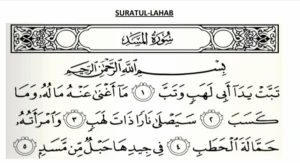
Transliteration
Bismil-Lahir-Rahmanir-Rahim
- Tabbat yada Abi Lahabin wa tabb
- Ma aghna anhu maluhu wama kasab
- Sayasla naran dhata lahab
- Wamra atuhu hammalatal hatab
- Fi jidiha hablun min masad
Translation
In the name of Allah the most Beneficent, the most Merciful.
- Perish the two hands of Abu Lahab (the father of flame) and perish him.
- Neither his wealth nor what he has gained shall be of benefit to him.
- He will be burnt in a fire of blazing flame.
- And his wife too, who carried wood (thorns which she used to put on the way of the Prophet or used to slander him).
- In her neck is a twisted rope of palm fibre.
What are the lessons of Surah Al-Lahab?
- Type of surah: it is a Makkan Surah.
- Two names: it is called Al-Lahab and Al-Masad, taken from the first and the last verses respectively.
- No abuse: we should not abuse or curse anyone.
- Warning to enemies: enemies of Islam will be disgraced in this world and enter hell in the hereafter.
- Allah’s protection: Allah has promised to protect the religion of Islam despite the odds.
What does Surah Al-Ikhlas teach?
Surah Al-Ikhlas is the 112th surah of the Qur’an, and it teaches that Allah is One and unique.
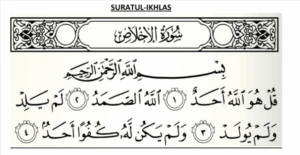
Transliteration
Bismil-Lahir-Rahmanir-Rahim
- Qul huwal-Lahu ahad
- Allahus-samad
- Lam yalid walam yulad
- Walam yakun lahu kufuwan ahad
Translation
In the name of Allah, the most Beneficent, the most Merciful.
- Say: He is Allah, the One.
- Allah, the eternal, absolute.
- He begets not, nor is He begotten.
- And there is none like unto Him.
What are the lessons of Surah Al-Ikhlas?
- Monotheism: the Surah teaches belief in one God and forbids polytheism.
- Attributes of Allah: it names two attributes:
- Ahad (the One);
- As-Samad (the Eternal).
- Dependence: everybody depends on Allah, but He does not depend on anybody or anything.
- Uniqueness: nothing is like Allah, and He has no child and no parent.
- Duty of Muslims: Muslims must proclaim the oneness and uniqueness of Allah and propagate both.
What does Surah Al-Falaq teach?
Surah Al-Falaq is the 113th surah of the Qur’an, and it teaches us to seek Allah’s protection from evil.

Transliteration
Bismil-Lahir-Rahmanir-Rahim
- Qul a udhu birabbil falaq
- Min sharri ma khalaq
- Wa min sharri ghasiqin idha waqab
- Wamin sharrin naffathati fil uqad
- Wamin sharrin hasidin idha hasad
Translation
In the name of Allah the most Beneficent, the most Merciful.
- Say: I seek refuge with the Lord of the dawn.
- Against the evil of what He created.
- And against the evil of the darkness when it occurs.
- And against the evil of witchcraft when they blow in the knots.
- And against the evil of the envious one when he practises envy.
What are the lessons of Surah Al-Falaq?
- Type of surah: it is a Makkan Surah.
- Obstacles: one is bound to face obstacles in one’s career, so one should prepare the mind and pray for Allah’s protection against all odds.
- Allah’s power: God can subdue all His creation.
- Cost of justice: anyone who does justice and upholds the truth will face some problems.
- Reliance: Muslims should rely totally on Allah.
What does Surah An-Nas teach?
Surah An-Nas is the 114th and last surah of the Qur’an, and it teaches us to seek Allah’s refuge from evil whispers.
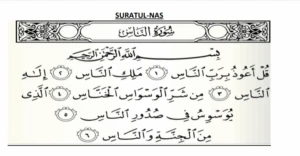
Transliteration
Bismil-Lahir-Rahmanir-Rahim
- Qul a udhu biRabbin-nas
- Malikin-nas
- Ilahin-nas
- Min sharril waswasil khannas
- Alladhi yuwaswisu fi sudurin-nas
- Minal jinnati wan-nas
Translation
In the name of Allah the most Beneficent, the most Merciful.
- Say: I seek refuge with (Allah) the Lord of mankind.
- The King of mankind.
- The God of mankind.
- From the mischief of the whisperer (of evil), who withdraws (after his whisper).
- (The same) who whispers into the hearts of mankind.
- Among Jinns and men.
What are the lessons of Surah An-Nas?
- Type of surah: it is a Makkan Surah.
- Three attributes of Allah: man can use them to drive away evil:
- Ar-Rabbu (the Lord): we should have confidence in Allah as our protector.
- Al-Malik (the King): Allah controls everybody and everything.
- Ilahu (God): He alone should be worshipped.
- Ill advice: we should not listen to ill advice.
- Sources of evil: the Surah names them as man and jinn.
- Refuge in Allah: we should seek Allah’s refuge against evil thoughts and deeds.
Evaluation
- Which of the five surahs in this note is a Madinah Surah?
- What are the two names of Surah Al-Lahab, and where is each name taken from?
- List the two attributes of Allah taught in Surah Al-Ikhlas.
- Name the three attributes of Allah in Surah An-Nas and state what each one teaches.
- According to Surah An-Nasr, what should we do when we receive a favour from Allah?
Assignment
Write out the translation of Surah Al-Ikhlas and state two lessons from it, then state three lessons from Surah Al-Falaq.
This term's Islamic Studies topics
SS3 Second Term · 7 topics
- Qur’an
- Hadith 32, 34, 35, 38, 41 of Imam An-Nawawi
- Nikkah (marriage)
- Islamic Moral Education I
- Islamic Moral Education II: Understanding Brotherhood in Islam
- Islamic Moral Education III: Personal Hygiene & Cleanliness in Islam
- Islamic Moral Education IV: Prohibition of Bribery, Stealing & Intoxicants in Islam
Get Islamic Studies as PDF and Word
Every week of SS3 Islamic Studies, Second Term, formatted and ready to print. Ad-free, and the copy lock comes off.
Get this term Card, bank transfer, USSD or OPay
SS3 Islamic Studies Lesson Notes for Other Topics

Hadith 32, 34, 35, 38, 41 of Imam An-Nawawi
Read the full lesson note.
Nikkah (marriage)
Read the full lesson note.

Islamic Moral Education I
Read the full lesson note.
Islamic Moral Education II - Understanding Brotherhood in Islam
Read the full lesson note.

Islamic Moral Education III - Personal Hygiene & Cleanliness in Islam
Read the full lesson note.
Islamic Moral Education IV - Prohibition of Bribery, Stealing & Intoxicants in Islam
Read the full lesson note.
Brief History Of Uthman Dan Fodio
Read the full lesson note.
Islamic Moral Education, Kindness To Parent
Read the full lesson note.

Moral Education, Modesty In Dressing, Behaviour And Trust.
Read the full lesson note.
Islamic Moral Education And Perseverance
Read the full lesson note.

Rights And Duties Of Husbands And Wives Nikkah (Marriage)
Read the full lesson note.
Nikkah
Read the full lesson note.
Nikah Talaq (Divorce)
Read the full lesson note.
Quran - Surah Nasr & Nas
Read the full lesson note.
Quran - Suratul Ikhlas
Read the full lesson note.
Lesson Notes for Other Classes

SS1 Lesson Note
The complete lesson note to guide your studies.

SS2 Lesson Note
The complete lesson note to guide your studies.
