
Structure of Business: Organisation Chart – SS3 Commerce Lesson Note (First Term)
Download this term · ₦1,000Lesson note at a glance
- Subject
- Commerce
- Class
- SS3
- Term
- First Term
- Topic
- Structure of Business: Organisation Chart
- Order
- Topic 8 of 9 this term
- Reading time
- 5 min
An organisation chart is a diagram that shows the structure of a business organisation.
- Line of authority: it shows who gives orders to whom.
- Departments: it shows how the departments relate to one another.
- Communication: it shows the channel through which information moves.
- Positions: it shows the posts held in the organisation.
Behavioural objectives
- Explain what organisational structure means.
- State what an organisation chart is.
- List the uses (purposes) of an organisation chart.
- State the main functions of the common departments in a business.
- Read the organisation chart of XYZ Ltd.
- Name and describe the types of organisational structure.
What is organisational structure?
Organisational structure is the framework by which tasks are divided, grouped and coordinated in a business.
- Division of work: activities are split into departments, divisions, units and subunits.
- Allocation of duties: positions, responsibilities and authority are given to the officials of the business.
- Coordination: the structure links the departments so that they work towards the same goal.
What are the key terms used with an organisation chart?
- Department: a section of the business that handles one main activity, such as marketing.
- Line of authority: the path through which orders pass from top management to lower staff.
- Channel of communication: the route through which information moves in the organisation.
- Span of control: the number of workers a supervisor or manager directly controls.
- Delegation: passing duties and the needed authority to a subordinate.
- Subordinate: a worker who reports to a superior.
What are the uses (purposes) of an organisation chart?
An organisation chart is used to show how a business is arranged and who is responsible for what.
- It shows the line of authority and responsibilities in an organisation.
- It shows the relationship between the various departments and functionaries in an organisation.
- It shows the channel of communication or information within the organisation.
- It shows the various positions in an organisation.
- It shows the status and role of each member of the organisation.
- It shows the span of control of each supervisor or manager.
- The whole structure of the firm can be seen at a glance.
- It is easier to analyse and review the structure of the organisation when it is shown graphically.
What are the limitations of an organisation chart?
An organisation chart shows only the formal arrangement of a business, so it has some limits.
- Informal links: it does not show friendships and unofficial contacts between workers.
- Out of date: it becomes wrong if it is not changed when the structure changes.
- Limited detail: it does not show how much authority each post really carries.
How is a simple organisation chart arranged?
A simple organisation chart places the highest officer at the top and the departments in boxes below.
How do you read an organisation chart?
To read an organisation chart, start at the top box and follow the lines downwards.
- Start at the top box. It holds the highest authority, such as the Board or Managing Director.
- Follow the vertical lines downwards. They show the line of authority and who reports to whom.
- Note that boxes on the same level have the same rank.
- Count the boxes joined directly under one manager. This gives that manager’s span of control.
- Read the titles in the boxes to know each position and department.
What are the levels of management shown on a chart?
There are three levels of management: top, middle and lower.
- Top management: the Board of Directors and the Managing Director, who set the aims and policies.
- Middle management: departmental managers, who carry out the policies in their departments.
- Lower management: supervisors and foremen, who direct the daily work of the workers.
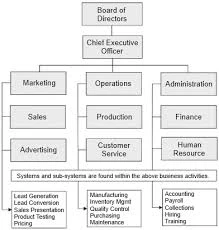
What does the organisation chart of XYZ Ltd look like?
The chart below shows the structure of a sample firm, XYZ Ltd. Read it from the top box downwards.
What do the common departments do?
Each department of a business handles one main activity.
- Administration Department: keeps records and files, handles letters and communication, manages office services and looks after the premises.
- Staff matters in administration: in many firms this department also handles staff welfare, discipline and security.
- Production Department: makes the goods or provides the service and checks quality.
- Marketing or Sales Department: carries out market research, advertising and selling.
- Finance or Accounts Department: keeps accounts, pays wages and prepares budgets and financial statements.
- Personnel (Human Resource) Department: recruits, trains and promotes staff.
What are the types of organisational structure?
There are four types of organisational structure: line, functional, line and staff, and committee.
Line organisation
- Meaning: authority flows in one straight line from the top to the bottom.
- Feature: each worker takes orders from one superior only.
Functional organisation
- Meaning: work is grouped by function, such as sales or finance.
- Feature: each specialist head directs the work of his or her function.
Line and staff organisation
- Meaning: line managers hold the authority, while staff specialists give them advice.
- Feature: staff officers advise but do not command the line workers.
Committee organisation
- Meaning: a group of people takes decisions together.
- Feature: the members share responsibility for the decision.
How do the four types compare?
| Type | Meaning | Main strength | Main weakness |
|---|---|---|---|
| Line | Authority flows in one straight line from top to bottom. | Clear authority and quick decisions. | Heavy load on top managers. |
| Functional | Work is grouped by function, such as sales or finance. | Workers become specialists. | A worker may receive orders from several heads. |
| Line and staff | Line managers hold authority. Staff specialists give them advice. | Managers get expert advice. | Line and staff officers may disagree. |
| Committee | A group of people takes decisions together. | Many views are heard. | Decisions can be slow. |
Evaluation
- What is an organisation chart?
- State two functions of the Administration Department of a business organisation.
- What is meant by span of control?
- Name two types of organisational structure.
- State one weakness of the line type of organisation.
Assignment
Define organisational structure and state five uses of an organisation chart.
This term's Commerce topics
SS3 First Term · 9 topics
Get Commerce as PDF and Word
Every week of SS3 Commerce, First Term, formatted and ready to print. Ad-free, and the copy lock comes off.
Get this term Card, bank transfer, USSD or OPay
SS3 Commerce Lesson Notes for Other Topics

Business Law
Read the full lesson note.

Types of Contract
Read the full lesson note.
Law of Agency
Read the full lesson note.

Contract of Sales Of Goods
Read the full lesson note.

Hire Purchase/Instalment Payment/ Deferred Payment
Read the full lesson note.

Contract of Employment
Read the full lesson note.
Government Regulation of Business
Read the full lesson note.
Introduction to Business Management
Read the full lesson note.

Introduction to Marketing
Read the full lesson note.

Advertising
Read the full lesson note.
Business Documents and Means of Payment
Read the full lesson note.
Privatisation and Commercialisation
Read the full lesson note.
Economic Grouping in West Africa - (ECOWAS) & Niger Basin Commission
Read the full lesson note.
Economic Grouping in West Africa (CONTD) West Africa Clearing House (WACH), Mano River Basin Commission.
Read the full lesson note.
Lesson Notes for Other Classes

SS1 Lesson Note
The complete lesson note to guide your studies.

SS2 Lesson Note
The complete lesson note to guide your studies.
