
Relational Models – SS2 Book Keeping Lesson Note (Second Term)
Download Lesson NoteLesson note at a glance
- Subject
- Book Keeping
- Class
- SS2
- Term
- Second Term
- Topic
- Relational Models
- Order
- Topic 5 of 5 this term
- Reading time
- 3 min
A relational database is a collection of data items organised as a set of formally described tables from which data can be accessed or reassembled in many different ways without having to reorganise the database tables. The relational database was invented by E. F. Codd at IBM in 1970.
Behavioural objectives
By the end of the lesson, students should be able to:
- define a relational database and state who invented it;
- describe how data is arranged in tables, rows and columns;
- explain what a user view of a database is;
- list common SQL commands and state what each one does;
- write a simple SELECT statement.
How is data arranged in a relational database?
The standard user and application program interface to a relational database is the Structured Query Language (SQL).
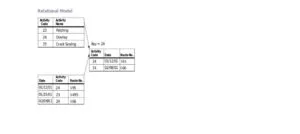
A relational database is a set of tables containing data fitted into predefined categories. Each table (which is sometimes called a relation) contains one or more data categories in columns. Each row contains a unique instance of data for the categories defined by the columns.
For example, a typical business order entry database would include a table that describes a customer with columns for name, address, phone number, and so forth. Another table would describe an order: product, customer, date, sales price, and so forth.
What is a view of a database?
A user of the database could obtain a view of the database that fits the user’s needs. For example, a branch office manager might like a view or report on all customers that had bought products after a certain date. A financial services manager in the same company could, from the same tables, obtain a report on accounts that needed to be paid.

Creating and modifying relations using SQL
What are SQL statements?
Most of the actions you need to perform on a database are done with SQL statements.
The following SQL statement selects all the records in the “Customers” table:
Example
SELECT * FROM Customers;
What are the most important SQL commands?
- SELECT – extracts data from a database
- UPDATE – updates data in a database
- DELETE – deletes data from a database
- INSERT INTO – inserts new data into a database
- CREATE DATABASE – creates a new database
- ALTER DATABASE – modifies a database
- CREATE TABLE – creates a new table
- ALTER TABLE – modifies a table
- DROP TABLE – deletes a table
- CREATE INDEX – creates an index (search key)
- DROP INDEX – deletes an index
What is the SQL SELECT statement?
The SELECT statement is used to select data from a database. The result is stored in a result table, called the result set.
SQL SELECT syntax
SELECT column_name,column_name
FROM table_name;
and
SELECT * FROM table_name;
Evaluation
- Define a relational database.
- Who invented the relational database, and in what year?
- What does each row of a table contain, and what do the columns define?
- State the purpose of the SELECT command.
- Write an SQL statement that selects all the records in the “Customers” table.
Assignment
- List four SQL commands and state what each one does.
- Explain, with one example, what a view of a database is.
- Write the SQL syntax for selecting all records from a table called table_name.
This term's Book Keeping topics
SS2 Second Term · 5 topics
Second Term Book Keeping Lesson Notes for Other Topics

Joint Venture Account
Read the full lesson note.

Contract Account
Read the full lesson note.

Introduction of Company Account
Read the full lesson note.

Partnership Account II
Read the full lesson note.

Partnership Account I
Read the full lesson note.

Manufacturing Account
Read the full lesson note.

Entreprenuership Education
Read the full lesson note.

Control Account
Read the full lesson note.

Stock Evalaution
Read the full lesson note.

Bad Debts And Doubtful Debts
Read the full lesson note.

Ledgers
Read the full lesson note.

Books Of Original Entry
Read the full lesson note.

Principles Of Double Entry
Read the full lesson note.

Single Column Cash Book
Read the full lesson note.

Double Column Cash Book
Read the full lesson note.
Lesson Notes for Other Classes

Basic 1 Lesson Note
The complete lesson note to guide your studies.

Basic 2 Lesson Note
The complete lesson note to guide your studies.

Basic 3 Lesson Note
The complete lesson note to guide your studies.

Basic 4 Lesson Note
The complete lesson note to guide your studies.

Basic 5 Lesson Note
The complete lesson note to guide your studies.

Basic 6 Lesson Note
The complete lesson note to guide your studies.


